


Relationship among insulin resistance, growth hormone, and insulin-like growth factor I concentrations in diestrous Swedish Elkhounds
- PMID: 24765678
- PMCID: PMC4857978
- DOI: 10.1111/jvim.12307
Relationship among insulin resistance, growth hormone, and insulin-like growth factor I concentrations in diestrous Swedish Elkhounds
Erratum in
- J Vet Intern Med. 2014 Jul-Aug;28(4):1375
Abstract
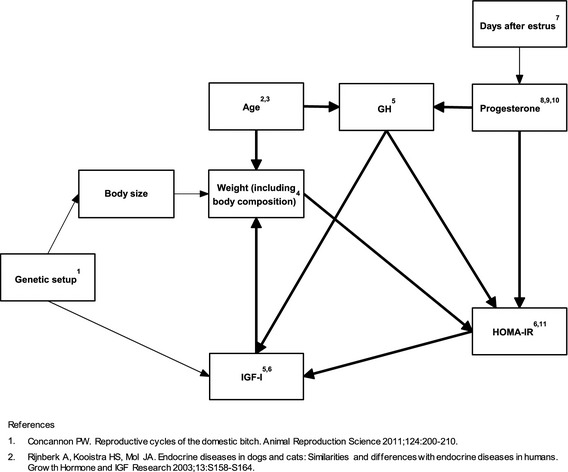
Background: In the dog, the normal estrous cycle includes a prolonged luteal phase. Progesterone stimulates local canine mammary growth hormone (GH) production, which may act systemically and contribute to insulin resistance. Swedish Elkhounds are predisposed to progesterone-related diabetes mellitus, and the relationship among insulin resistance, GH, and insulin-like growth factor I (IGF-I) is of particular interest.
Objective: To study insulin resistance in relation to GH and IGF-I in nondiabetic Swedish Elkhounds during diestrus. We also assessed whether alterations in these hormones could predict diestrus-linked diseases and all-cause mortality.
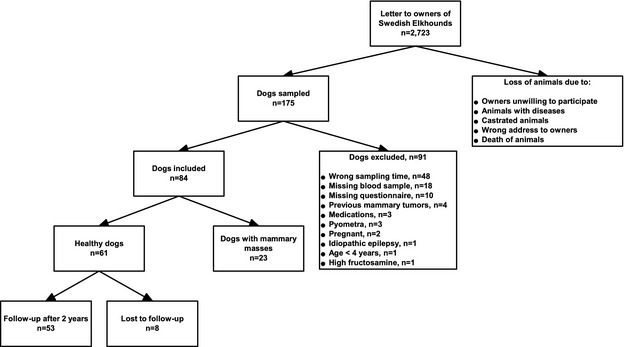
Animals: Eighty-four privately owned female intact Swedish Elkhounds >4 years of age.
Methods: Blood sampling and clinical examination during luteal phase, with a follow-up questionnaire after 20 months. Insulin resistance was calculated by homeostasis model assessment (HOMA-IR).
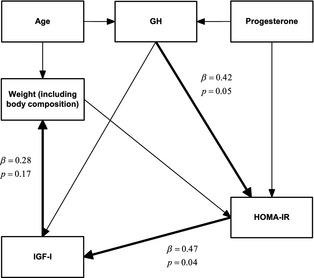
Results: In multivariable regression analysis, GH was positively associated with HOMA-IR (P = .009). An increase in GH of 1 ng/mL was associated with a 12.7% increase in HOMA-IR. Moreover, C-peptide was positively associated with IGF-I (P = .04), and an increase in C-peptide of 0.1 ng/mL was associated with a 6.9% increase in IGF-I. Structural equation modeling supported these results. Twenty-three animals were found to have previously unrecognized mammary masses and had higher GH (P < .0001) and IGF-I (P = .007) than dogs without mammary masses (n = 61). There was no association between high GH and IGF-I concentrations at sampling and future mammary masses.
Conclusion: We showed that GH was strongly associated with insulin resistance in older Swedish Elkhounds during diestrus.
Figures
References
-
- Selman PJ, Mol JA, Rutteman GR, et al. Progestin‐induced growth hormone excess in the dog originates in the mammary gland. Endocrinology 1994;134:287–292. - PubMed
-
- Selman PJ, Mol JA, Rutteman GR, Rijnberk A. Progestin treatment in the dog. I. Effects on growth hormone, insulin‐like growth factor I and glucose homeostasis. Eur J Endocrinol 1994;131:413–421. - PubMed
-
- Eigenmann JE, Eigenmann RY, Rijnberk A, et al. Progesterone‐controlled growth hormone overproduction and naturally occurring canine diabetes and acromegaly. Acta Endocrinol 1983;104:167–176. - PubMed
-
- Kopchick JJ. Growth and maturation In: Melmed S, ed. Endocrinology. Philadelphia, PA: W.B. Saunders; 2001:389–404.
-
- Pierluissi J, Campbell J. Metasomatotrophic diabetes and its induction: Basal insulin secretion and insulin release responses to glucose, glucagon, arginine and meals. Diabetologia 1980;18:223–228. - PubMed
MeSH terms
Substances
LinkOut - more resources
Full Text Sources
Other Literature Sources
