


doi: 10.1016/j.cell.2014.03.009.
Siri of the cell: what biology could learn from the iPhone
Affiliations
- PMID: 24766803
- PMCID: PMC4154484
- DOI: 10.1016/j.cell.2014.03.009
Item in Clipboard
Siri of the cell: what biology could learn from the iPhone
Cell.
.
Abstract
Modern genomics is very efficient at mapping genes and gene networks, but how to transform these maps into predictive models of the cell remains unclear. Recent progress in computer science, embodied by intelligent agents such as Siri, inspires an approach for moving from networks to multiscale models able to predict a range of cellular phenotypes and answer biological questions.
Copyright © 2014 Elsevier Inc. All rights reserved.
Figures
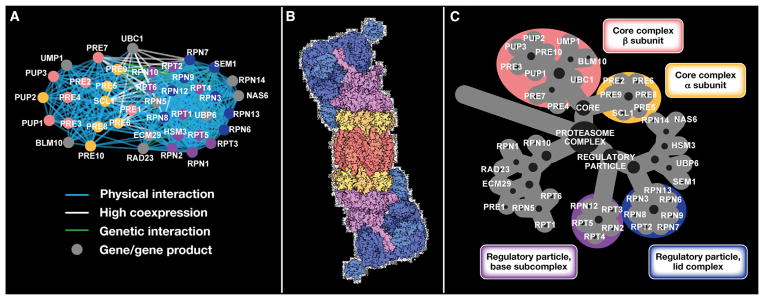
(A) Network representation of three types of molecular interactions among genes/gene products that form the proteasome structure, displayed using a force directed layout in Cytoscape (http://www.cytoscape.org ). (B) Cartoon representation of the structure of the proteasome (Protein Data Bank entry 4b4t), created by integrating partial crystallographic structures obtained by analysis of 2.4 million images from electron microscopy. (C) Hierarchical factorization of the proteasome subcomponents as described by NeXO. Across all panels, colors indicate membership to the core complex β subunit (red), core complex α subunit (orange), regulatory particle lid complex (blue), and regulatory particle base complex (purple) according to the GO (A), the Protein Data Bank (B), and NeXO (C). (A) and (C) adapted with permission from Dutkowski et al. (2013). (B) courtesy of David S. Goodsell and the Research Collaboratory for Structural Bioinformatics Protein Data Bank.
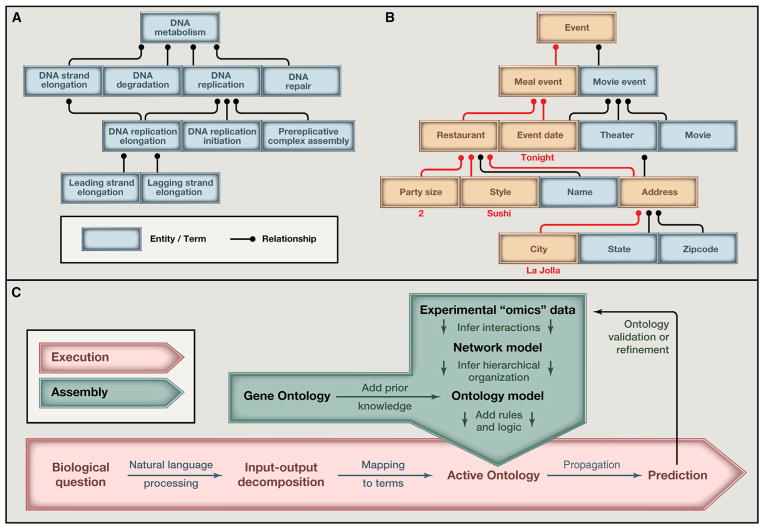
(A) A subset of the Gene Ontology (Ashburner et al., 2000). (B) A subset of an active ontology for event planning (Guzzoni et al., 2006). Red relationships and entities indicate dynamic computation. (C) One possible roadmap toward the assembly and execution of Siri of the cell.
References
-
- Barabási AL, Oltvai ZN. Network biology: understanding the cell’s functional organization. Nat Rev Genet. 2004;5:101–113. - PubMed
-
- Berner ES. Clinical Decision Support Systems: Theory and Practice. 2. New York: Springer; 2007.
-
- Brachman RJ, Levesque HJ. Knowledge Representation and Reasoning. Amsterdam: Morgan Kaufmann; 2004.
Publication types
MeSH terms
Grants and funding
LinkOut - more resources
Full Text Sources
Other Literature Sources
