


Galectin-3 is independently associated with cardiovascular mortality in community-dwelling older adults without known cardiovascular disease: The Rancho Bernardo Study
- PMID: 24766977
- PMCID: PMC4012893
- DOI: 10.1016/j.ahj.2013.12.031
Galectin-3 is independently associated with cardiovascular mortality in community-dwelling older adults without known cardiovascular disease: The Rancho Bernardo Study
Abstract
Background: Galectin-3 is a marker of myocardial fibrosis that has been implicated in the pathophysiologic pathway of fibrosis; its association with all-cause and cardiovascular disease (CVD) mortality in a community-based cohort free of baseline CVD has not been reported. Our aim was to determine the association between galectin-3 levels and all-cause and CVD mortality in community-dwelling older adults without known CVD.
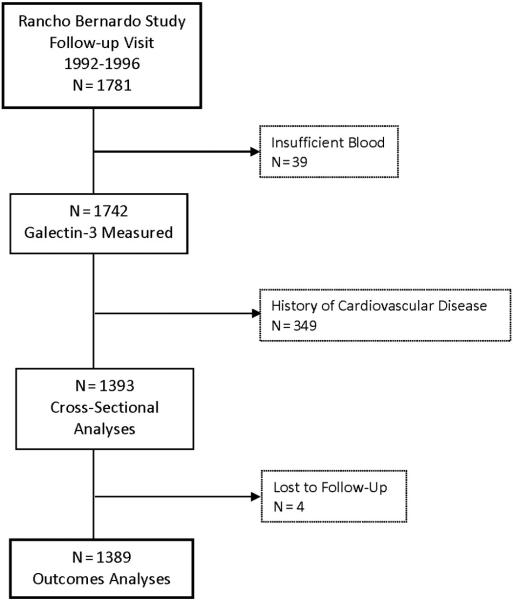
Methods: We measured plasma galectin-3 levels in 1,393 Rancho Bernardo Study participants without CVD with a mean age of 70 years. Participants were followed up for a mean of 11 years for coronary heart disease, CVD mortality, and all-cause mortality.
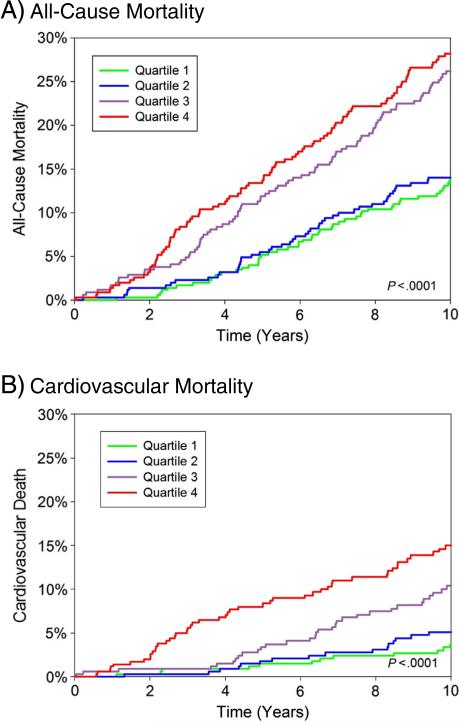
Results: During follow-up, 436 participants died (169 from CVD). In models adjusted for traditional CVD risk factors and renal function, galectin-3 was a significant predictor of CVD mortality (hazard ratio [HR] per SD log increase 1.30, 95% CI 1.10-1.53) and all-cause mortality (HR 1.12, 1.01-1.24), but not coronary heart disease (HR 1.09, 0.92-1.30). After further adjusting for N-terminal pro B-type natriuretic peptide, galectin-3 remained an independent predictor (HR 1.24, 1.05-1.47) of CVD mortality. Galectin-3 improved the c statistic (0.847-0.851, P = .003) for prediction of CVD death. Net reclassification improvement (>0) with the addition of galectin-3 was 35% (P < .0001); the integrated discrimination index was also significant (P = .03). Participants with both galectin-3 and N-terminal pro B-type natriuretic peptide above the median had increased risk of CVD death vs those with higher levels of only 1 of these markers (HR 1.74, 1.24-2.43).
Conclusion: Higher levels of galectin-3 are independently associated with all-cause and CVD mortality among community-dwelling older adults with no known CVD at baseline.
Copyright © 2014 Mosby, Inc. All rights reserved.
Figures

References
-
- Sharma UC, Pokharel S, van Brakel TJ, et al. Galectin-3 marks activated macrophages in failure-prone hypertrophied hearts and contributes to cardiac dysfunction. Circulation. 2004;110(19):3121–8. - PubMed
-
- Papaspyridonos M, McNeill E, de Bono JP, et al. Galectin-3 is an amplifier of inflammation in atherosclerotic plaque progression through macrophage activation and monocyte chemoattraction. Arterioscler Thromb Vasc Biol. 2008;28(3):433–40. - PubMed
-
- Calvier L, Miana M, Reboul P, et al. Galectin-3 mediates aldosterone-induced vascular fibrosis. Arterioscler Thromb Vasc Biol. 2013;33(1):67–75. - PubMed
-
- van Kimmenade RR, Januzzi JL, Jr, Ellinor PT, et al. Utility of amino-terminal pro-brain natriuretic peptide, galectin-3, and apelin for the evaluation of patients with acute heart failure. J Am Coll Cardiol. 2006;48(6):1217–24. - PubMed
Publication types
MeSH terms
Substances
Grants and funding
LinkOut - more resources
Full Text Sources
Other Literature Sources
