


Risk and consequences of chemotherapy-induced neutropenic complications in patients receiving daily filgrastim: the importance of duration of prophylaxis
- PMID: 24767095
- PMCID: PMC4018988
- DOI: 10.1186/1472-6963-14-189
Risk and consequences of chemotherapy-induced neutropenic complications in patients receiving daily filgrastim: the importance of duration of prophylaxis
Abstract
Background: To examine duration of daily filgrastim prophylaxis, and risk and consequences of chemotherapy-induced neutropenic complications (CINC) requiring inpatient care.
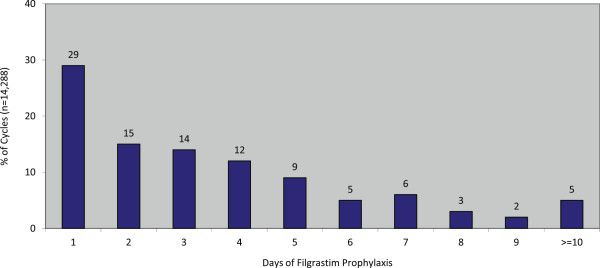
Methods: Using a retrospective cohort design and US healthcare claims data (2001-2010), we identified all cancer patients who initiated ≥1 course of myelosuppressive chemotherapy and received daily filgrastim prophylactically in ≥1 cycle. Cycles with daily filgrastim prophylaxis were pooled for analyses. CINC was identified based on hospital admissions with a diagnosis of neutropenia, fever, or infection; consequences were characterized in terms of hospital mortality, hospital length of stay (LOS), and CINC-related healthcare expenditures.
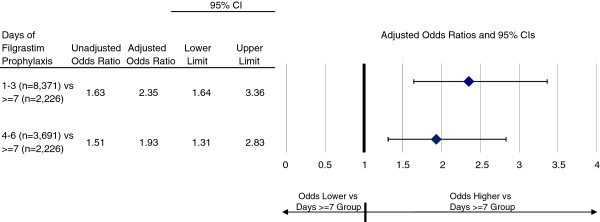
Results: Risk of CINC requiring inpatient care-adjusted for patient characteristics-was 2.4 (95% CI: 1.6-3.4) and 1.9 (1.3-2.8) times higher with 1-3 (N = 8371) and 4-6 (N = 3691) days of filgrastim prophylaxis, respectively, versus ≥7 days (N = 2226). Among subjects who developed CINC, consequences with 1-3 and 4-6 (vs. ≥7) days of filgrastim prophylaxis were: mortality (8.4% [n/N = 10/119] and 4.0% [3/75] vs. 0% [0/34]); LOS (means: 7.4 [N = 243] and 7.1 [N = 99] vs. 6.5 [N = 40]); and expenditures (means: $18,912 [N = 225] and $14,907 [N = 94] vs. $13,165 [N = 39]).
Conclusions: In this retrospective evaluation, shorter courses of daily filgrastim prophylaxis were found to be associated with an increased risk of CINC as well as poorer outcomes among those developing this condition. Because of the limitations inherent in healthcare claims databases specifically and retrospective evaluations generally, additional research addressing these limitations is needed to confirm the findings of this study.
Figures
References
-
- Smith TJ, Khatcheressian J, Lyman GH, Ozer H, Armitage JO, Balducci L, Bennett CL, Cantor SB, Crawford J, Cross SJ, Demetri G, Desch CE, Pizzo PA, Schiffer CA, Schwartzberg L, Somerfield MR, Somlo G, Wade JC, Wade JL, Winn RJ, Wozniak AJ, Wolff AC. 2006 update of recommendations for the use of white blood cell growth factors: an evidence-based clinical practice guideline. J Clin Oncol. 2006;14(19):3187–3205. doi: 10.1200/JCO.2006.06.4451. - DOI - PubMed
Publication types
MeSH terms
Substances
LinkOut - more resources
Full Text Sources
Other Literature Sources
