


Use of a semi-field system to evaluate the efficacy of topical repellents under user conditions provides a disease exposure free technique comparable with field data
- PMID: 24767458
- PMCID: PMC4006452
- DOI: 10.1186/1475-2875-13-159
Use of a semi-field system to evaluate the efficacy of topical repellents under user conditions provides a disease exposure free technique comparable with field data
Abstract
Background: Before topical repellents can be employed as interventions against arthropod bites, their efficacy must be established. Currently, laboratory or field tests, using human volunteers, are the main methods used for assessing the efficacy of topical repellents. However, laboratory tests are not representative of real life conditions under which repellents are used and field-testing potentially exposes human volunteers to disease. There is, therefore, a need to develop methods to test efficacy of repellents under real life conditions while minimizing volunteer exposure to disease.
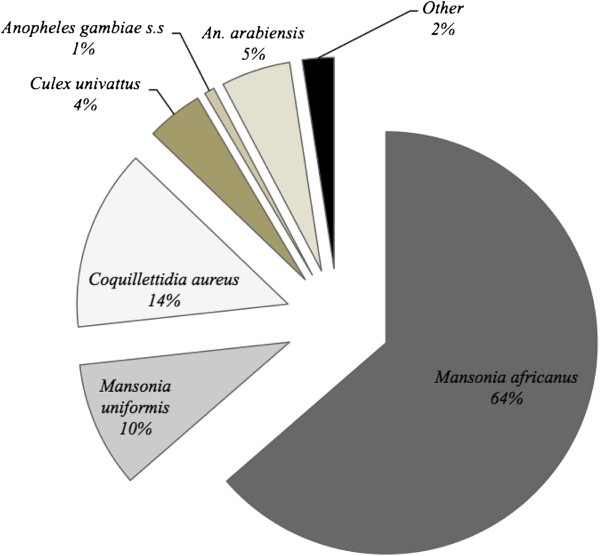
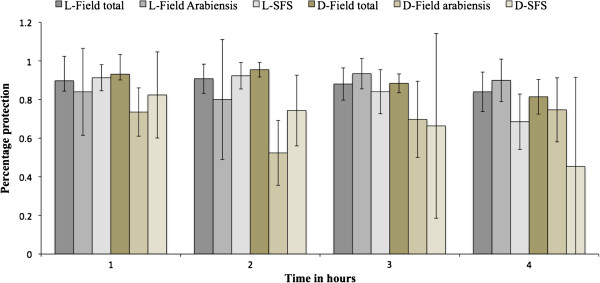
Methods: A lotion-based, 15% N, N-Diethyl-3-methylbenzamide (DEET) repellent and 15% DEET in ethanol were compared to a placebo lotion in a 200 sq m (10 m × 20 m) semi-field system (SFS) against laboratory-reared Anopheles arabiensis mosquitoes and in full field settings against wild malaria vectors and nuisance-biting mosquitoes. The average percentage protection against biting mosquitoes over four hours in the SFS and field setting was determined. A Poisson regression model was then used to determine relative risk of being bitten when wearing either of these repellents compared to the placebo.
Results: Average percentage protection of the lotion-based 15% DEET repellent after four hours of mosquito collection was 82.13% (95% CI 75.94-88.82) in the semi-field experiments and 85.10% (95% CI 78.97-91.70) in the field experiments. Average percentage protection of 15% DEET in ethanol after four hours was 71.29% (CI 61.77-82.28) in the semi-field system and 88.24% (84.45-92.20) in the field.
Conclusions: Semi-field evaluation results were comparable to full-field evaluations, indicating that such systems could be satisfactorily used in measuring efficacy of topically applied mosquito repellents, thereby avoiding risks of exposure to mosquito-borne pathogens, associated with field testing.
Figures
References
-
- WHOPES. Guidelines for Testing Efficacy of Mosquito Repellents for Human Skin. Geneva: World Health Organization; 2009.
-
- Khan A, Maibach HI, Skidmore DL. Insect repellents: effect of mosquito and repellent-related factors on protection time. J Econ Entomol. 1975;68:43–45. - PubMed
Publication types
MeSH terms
Substances
LinkOut - more resources
Full Text Sources
Other Literature Sources
