


Prospective associations between the cortisol awakening response and first onsets of anxiety disorders over a six-year follow-up--2013 Curt Richter Award Winner
- PMID: 24767619
- PMCID: PMC4108290
- DOI: 10.1016/j.psyneuen.2014.02.014
Prospective associations between the cortisol awakening response and first onsets of anxiety disorders over a six-year follow-up--2013 Curt Richter Award Winner
Abstract
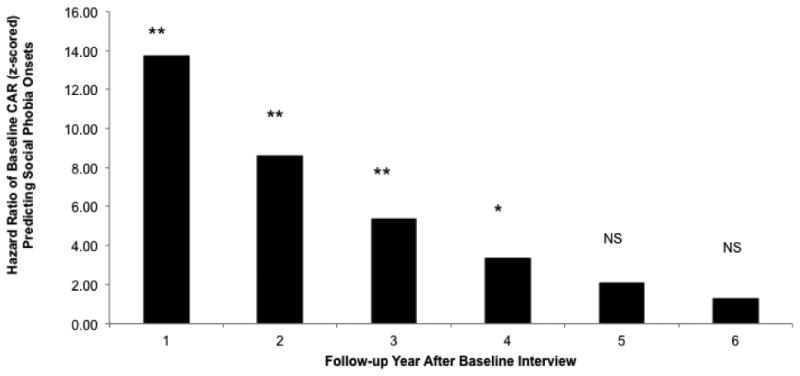
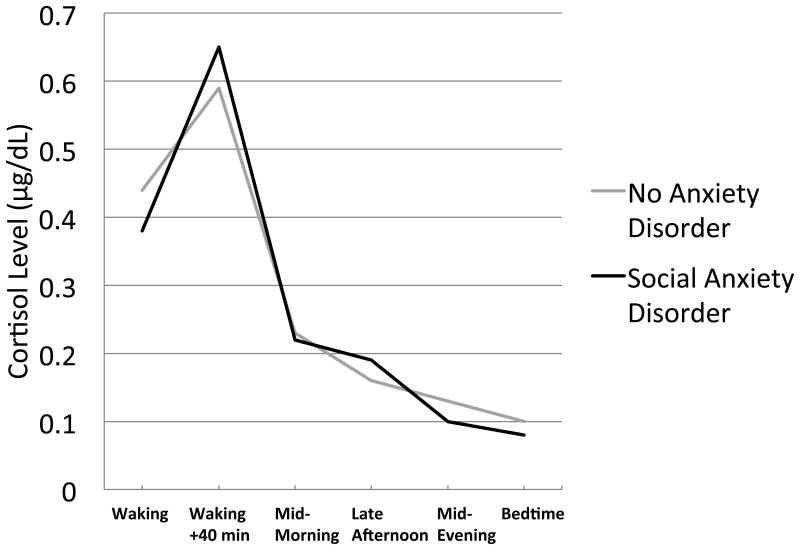
Cross-sectional associations have been found between anxiety disorders (ADs) and hypothalamic-pituitary-adrenal (HPA) axis functioning, as measured by levels of salivary cortisol, but prospective data are lacking, as are studies examining specific ADs. We have previously shown that one aspect of the diurnal rhythm of cortisol, the cortisol awakening response (CAR), prospectively predicts both new onsets and recurrences of major depressive disorder (MDD). Here we sought to examine whether it also predicts ADs. Participants (N=232) were drawn from the larger Northwestern-UCLA Youth Emotion Project, a two-site, longitudinal study of older adolescents, which aims to identify common and specific risk factors for mood and anxiety disorders. After baseline interviews for mental health diagnoses, a subset of adolescents completed a three-day cortisol sampling protocol measuring the CAR and other diurnal rhythm indices. Participants with past or current anxiety disorders at the time of cortisol measurement were excluded and Cox regression (survival analysis) was used to predict first onsets of ADs over the subsequent six years. AD onsets (N=25), the largest subset of which were social anxiety disorder (SAD) onsets (N=11), were observed over six annual follow up diagnostic interviews. Even when statistically adjusting for past and prospective MDD onsets and other covariates, a higher CAR significantly predicted increased first onsets of ADs (HR=2.20, p<.05). A higher CAR was also a strong and significant predictor of the subset of SAD onsets (HR=5.37, p<.005). Implications for the etiology of ADs, with a focus on SAD, are discussed.
Keywords: Adolescence; Anxiety disorders; Cortisol; Cortisol awakening response; Diurnal rhythms; Hypothalamic pituitary adrenal axis; Non-proportional hazard models; Prospective; Social anxiety disorder; Social phobia.
Copyright © 2014 Elsevier Ltd. All rights reserved.
Conflict of interest statement
Conflict of Interest: None of the authors have any conflicts of interest to declare with respect to this research.
Figures

References
-
- Adam EK, Kumari M. Assessing salivary cortisol in large-scale, epidemiological research. Psychoneuroendocrinology. 2009;34:1423–1436. - PubMed
-
- Adam EK, Sutton JM, Doane LD, Mineka S. Incorporating hypothalamic– pituitary–adrenal axis measures into preventive interventions for adolescent depression: Are we there yet? Development and Psychopathology. 2008;20:975–1001. - PubMed
-
- American Psychiatric Association. Diagnostic and statistical manual of mental disorders. 4th. American Psychiatric Publishing; Washington, D.C: 2000. text rev.
Publication types
MeSH terms
Substances
Grants and funding
LinkOut - more resources
Full Text Sources
Other Literature Sources
Medical
Miscellaneous
