


Brief cognitive intervention can modulate neuroendocrine stress responses to the Trier Social Stress Test: buffering effects of a compassionate goal orientation
- PMID: 24767620
- PMCID: PMC4120861
- DOI: 10.1016/j.psyneuen.2014.02.016
Brief cognitive intervention can modulate neuroendocrine stress responses to the Trier Social Stress Test: buffering effects of a compassionate goal orientation
Abstract
Background: The hypothalamic-pituitary-adrenal (HPA) axis is a critical mediator linking stress to health. Understanding how to modulate its reactivity could potentially help reduce the detrimental health effects of HPA axis activation. Social evaluative threat is a potent activator of this system. Access to control and coping responses can reduce its reactivity to pharmacological activation. Compassionate or affiliative behaviors may also moderate stress reactivity. Impact of these moderators on social evaluative threat is unknown. Here, we tested the hypotheses that interventions to increase control, coping, or compassionate (versus competitive) goals could reduce HPA-axis response to social evaluative threat.
Methods: Healthy participants (n=54) were exposed to social evaluative threat using the Trier Social Stress Test (TSST). They were randomly assigned to receive one of four different instructions prior to the stressor: Standard TSST instructions (SI), standard instructions with access to "control" (SI Control), or one of two cognitive interventions (CI) that (1) increased familiarity and helped participants prepare coping strategies (CI Coping), or (2) shifted goal orientation from self-promotion to helping others (CI Compassionate Goals). ACTH and cortisol were obtained before and after stress exposure via intravenous catheter.
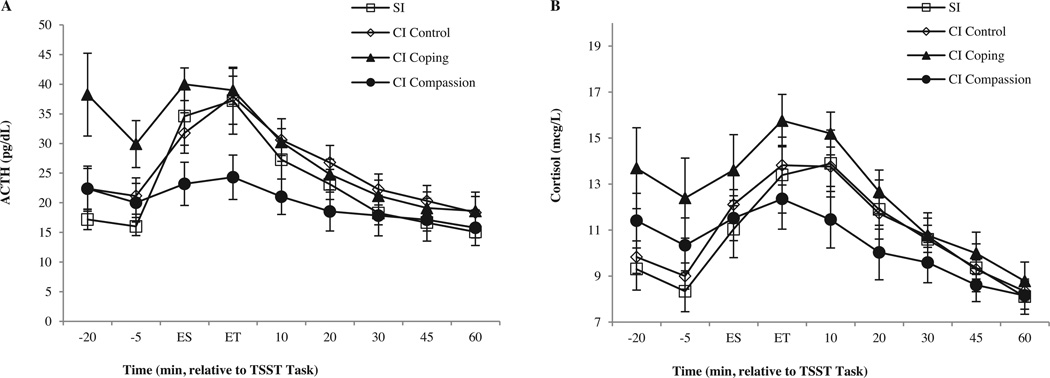
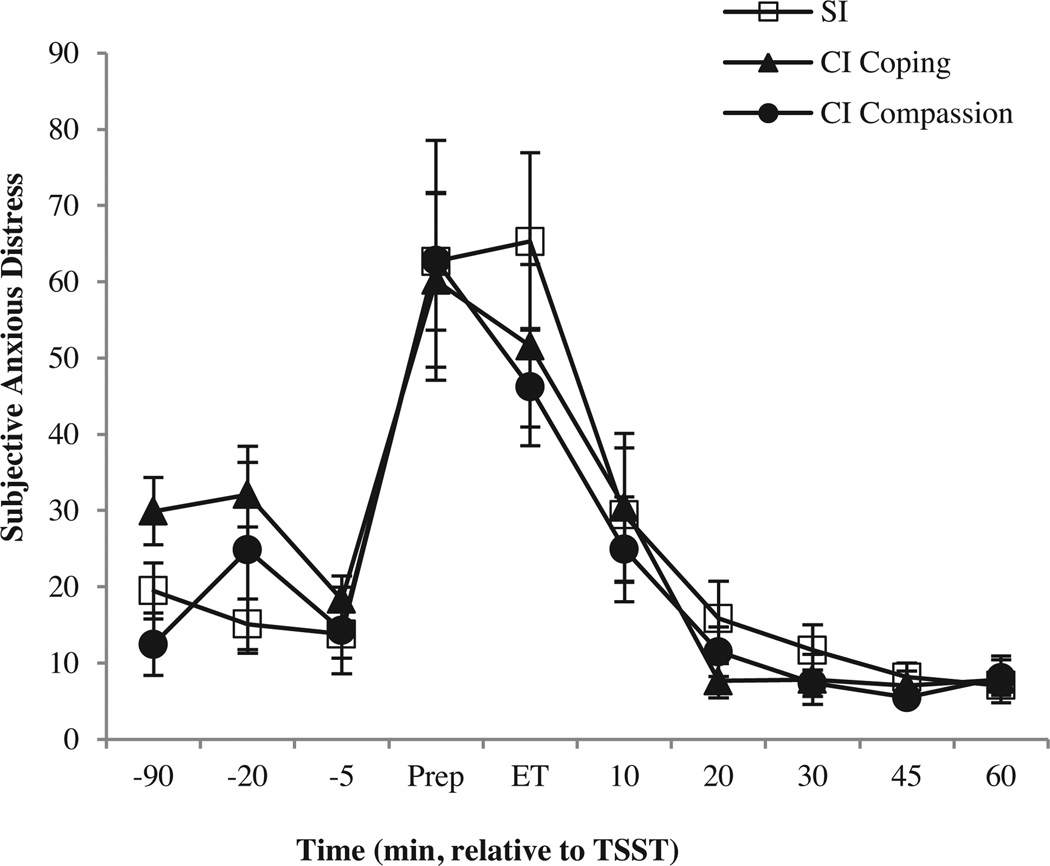
Results: Control alone had no effect. CI Compassionate Goals significantly reduced ACTH and cortisol responses to the TSST; CI Coping raised baseline levels. Compassionate Goals reduced hormonal responses without reducing subjective anxiety, stress or fear, while increasing expression of pro-social intentions and focus on helping others.
Conclusions: Brief intervention to shift focus from competitive self-promotion to a goal orientation of helping-others can reduce HPA-axis activation to a potent psychosocial stressor. This supports the potential for developing brief interventions as inoculation tools to reduce the impact of predictable stressors and lends support to growing evidence that compassion and altruistic goals can moderate the effects of stress.
Keywords: ACTH; Compassion; Control; Coping; Cortisol; HPA; Psychosocial stress; Stress; Trier Social Stress Test.
Copyright © 2014 Elsevier Ltd. All rights reserved.
Conflict of interest statement
None of the authors have any actual or potential conflict of interest related to the findings of this study.
Figures
References
-
- Abelson JL, Liberzon I, Young EA, Khan S. Cognitive modulation of the endocrine stress response to a pharmacological challenge in normal and panic disorder subjects. Arch. Gen. Psychiatry. 2005;62:668–675. - PubMed
-
- Adam EK, Kumari M. Assessing salivary Cortisol in large-scale, epidemiological research. Psychoneuroendocrinology. 2009;34:1423–1436. - PubMed
-
- Beck AT, Steer RA, Brown GK. Manual for the Beck Depression Inventory-II. San Antonio, TX: Psychological Corporation; 1996.
Publication types
MeSH terms
Substances
Grants and funding
LinkOut - more resources
Full Text Sources
Other Literature Sources
Medical
