


FTO polymorphisms moderate the association of food reinforcement with energy intake
- PMID: 24768648
- PMCID: PMC4665647
- DOI: 10.1016/j.physbeh.2014.04.029
FTO polymorphisms moderate the association of food reinforcement with energy intake
Abstract
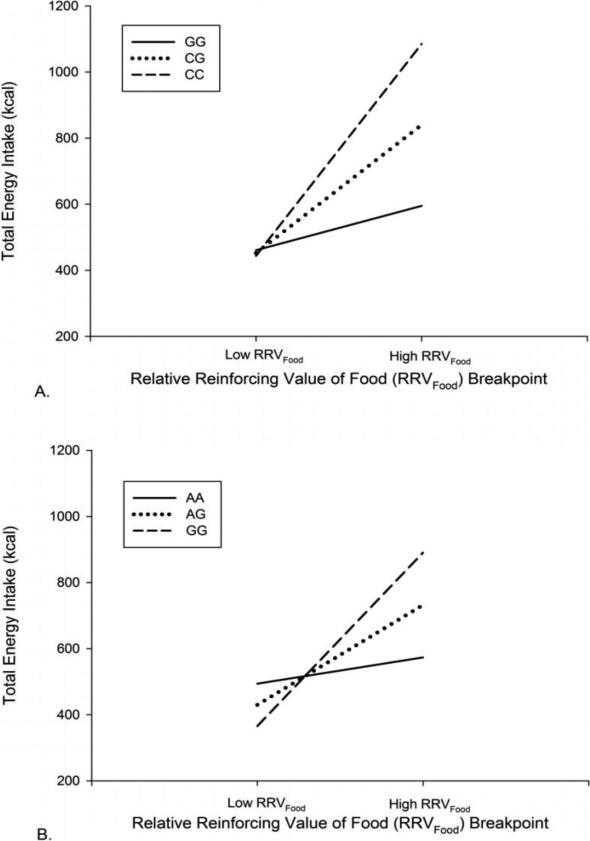
Food reinforcement (RRVfood) is related to increased energy intake, cross-sectionally related to obesity, and prospectively related to weight gain. The fat mass and obesity-associated (FTO) gene is related to elevated body mass index and increased energy intake. The primary purpose of the current study was to determine whether any of 68 FTO single nucleotide polymorphisms (SNPs) or a FTO risk score moderate the association between food reinforcement and energy or macronutrient intake. Energy and macronutrient intake was measured using a laboratory ad libitum snack food consumption task in 237 adults of varying BMI. Controlling for BMI, the relative reinforcing value of reading (RRVreading) and proportion of African ancestry, RRVfood predicted 14.2% of the variance in energy intake, as well as predicted carbohydrate, fat, protein and sugar intake. In individual analyses, six FTO SNPs (rs12921970, rs9936768, rs12446047, rs7199716, rs8049933 and rs11076022, spanning approximately 251kbp) moderated the relationship between RRVfood and energy intake to predict an additional 4.9-7.4% of variance in energy intake. We created an FTO risk score based on 5 FTO SNPs (rs9939609, rs8050136, rs3751812, rs1421085, and rs1121980) that are related to BMI in multiple studies. The FTO risk score did not increase variance accounted for beyond individual FTO SNPs. rs12921970 and rs12446047 served as moderators of the relationship between RRVfood and carbohydrate, fat, protein, and sugar intake. This study shows for the first time that the relationship between RRVfood and energy intake is moderated by FTO SNPs. Research is needed to understand how these processes interact to predict energy and macronutrient intake.
Keywords: Energy intake; FTO; Food reinforcement; Obesity.
Copyright © 2014 Elsevier Inc. All rights reserved.
Figures
References
-
- Hill C, Saxton J, Webber L, Blundell J, Wardle J. The relative reinforcing value of food predicts weight gain in a longitudinal study of 7--10-y-old children. Am J Clin Nutr. 2009;90:276–81. - PubMed
Publication types
MeSH terms
Substances
Grants and funding
LinkOut - more resources
Full Text Sources
Other Literature Sources
