


Fractional Erbium laser in the treatment of photoaging: randomized comparative, clinical and histopathological study of ablative (2940nm) vs. non-ablative (1540nm) methods after 3 months
- PMID: 24770501
- PMCID: PMC4008055
- DOI: 10.1590/abd1806-4841.20142370
Fractional Erbium laser in the treatment of photoaging: randomized comparative, clinical and histopathological study of ablative (2940nm) vs. non-ablative (1540nm) methods after 3 months
Abstract
Background: Fractional non-ablative lasers keep the epidermis intact, while fractional ablative lasers remove it, making them theoretically more effective.
Objectives: To evaluate the clinical and histological alterations induced by fractional photothermolysis for treating photoaging, comparing the possible equivalence of multiple sessions of 1540nm Erbium, to one session of 2940nm Erbium.
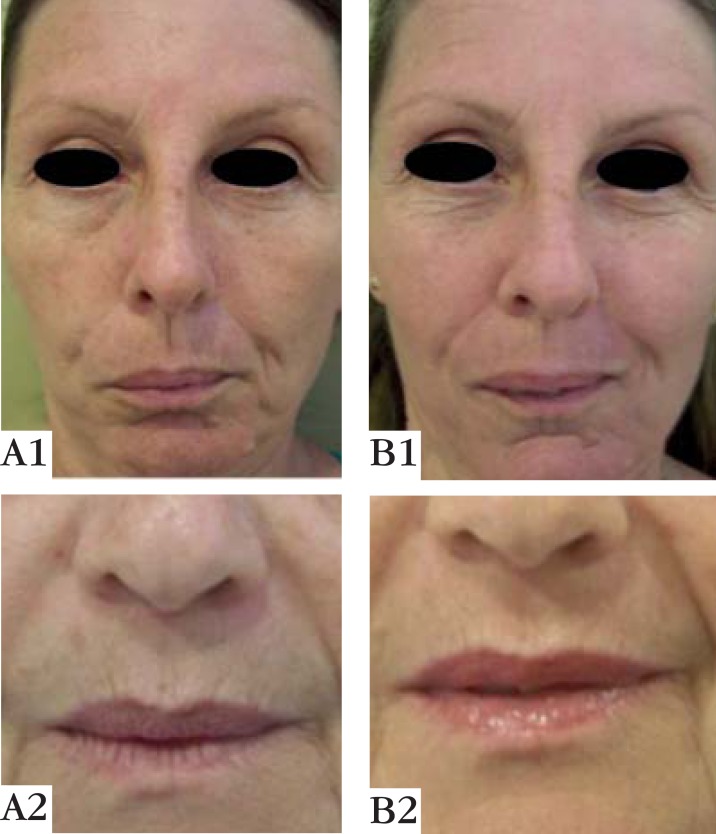
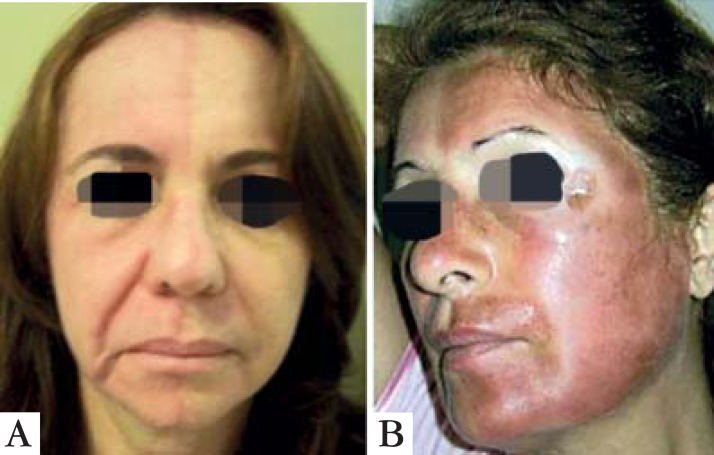
Methods: Eighteen patients (mean age 55.9) completed the treatment with three sessions of 1540nm fractional Erbium laser on one side of the face (50 mJ/mB, 15ms, 2 passes), and one session of 2940nm on the other side (5mJ/mB, 0.25ms, 2 passes). Biopsies were performed before and 3 months after treatment. Clinical, histological and morphometric evaluations were carried out.
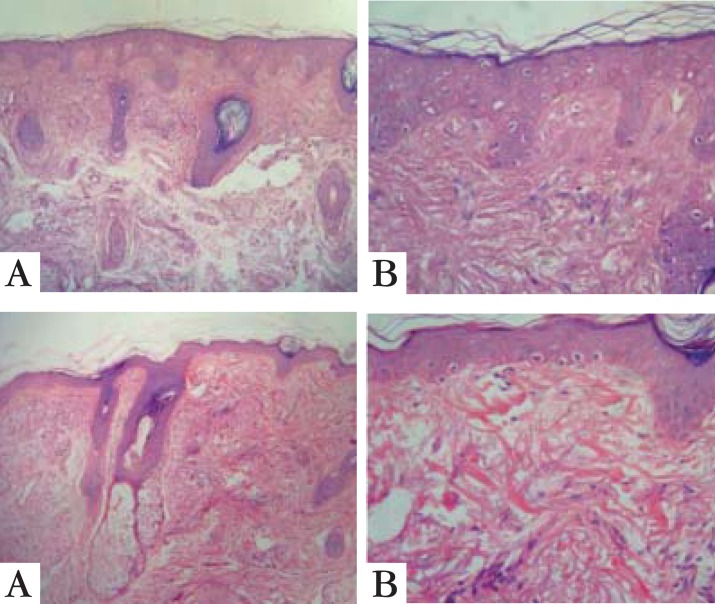
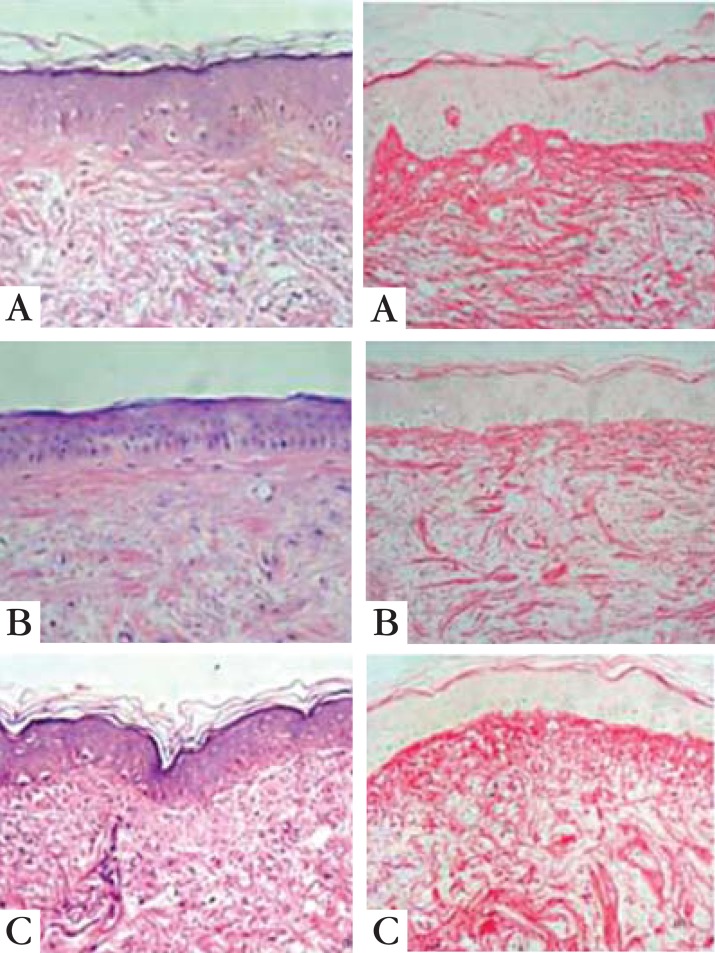
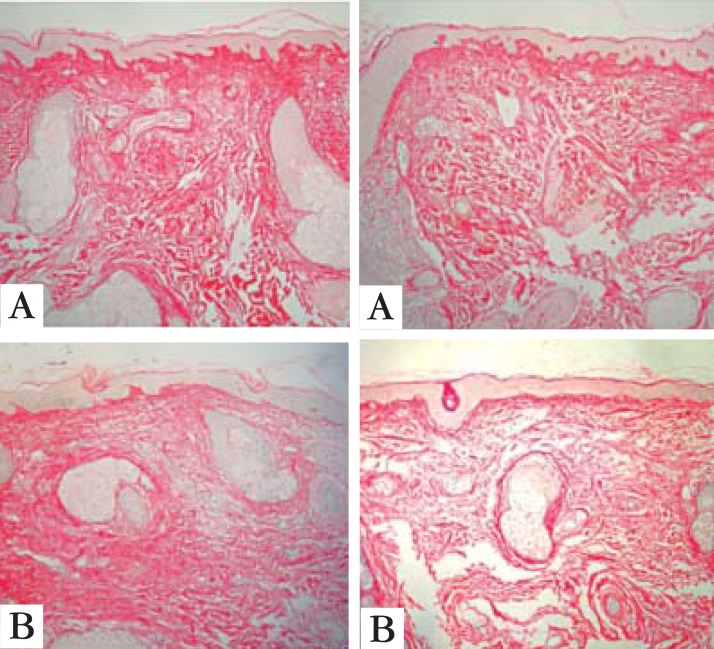
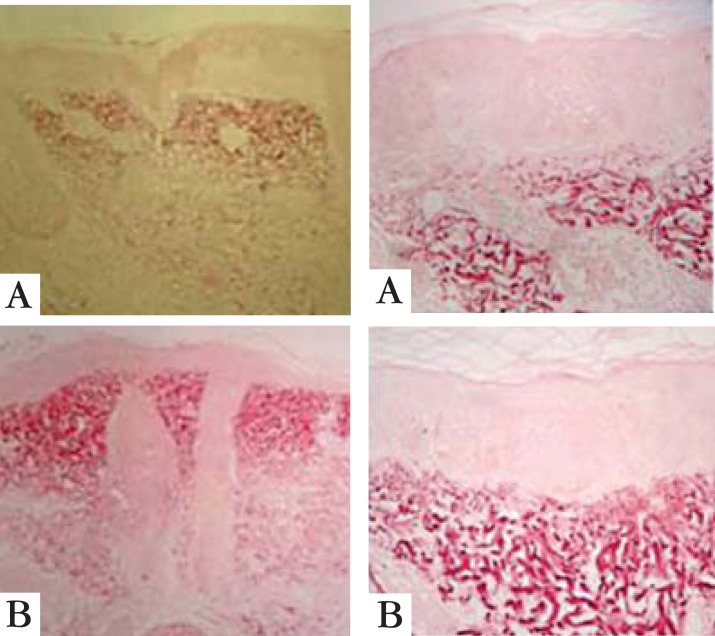
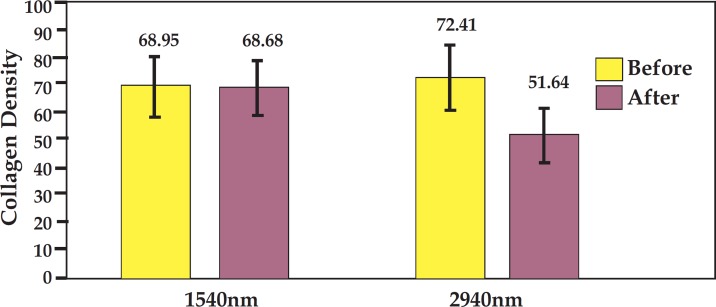
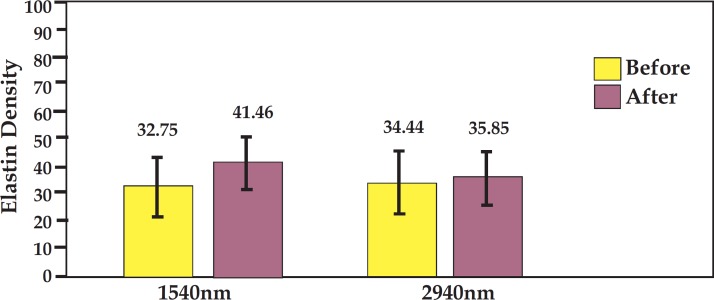
Results: All patients presented clinical improvement with no statistically significant difference (p> 0.05) between the treated sides. Histopathology revealed a new organization of collagen and elastic fibers, accompanied by edema, which was more evident with the 2940nm laser. This finding was confirmed by morphometry, which showed a decrease in collagen density for both treatments, with a statistical significance for the 2940nm laser (p > 0.001).
Conclusions: Three 1540nm sessions were clinically equivalent to one 2940nm session. The edema probably contributed to the positive results after three months, togheter with the new collagen and elastic fibers organization. The greater edema after the 2940nm session indicates that dermal remodeling takes longer than with 1540nm. It is possible that this histological superiority relates to a more prolonged effect, but a cohort longer than three months is needed to confirm that supposition.
Conflict of interest statement
Conflict of interest: None
Figures
References
-
- Wells HG. The War of the Worlds. London: William Heinemann; 1898. 303 p
-
- Wheeland RG, McBurney E, Geronemus RG. The role of dermatologists in the evolution of laser surgery. Dermatol Surg. 2000;26:815–822. - PubMed
-
- Maiman TH. Biomedical lasers evolve toward clinical applications. Hosp Manage. 1966;101:39–41. - PubMed
-
- Goldman L, Wilson RG, Hornby P, Meyer RG. Radiation from Q-switched ruby laser: effect of repeated impacts of power output of 10 megawatts on a tattoo of man. J Invest Dermatol. 1965;44:69–71. - PubMed
-
- Anderson RR, Parrish JA. Selective photothermolysis: precise microsurgery by selective absorption of pulsed radiation. Science. 1983;220:524–527. - PubMed
Publication types
MeSH terms
Substances
LinkOut - more resources
Full Text Sources
Other Literature Sources
Medical
Miscellaneous