


Effects of insulin resistance on white matter microstructure in middle-aged and older adults
- PMID: 24771537
- PMCID: PMC4105251
- DOI: 10.1212/WNL.0000000000000452
Effects of insulin resistance on white matter microstructure in middle-aged and older adults
Abstract
Objective: To investigate the potential relationship between insulin resistance (IR) and white matter (WM) microstructure using diffusion tensor imaging in cognitively healthy middle-aged and older adults.
Methods: Diffusion tensor imaging was acquired from 127 individuals (age range 41-86 years). IR was evaluated by the homeostasis model assessment of IR (HOMA-IR). Participants were divided into 2 groups based on HOMA-IR values: "high HOMA-IR" (≥2.5, n = 27) and "low HOMA-IR" (<2.5, n = 100). Cross-sectional voxel-based comparisons were performed using Tract-Based Spatial Statistics and anatomically defined regions of interest analysis.
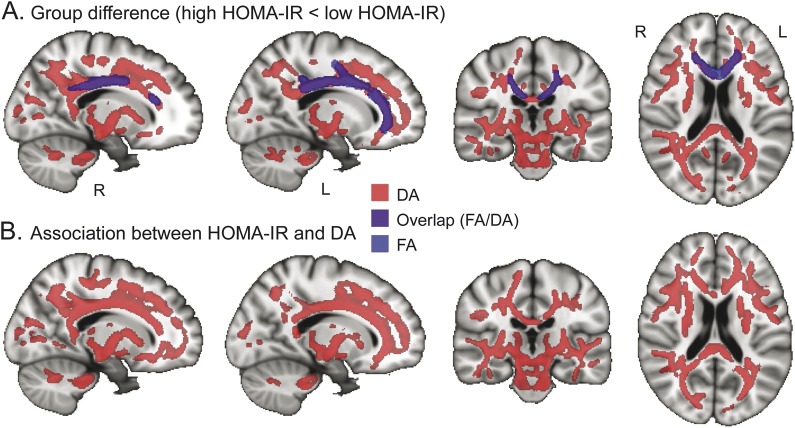
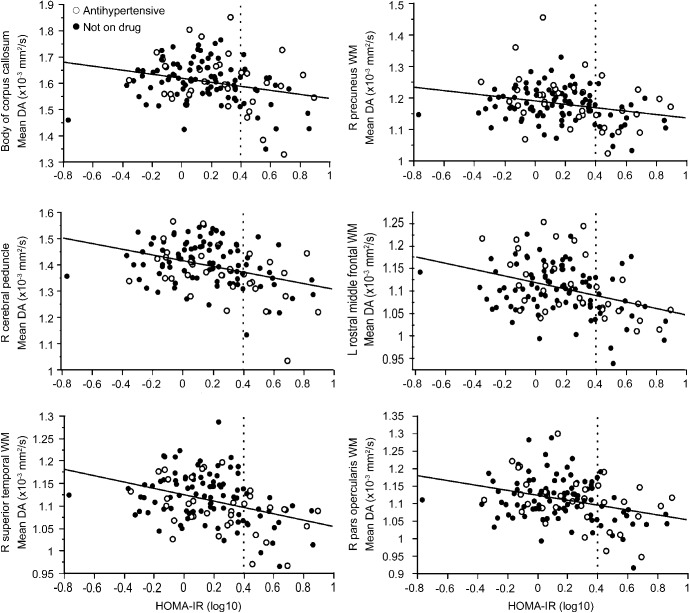
Results: The high HOMA-IR group demonstrated decreased axial diffusivity broadly throughout the cerebral WM in areas such as the corpus callosum, corona radiata, cerebral peduncle, posterior thalamic radiation, and right superior longitudinal fasciculus, and WM underlying the frontal, parietal, and temporal lobes, as well as decreased fractional anisotropy in the body and genu of corpus callosum and parts of the superior and anterior corona radiata, compared with the low HOMA-IR group, independent of age, WM signal abnormality volume, and antihypertensive medication status. These regions additionally demonstrated linear associations between diffusion measures and HOMA-IR across all subjects, with higher HOMA-IR values being correlated with lower axial diffusivity.
Conclusions: In generally healthy adults, greater IR is associated with alterations in WM tissue integrity. These cross-sectional findings suggest that IR contributes to WM microstructural alterations in middle-aged and older adults.
© 2014 American Academy of Neurology.
Figures
References
-
- US Department of Health and Human Services, National Diabetes Information Clearinghouse. Insulin resistance and prediabetes [online]. Available at: www.diabetes.niddk.nih.gov/dm/pubs/insulinresistance/. Accessed July 28, 2009
-
- Craft S, Watson GS. Insulin and neurodegenerative disease: shared and specific mechanisms. Lancet Neurol 2004;3:169–178 - PubMed
-
- Ronnemaa E, Zethelius B, Sundelof J, et al. Impaired insulin secretion increases the risk of Alzheimer disease. Neurology 2008;71:1065–1071 - PubMed
Publication types
MeSH terms
Grants and funding
LinkOut - more resources
Full Text Sources
Other Literature Sources
