


Small intestinal permeability in older adults
- PMID: 24771689
- PMCID: PMC4001874
- DOI: 10.14814/phy2.281
Small intestinal permeability in older adults
Abstract
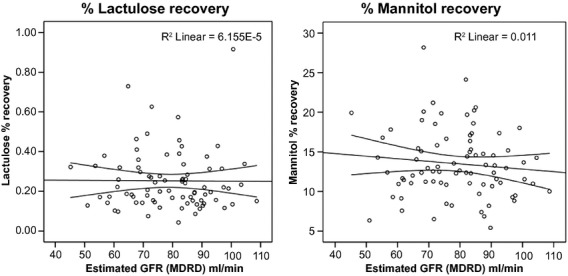
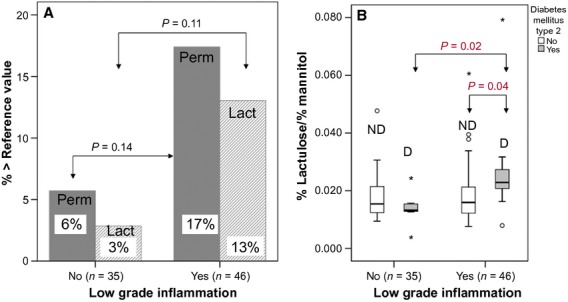
Abstract It is not yet clear whether intestinal mucosal permeability changes with advancing age in humans. This question is of high importance for drug and nutrition approaches for older adults. Our main objective was to answer the question if small intestinal barrier integrity deteriorates with healthy aging. We conducted a cross-sectional study including the pooled data of 215 nonsmoking healthy adults (93 female/122 male), 84 of whom were aged between 60 and 82 years. After a 12-h fast, all participants ingested 10 g of lactulose and 5 g of mannitol. Urine was collected for 5 h afterwards and analyzed for test sugars. The permeability index (PI = lactulose/mannitol) was used to assess small intestinal permeability. Low-grade inflammation defined by high-sensitivity C-reactive protein ≥1 mL/L and kidney function (estimated glomerular filtration rate) were determined in the older age group. The PI was similar in older compared to younger adults (P = 0.887). However, the urinary recovery of lactulose and mannitol was lower in the older adults and this change was neither associated with urinary volume nor glomerular filtration rate. The PI was not significantly correlated with low-grade inflammation or presence of noninsulin-dependent type 2 diabetes. However, it significantly deteriorated in the copresence of both conditions compared to low-grade inflammation alone (P = 0.043) or type 2 diabetes alone (P = 0.015). Small intestinal mucosal barrier does not deteriorate with age per se. But low-grade inflammation coupled with minor disease challenges, such as type 2 diabetes, can compromise the small intestinal barrier.
Keywords: Aging; cardiovascular risk; gut leakiness; small intestine; sugar test.
Figures

References
-
- Ahmadi‐Abhari S., Luben R. N., Wareham N. J., Khaw K. T. 2013. Distribution and determinants of C‐reactive protein in the older adult population: European Prospective Investigation into Cancer‐Norfolk study. Eur. J. Clin. Invest.; 43:899-911 - PubMed
-
- Amasheh S., Schmidt T., Mahn M., Florian P., Mankertz J., Tavalali S. 2005. Contribution of claudin‐5 to barrier properties in tight junctions of epithelial cells. Cell Tissue Res.; 321:89-96 - PubMed
-
- Arora S., Kassarjian Z., Krasinski S. D., Croffey B., Kaplan M. M., Russell R. M. 1989. Effect of age on tests of intestinal and hepatic function in healthy humans. Gastroenterology; 96:1560-1565 - PubMed
-
- Ballantyne C. M., Nambi V. 2005. Markers of inflammation and their clinical significance. Atheroscler. Suppl.; 6:21-29 - PubMed
LinkOut - more resources
Full Text Sources
Other Literature Sources
Research Materials
Miscellaneous
