


Detection and Treatment of Long-Chain Omega-3 Fatty Acid Deficiency in Adolescents with SSRI-Resistant Major Depressive Disorder
- PMID: 24772386
- PMCID: PMC3998067
- DOI: 10.1016/j.phanu.2014.02.002
Detection and Treatment of Long-Chain Omega-3 Fatty Acid Deficiency in Adolescents with SSRI-Resistant Major Depressive Disorder
Abstract
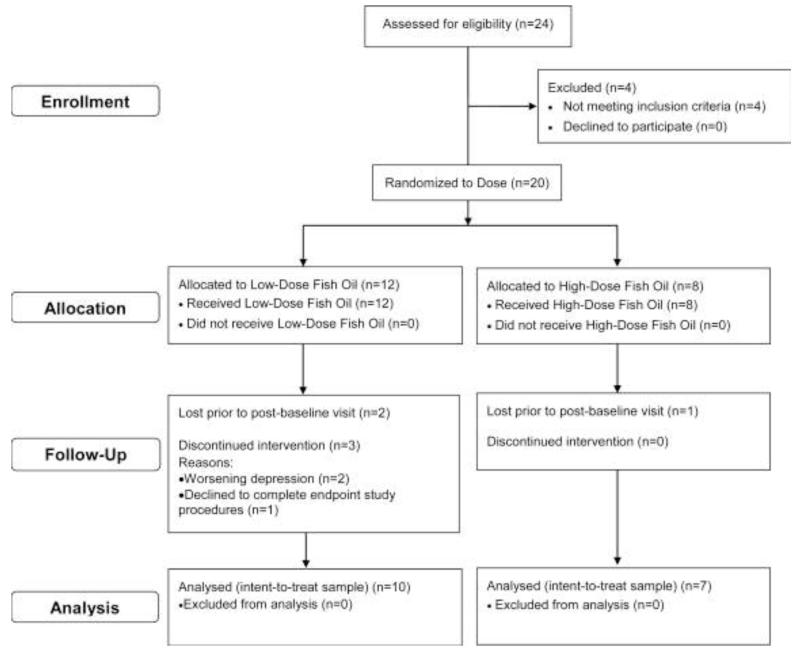
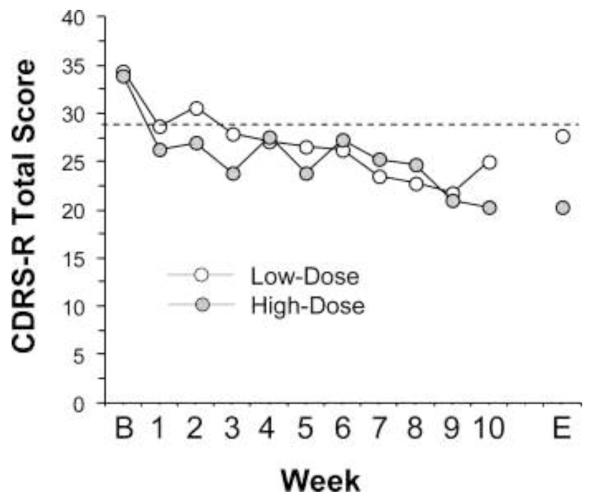
Residual depressive symptoms are commonly observed in adolescents with major depressive disorder (MDD) following treatment with selective serotonin reuptake inhibitors (SSRIs). This study combined a case-control analysis and an open-label fish oil (FO) trial to investigate the relationship between long-chain omega-3 (LCn-3) fatty acid status and residual depressive symptoms in SSRI-resistant adolescent MDD patients. Baseline erythrocyte docosahexaenoic acid (DHA)(-28%, p=0.0003), but not eicosapentaenoic acid (EPA)(-18%, p=0.2), was significantly lower in patients (n=20) compared with healthy controls (n=20). Patients receiving 10-week low-dose (2.4 g/d, n=7) and high-dose (16.2 g/d, n=7) FO exhibited significant increases in erythrocyte EPA and DHA composition. In the intent-to-treat sample, depressive symptoms decreased significantly in the high-dose group (n=7, -40%, p<0.0001), and there was a trend in the low-dose group (n=10, -20%, p=0.06). Symptom remission was observed in 40% of patients in the low-dose group and 100% of patients in the high-dose group. There were no significant changes in vital signs and adverse events were rated as mild or moderate in severity. These preliminary findings demonstrate that adolescents with SSRI-resistant depression exhibit robust DHA deficits, and suggest that adjunctive FO supplementation is well-tolerated and effective for increasing LCn-3 fatty acid status and augmenting SSRI antidepressant effects.
Keywords: Adolescents; Docosahexaenoic acid; Eicosapentaenoic acid; Erythrocyte; Major depressive disorder (MDD); Omega-3 fatty acids.
Figures
References
-
- McNamara RK. Developmental long-chain omega-3 fatty acid deficiency and prefrontal cortex pathology in psychiatric disorders. In: Collins RO, Adams JL, editors. Prefrontal Cortex: Developmental Differences and Role in Neurological Disorders. Nova Science Publishers, Inc.; U.S.A.: 2013. pp. 1–38.
-
- Hibbeln JR. Fish consumption and major depression. Lancet. 1998;351:1213. - PubMed
-
- Peet M. International variations in the outcome of schizophrenia and the prevalence of depression in relation to national dietary practices: an ecological analysis. British Journal of Psychiatry. 2004;184:404–408. - PubMed
-
- Appleton KM, Rogers PJ, Ness AR. Updated systematic review and meta-analysis of the effects of n-3 long-chain polyunsaturated fatty acids on depressed mood. American Journal of Clinical Nutrition. 2010;91:757–770. - PubMed
-
- Freeman MP, Hibbeln JR, Wisner KL, Davis JM, Mischoulon D, Peet M, Keck PE, Jr, Marangell LB, Richardson AJ, Lake J, Stoll AL. Omega-3 fatty acids: evidence basis for treatment and future research in psychiatry. Journal of Clinical Psychiatry. 2006;67:1954–1967. - PubMed
Grants and funding
LinkOut - more resources
Full Text Sources
Other Literature Sources
Research Materials
Miscellaneous