


Task-modulated coactivation of vergence neural substrates
- PMID: 24773099
- PMCID: PMC4202927
- DOI: 10.1089/brain.2013.0216
Task-modulated coactivation of vergence neural substrates
Abstract
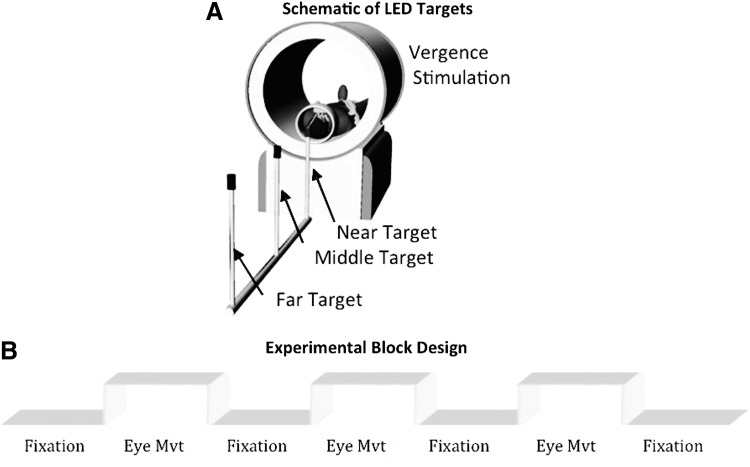
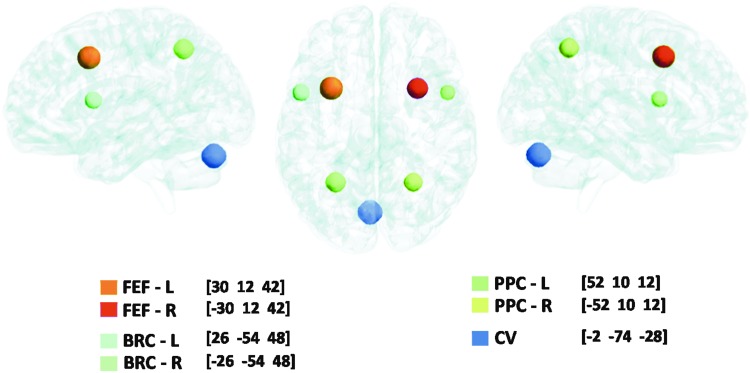
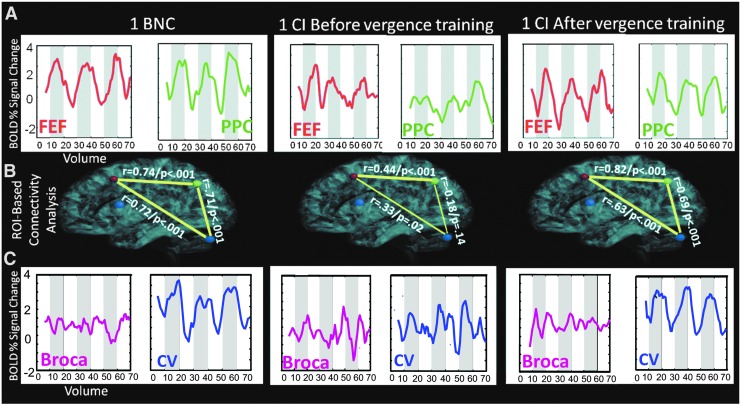
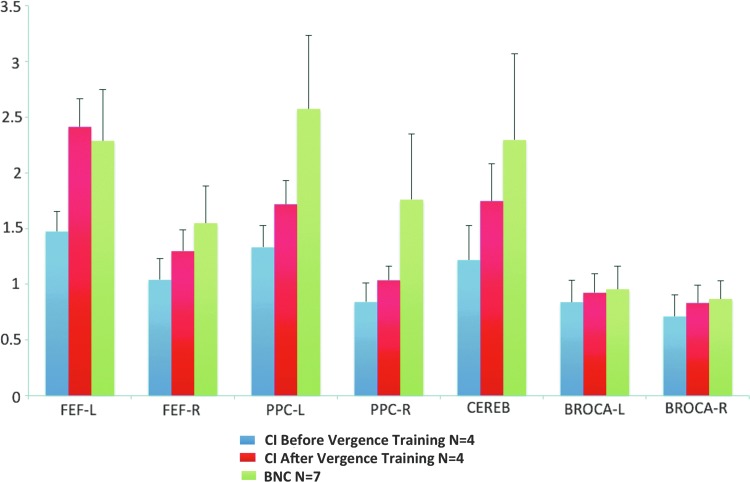
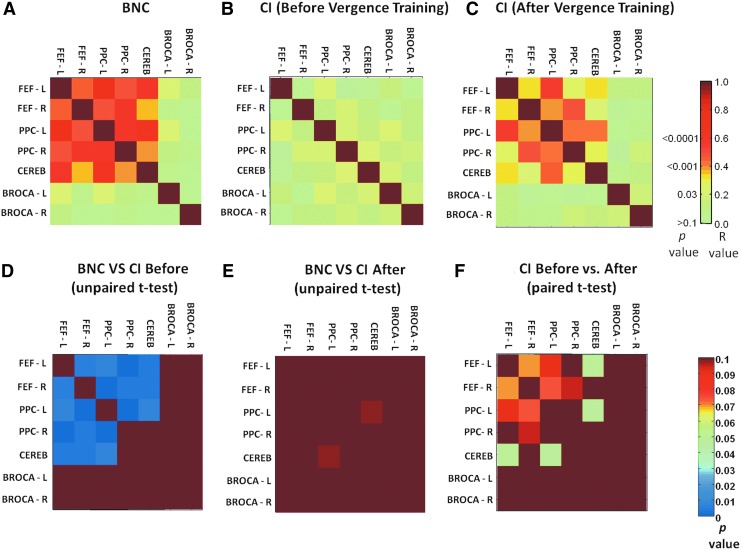
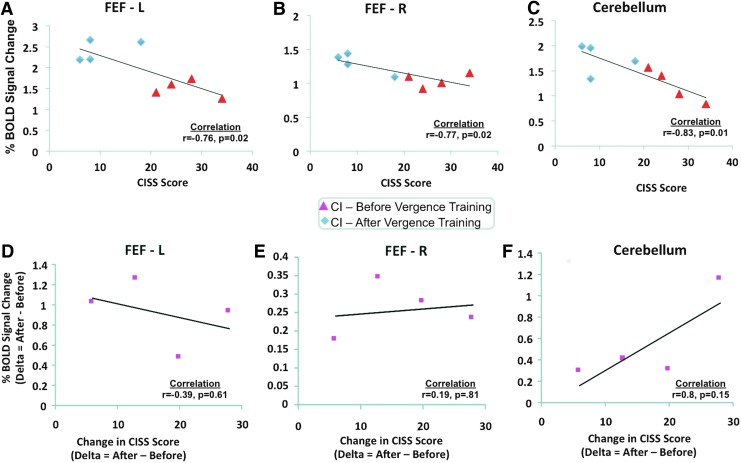
While functional magnetic resonance imaging (fMRI) has identified which regions of interests (ROIs) are functionally active during a vergence movement (inward or outward eye rotation), task-modulated coactivation between ROIs is less understood. This study tested the following hypotheses: (1) significant task-modulated coactivation would be observed between the frontal eye fields (FEFs), the posterior parietal cortex (PPC), and the cerebellar vermis (CV); (2) significantly more functional activity and task-modulated coactivation would be observed in binocularly normal controls (BNCs) compared with convergence insufficiency (CI) subjects; and (3) after vergence training, the functional activity and task-modulated coactivation would increase in CIs compared with their baseline measurements. A block design of sustained fixation versus vergence eye movements stimulated activity in the FEFs, PPC, and CV. fMRI data from four CI subjects before and after vergence training were compared with seven BNCs. Functional activity was assessed using the blood oxygenation level dependent (BOLD) percent signal change. Task-modulated coactivation was assessed using an ROI-based task-modulated coactivation analysis that revealed significant correlation between the FEF, PPC, and CV ROIs. Prior to vergence training, the CIs had a reduced BOLD percent signal change compared with BNCs for the CV (p<0.05), FEFs, and PPC (p<0.01). The BOLD percent signal change increased within the CV, FEF, and PPC ROIs (p<0.001) as did the task-modulated coactivation between the FEFs and CV as well as the PPC and CV (p<0.05) when comparing the CI pre- and post-training datasets. Results from the Convergence Insufficiency Symptom Survey were correlated to the percent BOLD signal change from the FEFs and CV (p<0.05).
Keywords: Convergence Insufficiency Symptom Survey; cerebellar vermis; convergence insufficiency; frontal eye fields; posterior parietal cortex; task-modulated coactivation; vergence.
Figures
References
-
- Akao T, Kurkin SA, Fukushima J, Fukushima K. 2005. Visual and vergence eye movement-related responses of pursuit neurons in the caudal frontal eye fields to motion-in-depth stimuli. Exp Brain Res 164:92–108 - PubMed
-
- Alkan Y, Biswal BB, Taylor PA, Alvarez TL. 2011b. Segregation of frontoparietal and cerebellar components within saccade and vergence networks using hierarchical independent component analysis of fMRI. Vis Neurosci 28:247–261 - PubMed
-
- Alvarez TL, Alkan Y, Gohel S, Douglas Ward B, Biswal BB. 2010a. Functional anatomy of predictive vergence and saccade eye movements in humans: a functional MRI investigation. Vis Res 50:2163–2175 - PubMed
-
- Alvarez TL, Bhavsar M, Semmlow JL, Bergen MT, Pedrono C. 2005. Short-term predictive changes in the dynamics of disparity vergence eye movements. J Vis 5:640–649 - PubMed
Publication types
MeSH terms
Grants and funding
LinkOut - more resources
Full Text Sources
Other Literature Sources
Medical
