Theoretically motivated interventions for reducing sexual risk taking in adolescence: a randomized controlled experiment applying fuzzy-trace theory
- PMID: 24773191
- PMCID: PMC4115050
- DOI: 10.1037/a0036717
Theoretically motivated interventions for reducing sexual risk taking in adolescence: a randomized controlled experiment applying fuzzy-trace theory
Abstract
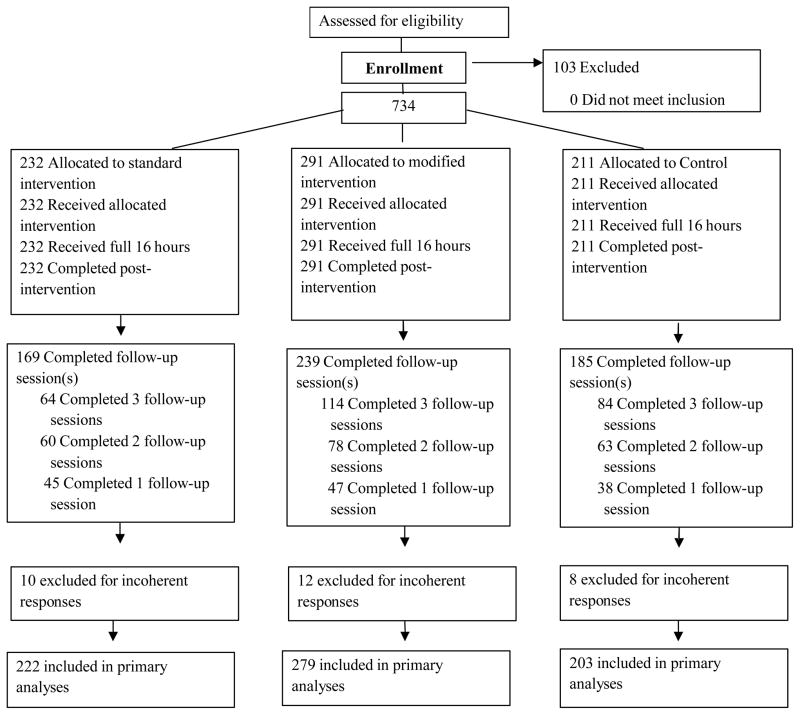
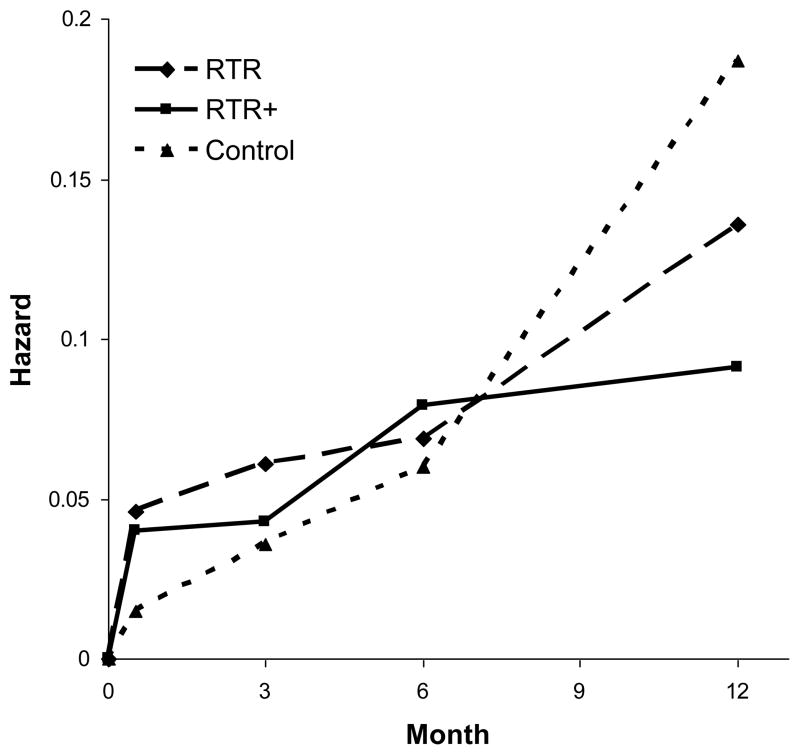
Fuzzy-trace theory is a theory of memory, judgment, and decision making, and their development. We applied advances in this theory to increase the efficacy and durability of a multicomponent intervention to promote risk reduction and avoidance of premature pregnancy and sexually transmitted infections. Seven hundred and thirty-four adolescents from high schools and youth programs in 3 states (Arizona, Texas, and New York) were randomly assigned to 1 of 3 curriculum groups: RTR (Reducing the Risk), RTR+ (a modified version of RTR using fuzzy-trace theory), and a control group. We report effects of curriculum on self-reported behaviors and behavioral intentions plus psychosocial mediators of those effects: namely, attitudes and norms, motives to have sex or get pregnant, self-efficacy and behavioral control, and gist/verbatim constructs. Among 26 outcomes, 19 showed an effect of at least 1 curriculum relative to the control group: RTR+ produced improvements for 17 outcomes and RTR produced improvements for 12 outcomes. For RTR+, 2 differences (for perceived parental norms and global benefit perception) were confined to age, gender, or racial/ethnic subgroups. Effects of RTR+ on sexual initiation emerged 6 months after the intervention, when many adolescents became sexually active. Effects of RTR+ were greater than RTR for 9 outcomes, and remained significantly greater than controls at 1-year follow-up for 12 outcomes. Consistent with fuzzy-trace theory, results suggest that by emphasizing gist representations, which are preserved over long periods and are key memories used in decision making, the enhanced intervention produced larger and more sustained effects on behavioral outcomes and psychosocial mediators of adolescent risk taking.
PsycINFO Database Record (c) 2014 APA, all rights reserved.
Figures
Similar articles
-
Using fuzzy-trace theory to understand and improve health judgments, decisions, and behaviors: A literature review.Health Psychol. 2016 Aug;35(8):781-792. doi: 10.1037/hea0000384. Health Psychol. 2016. PMID: 27505197 Free PMC article. Review.
-
Attitudes, norms, and self-efficacy: a model of adolescents' HIV-related sexual risk behavior.Health Educ Q. 1992 Summer;19(2):263-77. doi: 10.1177/109019819201900209. Health Educ Q. 1992. PMID: 1618632
-
The "Safer Choices" intervention: its impact on the sexual behaviors of different subgroups of high school students.J Adolesc Health. 2004 Dec;35(6):442-52. doi: 10.1016/j.jadohealth.2004.02.006. J Adolesc Health. 2004. PMID: 15581523 Clinical Trial.
-
Risk and Rationality in Adolescent Decision Making: Implications for Theory, Practice, and Public Policy.Psychol Sci Public Interest. 2006 Sep;7(1):1-44. doi: 10.1111/j.1529-1006.2006.00026.x. Epub 2006 Sep 1. Psychol Sci Public Interest. 2006. PMID: 26158695
-
Fuzzy-trace theory: dual processes in memory, reasoning, and cognitive neuroscience.Adv Child Dev Behav. 2001;28:41-100. doi: 10.1016/s0065-2407(02)80062-3. Adv Child Dev Behav. 2001. PMID: 11605365 Review.
Cited by
-
Interventions to reduce risk for sexually transmitted infections in adolescents: A meta-analysis of trials, 2008-2016.PLoS One. 2018 Jun 28;13(6):e0199421. doi: 10.1371/journal.pone.0199421. eCollection 2018. PLoS One. 2018. PMID: 29953546 Free PMC article.
-
How Reasoning, Judgment, and Decision Making are Colored by Gist-based Intuition: A Fuzzy-Trace Theory Approach.J Appl Res Mem Cogn. 2015 Dec 1;4(4):344-355. doi: 10.1016/j.jarmac.2015.09.001. J Appl Res Mem Cogn. 2015. PMID: 26664820 Free PMC article.
-
The Gist of Juries: Testing a Model of Damage Award Decision Making.Psychol Public Policy Law. 2015 Aug;21(3):280-294. doi: 10.1037/law0000048. Epub 2015 Jun 22. Psychol Public Policy Law. 2015. PMID: 29075092 Free PMC article.
-
Brain activation covaries with reported criminal behaviors when making risky choices: A fuzzy-trace theory approach.J Exp Psychol Gen. 2018 Jul;147(7):1094-1109. doi: 10.1037/xge0000434. J Exp Psychol Gen. 2018. PMID: 29975093 Free PMC article.
-
Understanding Genetic Breast Cancer Risk: Processing Loci of the BRCA Gist Intelligent Tutoring System.Learn Individ Differ. 2016 Jul;49:178-189. doi: 10.1016/j.lindif.2016.06.009. Epub 2016 Jul 1. Learn Individ Differ. 2016. PMID: 28008216 Free PMC article.
References
-
- Abma J, Chandra A, Mosher W, Peterson L, Piccinino L. Fertility, family planning, and women’s health: New data from the 1995 National Survey of Family Growth. Vital and Health Statistics. 1997;23(19):1–114. - PubMed
-
- Adam MB, Reyna VF. Coherence and correspondence criteria for rationality: experts’ estimation of risks of sexually transmitted infections. Journal of Behavioral Decision Making. 2005;18:169–186.
-
- Altman DG. Adjustment for covariate imbalance. In: Armitage P, Colton T, editors. Encyclopedia of Biostatistics. Chichester, UK: John Wiley & Sons; 1998. pp. 1000–1005.
-
- American Psychological Association. Publication manual of the American Psychological Association. 6. Washington, DC: American Psychological Association; 2010.
-
- Assmann SF, Pocock SJ, Enos LE, Kasten LE. Subgroup analysis and other (mis)uses of baseline data in clinical trials. Lancet. 2000;355:1064–1069. - PubMed
Publication types
MeSH terms
Grants and funding
LinkOut - more resources
Full Text Sources
Other Literature Sources
Medical