Review
. 2014:15:215-244.
doi: 10.1146/annurev-genom-091212-153408. Epub 2014 Apr 16.

The genetics of microdeletion and microduplication syndromes: an update

Affiliations
Review

The genetics of microdeletion and microduplication syndromes: an update

Corey T Watson et al. Annu Rev Genomics Hum Genet. 2014.

Abstract

Chromosomal abnormalities, including microdeletions and microduplications, have long been associated with abnormal developmental outcomes. Early discoveries relied on a common clinical presentation and the ability to detect chromosomal abnormalities by standard karyotype analysis or specific assays such as fluorescence in situ hybridization. Over the past decade, the development of novel genomic technologies has allowed more comprehensive, unbiased discovery of microdeletions and microduplications throughout the human genome. The ability to quickly interrogate large cohorts using chromosome microarrays and, more recently, next-generation sequencing has led to the rapid discovery of novel microdeletions and microduplications associated with disease, including very rare but clinically significant rearrangements. In addition, the observation that some microdeletions are associated with risk for several neurodevelopmental disorders contributes to our understanding of shared genetic susceptibility for such disorders. Here, we review current knowledge of microdeletion/duplication syndromes, with a particular focus on recurrent rearrangement syndromes.

Keywords: copy-number variation; developmental delay; intellectual disability; microarray; nonallelic homologous recombination; recurrent rearrangement.


Figures

Figure 1
Figure 1
Nonallelic homologous recombination (NAHR), the primary mechanism underlying the generation of recurrent copy-number variants (CNVs). Segmental duplications, also termed low-copy repeats, represent regions of extended sequence identity that can provide a substrate for NAHR-mediated chromosomal rearrangements. In this schematic, two large segmental duplications (blue arrows) with high sequence similarity flank a region containing genes a, b, and c. Following misalignment of the homologs, these duplications facilitate NAHR during meiosis by assisting an illegitimate crossing-over event between paralogous, rather than allelic, segmental duplications. This results in two reciprocal products: one chromosome carrying a duplication of the intervening region and an additional copy of genes a, b, and c, and a second chromosome carrying a deletion of this same region. Such rearrangements are common causes of many recurrent genomic disorders characterized by reciprocal rearrangements of specific chromosomal regions (see Table 1).
Figure 2
Figure 2
Analysis methods for the identification and characterization of genomic structural variants from massively parallel sequencing data. (a) Libraries are constructed from individual DNA samples, and the ends of the cloned DNA inserts/adapter-ligated fragments are sequenced using either traditional Sanger sequencing or next-generation methods. End sequences can then be mapped to the human reference genome, providing mapping data that can be used to infer the position, size, and type of structural variants carried by the individual used to generate the sequencing library with respect to the reference assembly. Several commonly used methods include paired-end read mapping, split-read mapping, and read-depth analysis (panels b, c, and d, respectively). (b) In paired-end read mapping, paired reads derived from a single DNA molecule that show relative discordancy in their mapping (in terms of relative separation or orientation of the read pairs) allow the detection of deletions, insertions, and inversions. The maximum size and resolution of the events detected are dictated by the size and distribution of the library that is sequenced. If appropriate mapping parameters are used, paired-end reads located on separate chromosomes can also be used to infer translocation events (not shown). (c) Split-read mapping is used to identify instances in which portions of a single read align discontiguously to the reference genome; this approach is useful for directly mapping and characterizing the exact breakpoints of insertion, deletion, and inversion events. The power of this approach is dictated largely by read length. (d) Read-depth analysis utilizes the relative sequencing coverage across the genome from a population of individuals to identify regions with significantly altered read depth among individuals, highlighting loci that harbor deletions or duplications. The resolution of this method is strongly influenced by depth of coverage. Importantly, both paired-end and split-read mapping methods often perform poorly where the breakpoints are embedded in segmental duplications owing to the potential for mismapping of reads in paralogous sequences. In such cases, the read-depth approach is often more tractable. Targeted sequencing and assembly in regions harboring novel structural events is another powerful method in structurally complex regions (not shown); de novo assemblies can allow for the delineation of complex event breakpoints as well as complete descriptions at nucleotide resolution of insertion and duplication sequences not represented in the reference genome.
Figure 3
Figure 3
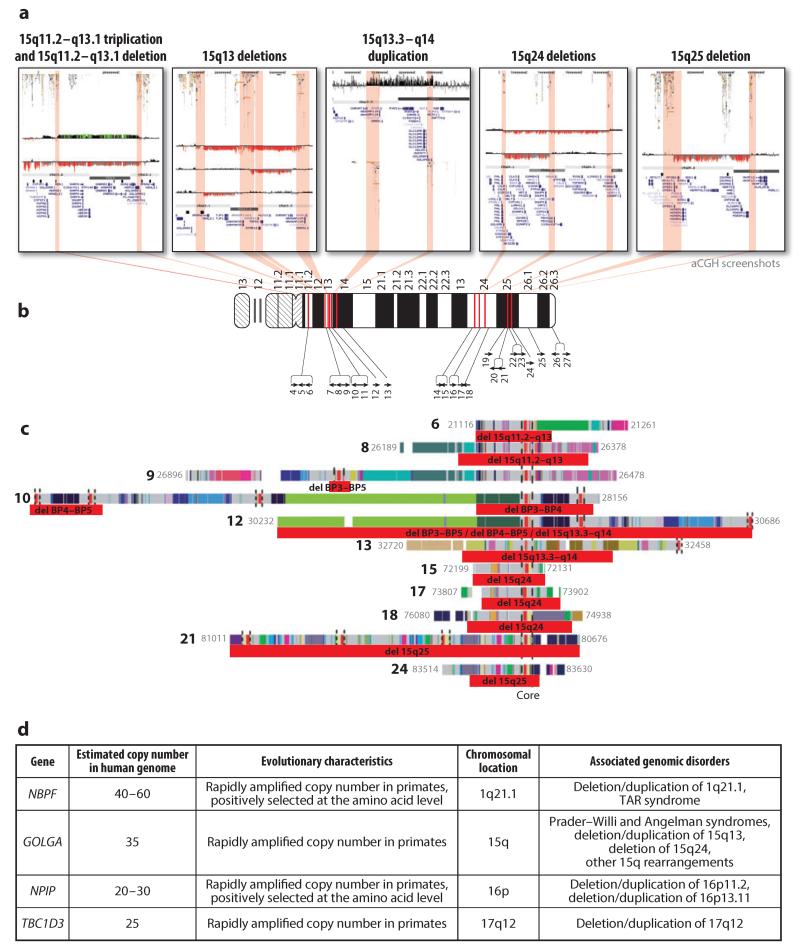
Gene families that have undergone rapid expansion during recent primate evolution that are associated with several recurrent genomic disorders in humans. (a) Studies of multiple chromosome 15 rearrangements by array comparative genomic hybridization (aCGH) show that the breakpoints of these rearrangements coincide with the location of a duplication family containing the GOLGA gene. These include both recognized recurrent genomic disorders and rarer rearrangements, including (left to right) a triplication of 15q11.2–q13.1 (157), a deletion of 15q11.2–q13.1 associated with Angelman syndrome (157), BP3–BP5 deletions of 15q13, a duplication of 15q13.3–q14 associated with epilepsy, deletions of 15q24 (158), and a deletion of 15q25 associated with congenital diaphragmatic hernia (111). In each image, the locations of duplication blocks containing the GOLGA gene (75) are indicated by red shaded regions. Tracks show segmental duplications, cytogenetic bands, assembly gaps, and RefSeq genes. (b) This panel shows the locations of 27 assembled GOLGA-containing duplication blocks on chromosome 15. Each block is indicated by a black arrow (75), numbered according to its genomic location along the chromosome. Those that coincide with the breakpoints of deletion/duplication events are highlighted (red bars). (c) GOLGA duplication blocks coincide with sites of rearrangement breakpoints on chromosome 15. Red bars below each duplication block indicate the interval in which rearrangement breakpoints occur. Although the presence of structural polymorphisms and cross-hybridization between paralogous sequences makes it difficult to precisely determine the breakpoints by aCGH, in every case data showed that the intervals in which the breakpoints occur overlap a GOLGA core. Blocks are numbered, with colored bars denoting the ancestral chromosomal origin of each subelement (75). The core element, which contains the GOLGA gene and is shared by all duplication blocks, is highlighted by vertical dashed lines. Note that some blocks contain multiple GOLGA sequences. (d) At least four different gene families, all of which have undergone rapid amplification of copy number in the past 20–30 million years of primate evolution, are associated with the breakpoints of recurrent genomic disorders in the human genome. This includes NBPF, which shows the most extreme increase in human-specific copy number of any gene identified to date (135), and NPIP, which both has expanded in copy number specifically in the great ape lineage and shows one of the highest levels of amino acid replacement of any human gene (76). Abbreviation: TAR, thrombocytopenia absent radius. Panels ac have been adapted in part from a figure first published by the Nature Publishing Group (157).

References

    1. 1000 Genomes Proj. Consort. A map of human genome variation from population-scale sequencing. Nature. 2010;467:1061–73. - PMC - PubMed
    1. 1000 Genomes Proj. Consort. An integrated map of genetic variation from 1,092 human genomes. Nature. 2012;491:56–65. - PMC - PubMed
    1. Albers CA, Paul DS, Schulze H, Freson K, Stephens JC, et al. Compound inheritance of a low-frequency regulatory SNP and a rare null mutation in exon-junction complex subunit RBM8A causes TAR syndrome. Nat. Genet. 2012;44:435–39. - PMC - PubMed
    1. Amos-Landgraf JM, Ji Y, Gottlieb W, Depinet T, Wandstrat AE, et al. Chromosome breakage in the Prader-Willi and Angelman syndromes involves recombination between large, transcribed repeats at proximal and distal breakpoints. Am. J. Hum. Genet. 1999;65:370–86. - PMC - PubMed
    1. Andrieux J, Dubourg C, Rio M, Attie-Bitach T, Delaby E, et al. Genotype-phenotype correlation in four 15q24 deleted patients identified by array-CGH. Am. J. Med. Genet. A. 2009;149A:2813–19. - PMC - PubMed

Publication types