


Willingness to pay for contagious bovine pleuropneumonia vaccination in Narok South District of Kenya
- PMID: 24774477
- PMCID: PMC4062942
- DOI: 10.1016/j.prevetmed.2014.03.028
Willingness to pay for contagious bovine pleuropneumonia vaccination in Narok South District of Kenya
Abstract
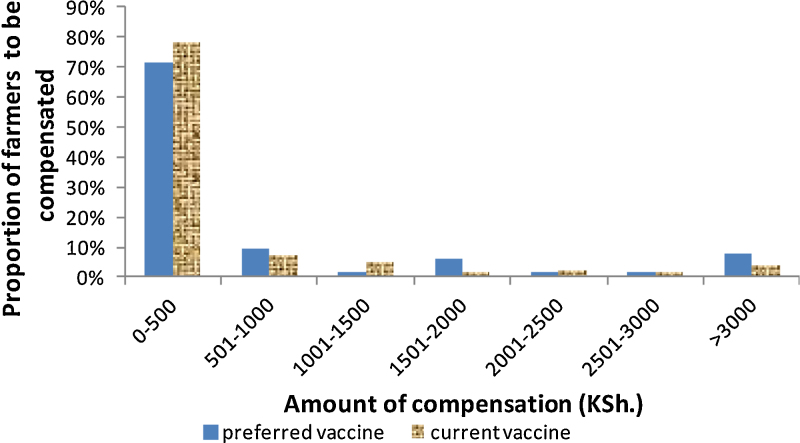
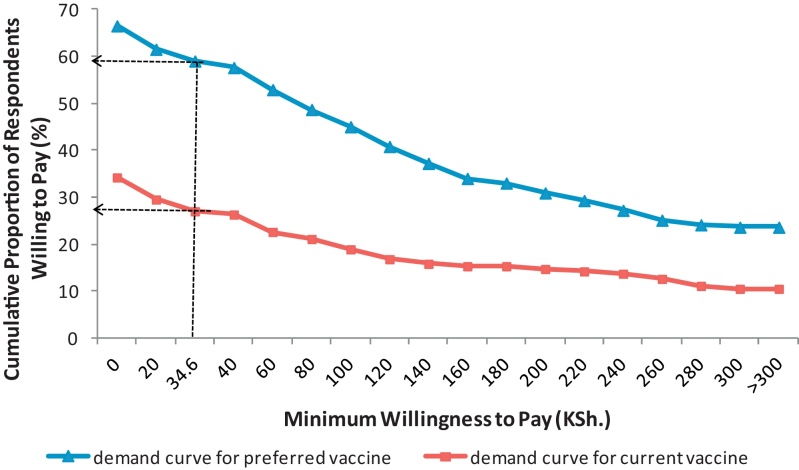
Contagious bovine pleuropneumonia (CBPP) is an economically important trans-boundary cattle disease which affects food security and livelihoods. A conjoint analysis-contingent valuation was carried out on 190 households in Narok South District of Kenya to measure willingness to pay (WTP) and demand for CBPP vaccine and vaccination as well as factors affecting WTP. The mean WTP was calculated at Kenya Shillings (KSh) 212.48 (USD 3.03) for vaccination using a vaccine with the characteristics that were preferred by the farmers (preferred vaccine and vaccination) and KSh -71.45 (USD -1.02) for the currently used vaccine and vaccination. The proportion of farmers willing to pay an amount greater than zero was 66.7% and 34.4% for the preferred and current vaccine and vaccination respectively. About one third (33.3%) of farmers would need to be compensated an average amount of KSh 1162.62 (USD 13.68) per animal to allow their cattle to be vaccinated against CBPP using the preferred vaccine and vaccination. About two-thirds (65.6%) of farmers would need to be compensated an average amount of KSh 853.72 (USD 12.20) per animal to allow their cattle to be vaccinated against CBPP using the current vaccine and vaccination. The total amount of compensation would be KSh 61.39 million (USD 0.88 million) for the preferred vaccine and vaccination and KSh 90.15 million (USD 1.29 million) for the current vaccine and vaccination. Demand curves drawn from individual WTP demonstrated that only 59% and 27% of cattle owners with a WTP greater than zero were willing to pay a benchmark cost of KSh 34.60 for the preferred and current vaccine respectively. WTP was negatively influenced by the attitude about household economic situation (p=0.0078), presence of cross breeds in the herd (p<0.0001) and years since CBPP had been experienced in the herd (p=0.0375). It was positively influenced by education (p=0.0251) and the practice of treating against CBPP (p=0.0432). The benefit cost ratio (BCR) for CBPP vaccination was 2.9-6.1 depending on the vaccination programme. In conclusion, although a proportion of farmers was willing to pay, participation levels may be lower than those required to interrupt transmission of CBPP. Households with characteristics that influence WTP negatively need persuasion to participate in CBPP vaccination. It is economically worthwhile to vaccinate against CBPP. A benefit cost analysis (BCA) using aggregated WTP as benefits can be used as an alternative method to the traditional BCA which uses avoided production losses (new revenue) and costs saved as benefits.
Keywords: Conjoint analysis–contingent valuation; Contagious bovine pleuropneumonia; Kenya; Narok; Vaccination; Vaccine; Willingness to pay.
Copyright © 2014 The Authors. Published by Elsevier B.V. All rights reserved.
Figures
Similar articles
-
Exploring farmer preferences for contagious bovine pleuropneumonia vaccination: a case study of Narok District of Kenya.Prev Vet Med. 2013 Jul 1;110(3-4):356-69. doi: 10.1016/j.prevetmed.2013.02.013. Epub 2013 Mar 5. Prev Vet Med. 2013. PMID: 23465609
-
Control of contagious bovine pleuropneumonia: knowledge, attitudes, perceptions and practices in Narok district of Kenya.Prev Vet Med. 2014 Aug 1;115(3-4):143-56. doi: 10.1016/j.prevetmed.2014.03.029. Epub 2014 Apr 5. Prev Vet Med. 2014. PMID: 24768437 Free PMC article.
-
Information sharing and willingness-to-pay for CBPP vaccine in rural Kenya.Vaccine. 2019 Mar 14;37(12):1659-1666. doi: 10.1016/j.vaccine.2019.01.072. Epub 2019 Feb 16. Vaccine. 2019. PMID: 30782491
-
An estimation of the economic impact of contagious bovine pleuropneumonia in Africa.Rev Sci Tech. 2006 Dec;25(3):999-1011. Rev Sci Tech. 2006. PMID: 17361766 Review.
-
A history of the prevalence and control of contagious bovine pleuropneumonia in China.Vet J. 2012 Feb;191(2):166-70. doi: 10.1016/j.tvjl.2011.02.011. Epub 2011 Mar 24. Vet J. 2012. PMID: 21439870 Review.
Cited by
-
A Rational Explanation of Limited FMD Vaccine Uptake in Endemic Regions.Pathogens. 2019 Oct 10;8(4):181. doi: 10.3390/pathogens8040181. Pathogens. 2019. PMID: 31658689 Free PMC article.
-
Prioritizing smallholder animal health needs in East Africa, West Africa, and South Asia using three approaches: Literature review, expert workshops, and practitioner surveys.Prev Vet Med. 2021 Apr;189:105279. doi: 10.1016/j.prevetmed.2021.105279. Epub 2021 Jan 27. Prev Vet Med. 2021. PMID: 33581421 Free PMC article.
-
Assessing farmers' willingness to pay for FMD vaccines and factors influencing payment: a contingent valuation study in central Oromia, Ethiopia.BMC Vet Res. 2024 Jul 15;20(1):313. doi: 10.1186/s12917-024-04169-7. BMC Vet Res. 2024. PMID: 39010130 Free PMC article.
-
Ugandan cattle farmers' perceived needs of disease prevention and strategies to improve biosecurity.BMC Vet Res. 2019 Jun 21;15(1):208. doi: 10.1186/s12917-019-1961-2. BMC Vet Res. 2019. PMID: 31226988 Free PMC article.
-
Knowledge about Human Papillomavirus and Cervical Cancer: Predictors of HPV Vaccination among Dental Students.Asian Pac J Cancer Prev. 2017 Jun 25;18(6):1573-1579. doi: 10.22034/APJCP.2017.18.6.1573. Asian Pac J Cancer Prev. 2017. PMID: 28669170 Free PMC article.
References
-
- Adamowicz W., Louviere J., Williams M. Combining revealed and stated preference methods for valuing environmental amenities. J. Environ. Econ. Manag. 1994;26:271–292.
-
- AU/IBAR . 2004. Report on the PanAfrican Programme for the Control of Epizootics (PACE)
-
- Workshop on Contagious Bovine Pleuropneumonia; 25–27 February, Guinea-Conakry; African Union Inter-African Bureau for Animal Resources (AU/IBAR); 2004.
-
- Brown T.C. Introduction to stated preference methods. In: Champ P.A., Boyle K.J., Brown T.C., editors. A Primer on Market Valuation. Springer; New York, USA: 2005. pp. 99–110.
-
- Casey J.F. Conjoint analysis of farmer preferences for agro-forestry in Calakmul, Mexico. In: Alberini A., Kahn J.R., editors. The Handbook of Contingent Valuation. Edward Elgar Publishers; Mexico: 2009. pp. 340–353.
Publication types
MeSH terms
Grants and funding
LinkOut - more resources
Full Text Sources
Other Literature Sources
Medical
