


A qualitative exploration of discharge destination as an outcome or a driver of acute stroke care
- PMID: 24774583
- PMCID: PMC4045916
- DOI: 10.1186/1472-6963-14-193
A qualitative exploration of discharge destination as an outcome or a driver of acute stroke care
Abstract
Background: Many patients with acute stroke do not receive recommended care in tertiary hospital settings. Allied health professionals have important roles within multidisciplinary stroke teams and influence the quality of care patients receive. Studies examining the role of allied health professionals in acute stroke management are scarce, and very little is known about the clinical decision making of these stroke clinicians. In this study we aimed to describe factors that influence the complex clinical decision making of these professionals as they prioritise acute stroke patients for recommended care. This qualitative study was part of a larger mixed methods study.
Methods: The qualitative methodology applied was a constructivist grounded theory approach.Fifteen allied health professionals working with acute stroke patients at three metropolitan tertiary care hospitals in South Australia were purposively sampled.Semi-structured interviews were conducted face to face using a question guide, and digital recording. Interviews were transcribed and analysed by two researchers using rigorous grounded theory processes.
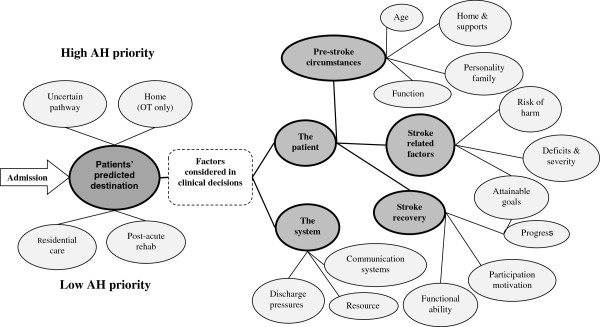
Results: Our analysis highlighted 'predicted discharge destination' as a powerful driver of care decisions and clinical prioritisation for this professional group. We found that complex clinical decision making to predict discharge destination required professionals to concurrently consider patient's pre-stroke status, the nature and severity of their stroke, the course of their recovery and multiple factors from within the healthcare system. The consequences of these decisions had potentially profound consequences for patients and sometimes led to professionals experiencing considerable uncertainty and stress.
Conclusions: Our qualitative enquiry provided new insights into the way allied health professionals make important clinical decisions for patients with acute stroke. This is the first known study to demonstrate that the subjective prediction of discharge destination made early in an acute admission by allied health professionals, has a powerful influence over the care and rehabilitation provided, and the ultimate outcomes for stroke patients.
Figures
References
-
- National Stroke Foundation. National Stroke Audit - Acute Services Clinical Audit Report 2011. Melbourne, Australia: National Stroke Foundation; 2011.
-
- Stroke Unit Trialists Collaboration. Organised inpatient (stroke unit) care for stroke. Cochrane Database Syst Rev. 2007. Art. No. CD000197. doi:10.1002/14651858.CD000197.pub2. - PubMed
-
- National Stroke Foundation. Clinical Guidelines for Stroke Management 2010. Melbourne, Australia: National Stroke Foundation; 2010.
MeSH terms
LinkOut - more resources
Full Text Sources
Other Literature Sources
Medical
