. 2014 Apr 28:14:113.
doi: 10.1186/1471-2229-14-113.

Evaluating contribution of ionic, osmotic and oxidative stress components towards salinity tolerance in barley

Affiliations

Evaluating contribution of ionic, osmotic and oxidative stress components towards salinity tolerance in barley

Getnet Dino Adem et al. BMC Plant Biol. .

Abstract

Background: Salinity tolerance is a physiologically multi-faceted trait attributed to multiple mechanisms. Three barley (Hordeum vulgare) varieties contrasting in their salinity tolerance were used to assess the relative contribution of ionic, osmotic and oxidative stress components towards overall salinity stress tolerance in this species, both at the whole-plant and cellular levels. In addition, transcriptional changes in the gene expression profile were studied for key genes mediating plant ionic and oxidative homeostasis (NHX; RBOH; SOD; AHA and GORK), to compare a contribution of transcriptional and post-translational factors towards the specific components of salinity tolerance.

Results: Our major findings are two-fold. First, plant tissue tolerance was a dominating component that has determined the overall plant responses to salinity, with root K(+) retention ability and reduced sensitivity to stress-induced hydroxyl radical production being the main contributing tolerance mechanisms. Second, it was not possible to infer which cultivars were salinity tolerant based solely on expression profiling of candidate genes at one specific time point. For the genes studied and the time point selected that transcriptional changes in the expression of these specific genes had a small role for barley's adaptive responses to salinity.

Conclusions: For better tissue tolerance, sodium sequestration, K(+) retention and resistance to oxidative stress all appeared to be crucial. Because these traits are highly interrelated, it is suggested that a major progress in crop breeding for salinity tolerance can be achieved only if these complementary traits are targeted at the same time. This study also highlights the essentiality of post translational modifications in plant adaptive responses to salinity.


Figures
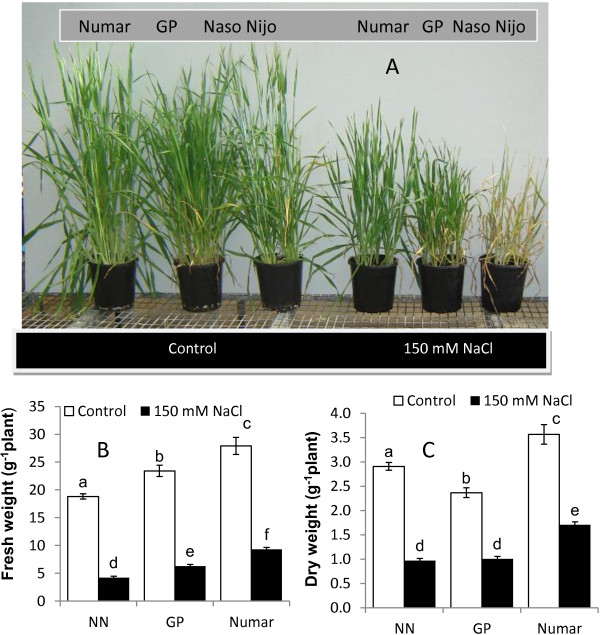
Figure 1
Figure 1
Growth responses and agronomical characteristics of three barley cultivars (Numar, Golden Promise, and Naso Nijo) treated with 150 mM NaCl for 4 weeks. A – plant phenotype under control and salt conditions; B – shoot fresh weight; C – shoot dry weight. Open bar - control; closed bar - salt. Mean ± SE (n = 30).
Figure 2
Figure 2
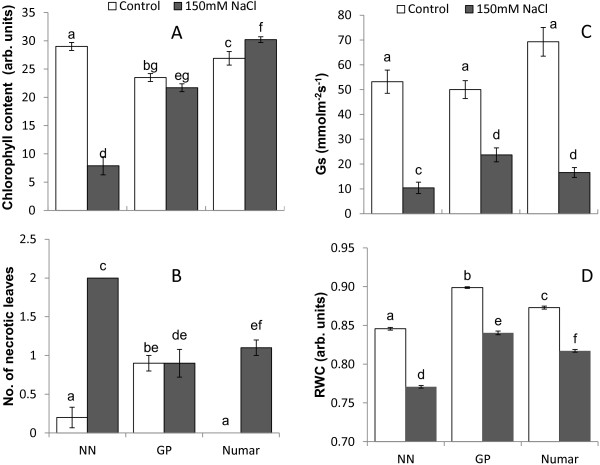
Whole-plant physiological characteristics in control- and salt-grown (150 mM NaCl for 4 weeks) plants. A - chlorophyll content (SPAD readings); B - number of necrotic leaves; C – stomatal conductance (Gs); D – relative water content. Open bar - control; closed bar - salt. Mean ± SE (n = 10 and 30 for A-C and D, respectively).
Figure 3
Figure 3
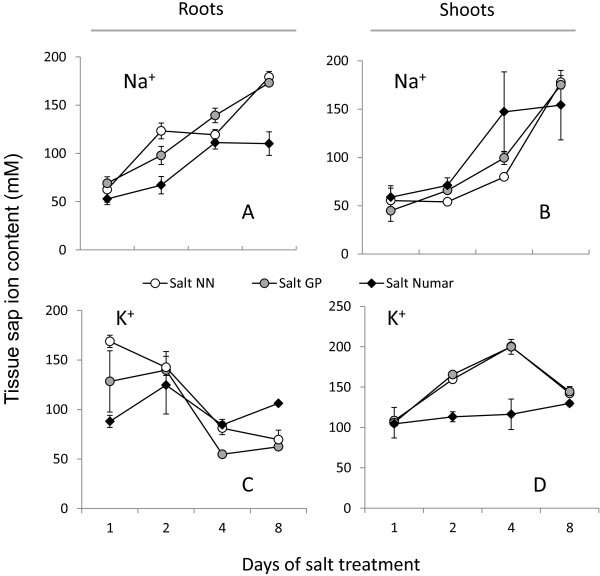
Changes in root and shoot sap Na+ and K+ content in three barley cultivars contrasting in their salinity stress tolerance during salt stress progression. Plants were grown hydroponically under control conditions until 3 days old, and then exposed to 100 mM NaCl treatment. Mean ± SE (n = 24).
Figure 4
Figure 4
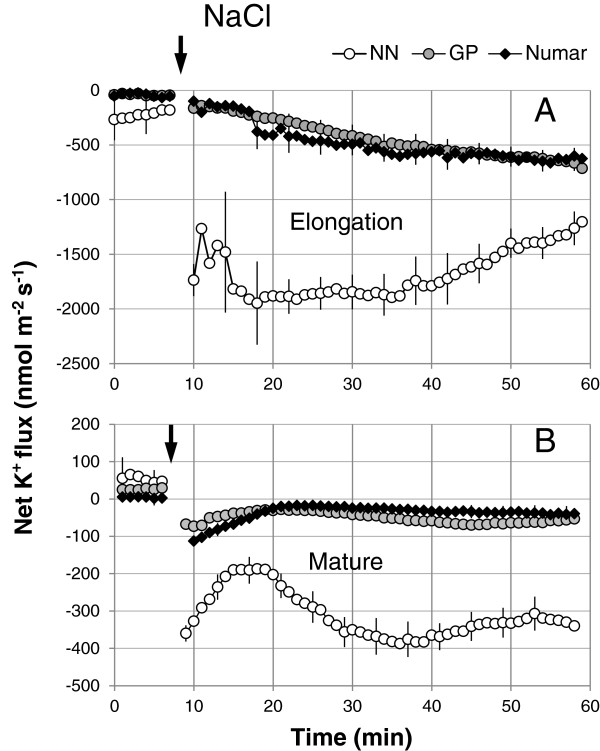
Kinetics of NaCl- induced net K+ fluxes measured form the elongation (A) and mature (B) root zones of three barley cultivars in response to 100 mM NaCl treatment. Mean ± SE (n = 6-8). The sign convention is “efflux negative”. The arrow indicates the application of the treatment.
Figure 5
Figure 5
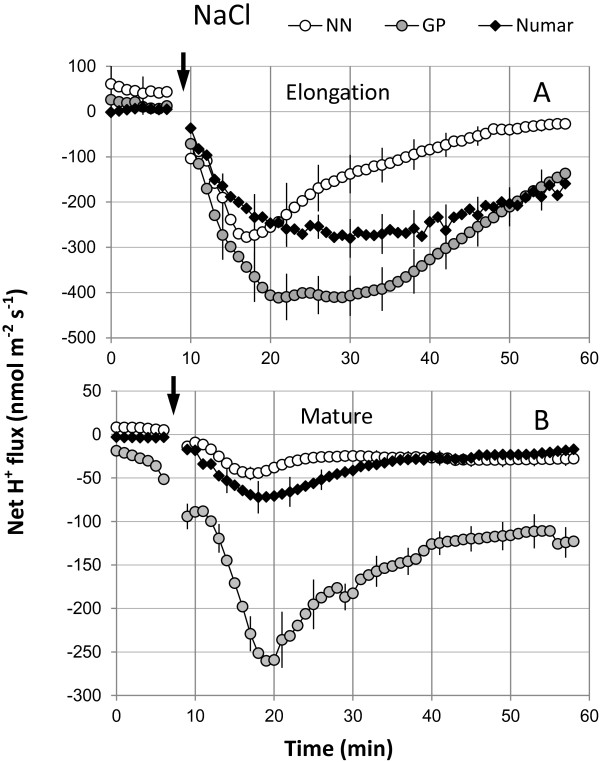
Kinetics of NaCl- induced net H+ fluxes measured from the elongation (A) and mature (B) root zones of three barley cultivars in response to 100 mM NaCl treatment. Mean ± SE (n = 6-8). The sign convention is “efflux negative”. The arrow indicates the application of the treatment.
Figure 6
Figure 6
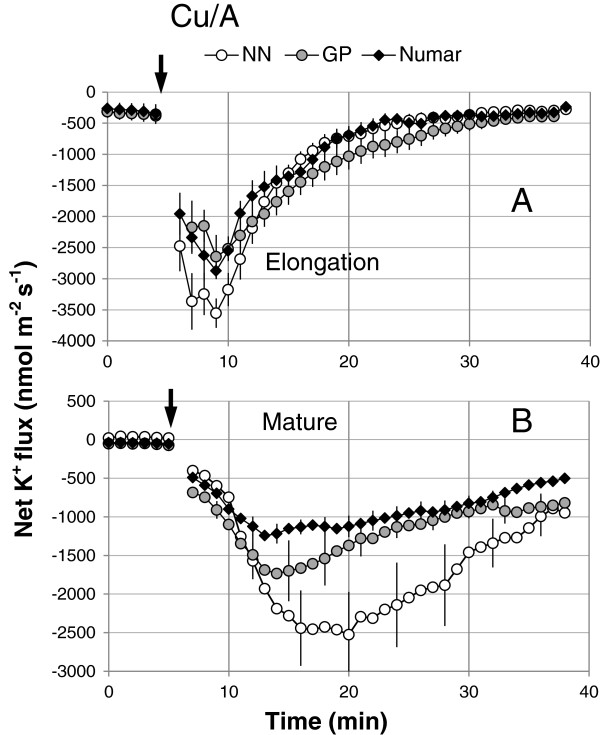
Hydroxyl radical-induced changes in net K+ flux measured from the elongation (A) and mature (B) root zones of three barley cultivars. The hydroxyl radical-generated copper ascorbate mix (0.3 mM CuCl2 and 1 mM Na+-Ascorbate) was added at the time indicated by an arrow. Mean ± SE (n = 6-8). The sign convention is “efflux negative”.
Figure 7
Figure 7
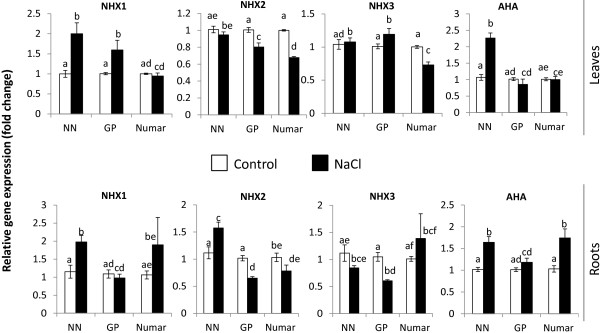
Expression of barley NHX1, NHX2, NHX3, and AHA2 transporter genes in leaf and root tissues after 48 h of 100 mM NaCl treatment. Mean ± SE (n = 12-15).
Figure 8
Figure 8
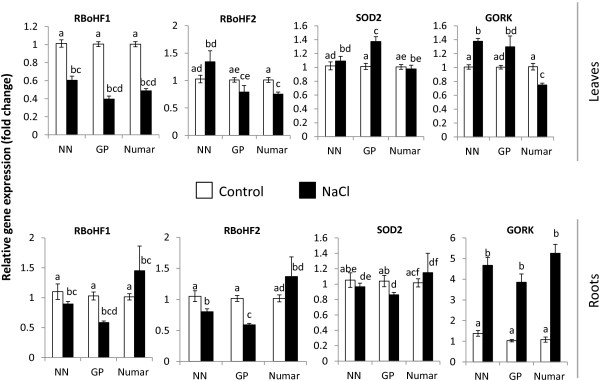
Expression of barley RBoHF1 (Respiratory oxidative burst homologue/NADPH oxidase), RBoHF2, SOD2 and GORK genes in leaf and root tissues after 48 h of 100 mM NaCl treatment. Mean ± SE (n = 12-15).

References

    1. Qadir M, Tubeileh A, Akhtar J, Larbi A, Minhas P, Khan M. Productivity enhancement of salt-affected environments through crop diversification. Land Degrad Dev. 2008;19:429–453. doi: 10.1002/ldr.853. - DOI
    1. Flowers T, Galal H, Bromham L. Evolution of halophytes: multiple origins of salt tolerance in land plants. Funct Plant Biol. 2010;37:604–612. doi: 10.1071/FP09269. - DOI
    1. Munns R, James RA, Xu B, Athman A, Conn SJ, Jordans C, Byrt CS, Hare RA, Tyerman SD, Tester M, Plett D, Gilliham M. Wheat grain yield on saline soils is improved by an ancestral Na + transporter gene. Nat Biotechnol. 2012;30(4):360–364. doi: 10.1038/nbt.2120. - DOI - PubMed
    1. Shabala S. Learning from halophytes:physiological basis and strategies to improve abiotic stress tolerance in crops. Ann Bot. 2013;112(7):1209–1221. doi: 10.1093/aob/mct205. - DOI - PMC - PubMed
    1. Zhu JK. Regulation of ion homeostasis under salt stress. Curr Opin Plant Biol. 2003;6(5):441–445. doi: 10.1016/S1369-5266(03)00085-2. - DOI - PubMed

Publication types

MeSH terms

LinkOut - more resources