. 2014 May 8;509(7499):245-248.
doi: 10.1038/nature13310. Epub 2014 Apr 30.

Signal amplification and transduction in phytochrome photosensors

Affiliations

Signal amplification and transduction in phytochrome photosensors

Heikki Takala et al. Nature. .

Abstract

Sensory proteins must relay structural signals from the sensory site over large distances to regulatory output domains. Phytochromes are a major family of red-light-sensing kinases that control diverse cellular functions in plants, bacteria and fungi. Bacterial phytochromes consist of a photosensory core and a carboxy-terminal regulatory domain. Structures of photosensory cores are reported in the resting state and conformational responses to light activation have been proposed in the vicinity of the chromophore. However, the structure of the signalling state and the mechanism of downstream signal relay through the photosensory core remain elusive. Here we report crystal and solution structures of the resting and activated states of the photosensory core of the bacteriophytochrome from Deinococcus radiodurans. The structures show an open and closed form of the dimeric protein for the activated and resting states, respectively. This nanometre-scale rearrangement is controlled by refolding of an evolutionarily conserved 'tongue', which is in contact with the chromophore. The findings reveal an unusual mechanism in which atomic-scale conformational changes around the chromophore are first amplified into an ångstrom-scale distance change in the tongue, and further grow into a nanometre-scale conformational signal. The structural mechanism is a blueprint for understanding how phytochromes connect to the cellular signalling network.


Figures
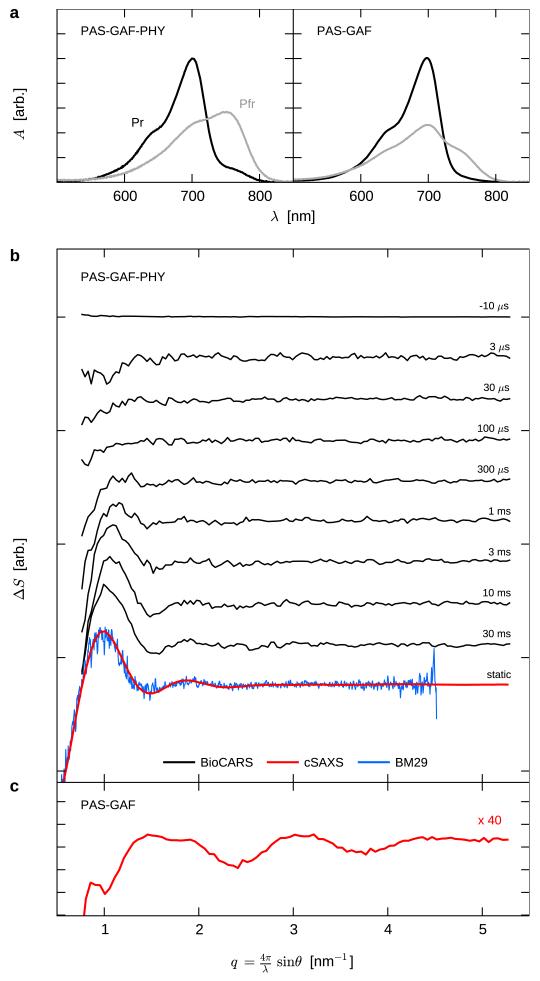
Figure 1
Figure 1. Time-resolved solution X-ray scattering of the PAS-GAF and PAS-GAF-PHY fragments from D. radiodurans
a, Absorption spectra of protein fragments after illumination with far-red (780 nm) and red (655 nm) light, labelled Pr and Pfr respectively. b and c, Solution X-ray scattering data from the PAS-GAF-PHY and PAS-GAF fragments shown on the same scale. Time-resolved data (black, BioCARS), direct static data collected by laser-induced population switching (red, cSAXS), and indirect static data from a standard SAXS experiment with pre-illuminated samples (blue, BM29) is shown. ΔS is the difference in scattered X-ray intensity caused by illumination at 671 nm. q = 4π/λ · sin θ at wavelength λ and scattering angle 2θ.
Figure 2
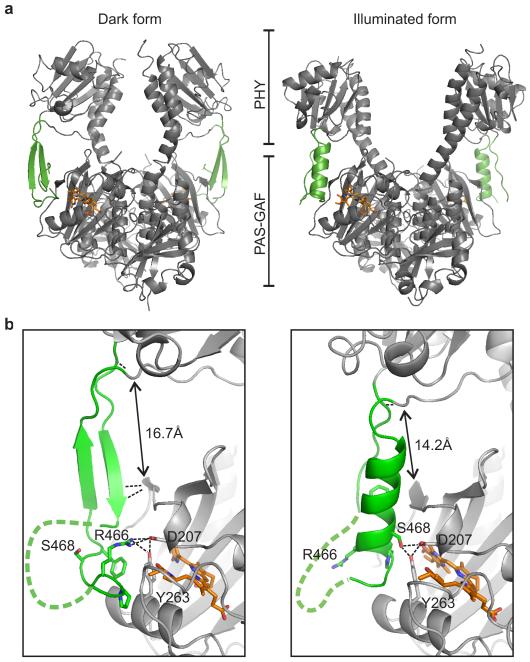
Figure 2. Dark and illuminated crystal structures of PAS-GAF-PHY from D. radiodurans
a, Crystal structures of the PAS-GAF-PHY dimer in the dark and illuminated forms. The tongue of the PHY domain (green) changes fold and the dimer opens up in the illuminated state. The biliverdin chromophore is shown in orange. b, Fold and interactions of the PHY tongue. The β-sheet (dark) coordinates to Asp207 and Tyr263 via Arg466, whereas the α-helix (illuminated) coordinates via Ser468, both of which are part of the conserved 465PRxSF469 motif. The named residues are shown as sticks. The β-sheet (dark) is further held by hydrogen bonding interactions between the amide groups of Ala450, Gly452 and Arg202. The change in PHY domain conformation leads to a shortening of the tongue by 2.5 Å as measured between GAF (Arg202) and PHY (Tyr479) domains (arrows). A backbone interaction close to the PHY domain between Leu445 and Tyr479, shared by both crystal structures, is also indicated. The green dashed lines indicate regions that are not modelled or not shown for clarity.
Figure 3
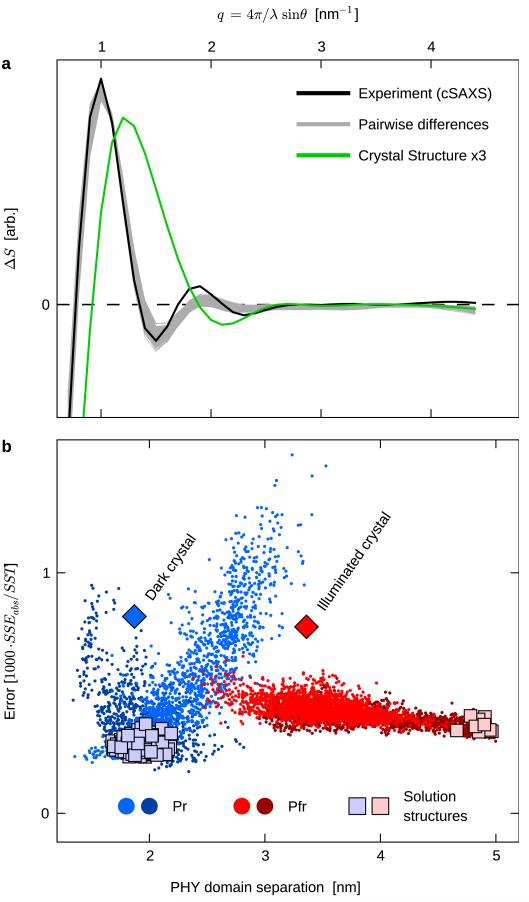
Figure 3. Refinement of solution structures against difference SAXS data
a, Calculated differences X-ray scattering between the proposed solution structures (Pfr-Pr, grey) agree with experimental data (black). As a safeguard against overfitting, the grey curves show all 747 differences between solution structures, not just the 100 best curves on which the pairs were selected (See text for details). The agreement with experiment is dramatically improved for the solution structures, compared to the difference scattering calculated from the two crystal forms (green). b, Validation of the obtained solution structures (squares) against absolute X-ray scattering. All MD snapshots (dots) and crystal structures (diamonds) are scored against absolute SAXS data (BM29) after correction for the mixed Pr/Pfr populations (see Extended Data Figure 5d). The two shades of red and blue correspond to different simulation conditions as detailed in Supplementary Information. The PHY domain separation is measured as the distance between the centers of mass of the two C-terminal helices (residues 484-503).
Figure 4
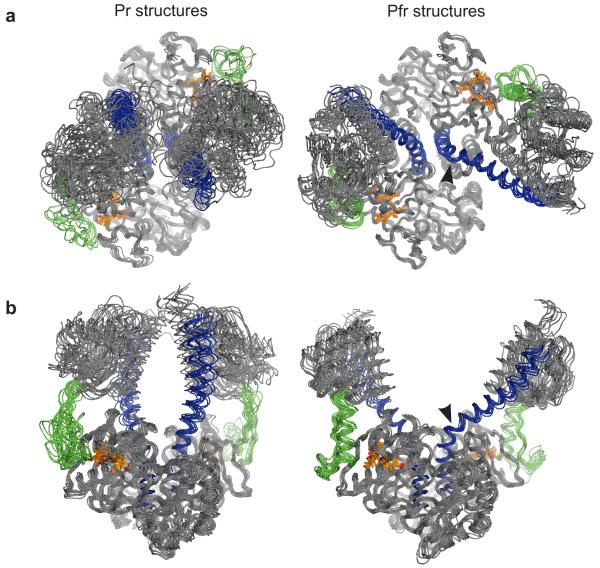
Figure 4. Proposed solution structures of the bacterial phytochrome from D. radiodurans
Representative solution structures for the Pr and Pfr states of the photosensory core, identified from solution X-ray scattering experiments. Nine Pfr and ten Pr structures are presented viewed along (a) and perpendicular (b) to the dimer symmetry axis. The long scaffolding helix is highlighted in blue, the PHY tongue in green, and the biliverdin chromophore in orange. The PHY domain separation differs by about 3 nm between the Pr and Pfr structures as shown in Figure 3b. The hinge region at the scaffolding helix (residues Val318 and Lys319) in Pfr is indicated with black arrowheads.

Comment in

References

    1. Butler WL, Norris KH, Siegelman HW, Hendricks SB. Detection, Assay, and Preliminary Purification of the Pigment Controlling Photoresponsive Development of Plants. Proc. Natl. Acad. Sci. U. S. A. 1959;45:1703–1708. doi:DOI 10.1073/pnas.45.12.1703. - PMC - PubMed
    1. Kehoe DM, Grossman AR. Similarity of a chromatic adaptation sensor to phytochrome and ethylene receptors. Science. 1996;273:1409–1412. doi:DOI 10.1126/science.273.5280.1409. - PubMed
    1. Yeh KC, Wu SH, Murphy JT, Lagarias JC. A cyanobacterial phytochrome two-component light sensory system. Science. 1997;277:1505–1508. doi:DOI 10.1126/science.277.5331.1505. - PubMed
    1. Yeh K-C, Lagarias JC. Eukaryotic phytochromes: Light-regulated serine/threonine protein kinases with histidine kinase ancestry. Proceedings of the National Academy of Sciences. 1998;95:13976–13981. doi:10.1073/pnas.95.23.13976. - PMC - PubMed
    1. Jiang ZY, et al. Bacterial photoreceptor with similarity to photoactive yellow protein and plant phytochromes. Science. 1999;285:406–409. doi:DOI 10.1126/science.285.5426.406. - PubMed

Extended Data References

    1. Sievers F, et al. Fast, scalable generation of high-quality protein multiple sequence alignments using Clustal Omega. Mol Syst Biol. 2011;7 doi: http://www.nature.com/msb/journal/v7/n1/suppinfo/msb201175_S1.html. - PMC - PubMed
    1. Wagner JR, Zhang JR, Brunzelle JS, Vierstra RD, Forest KT. High resolution structure of Deinococcus bacteriophytochrome yields new insights into phytochrome architecture and evolution. Journal of Biological Chemistry. 2007;282:12298–12309. doi:DOI 10.1074/jbc.M611824200. - PubMed
    1. Mailliet J, et al. Spectroscopy and a High-Resolution Crystal Structure of Tyr263 Mutants of Cyanobacterial Phytochrome Cph1. J. Mol. Biol. 2011;413:115–127. doi:DOI 10.1016/j.jmb.2011.08.023. - PubMed
    1. Konarev PV, Volkov VV, Sokolova AV, Koch MHJ, Svergun DI. PRIMUS: a Windows PC-based system for small-angle scattering data analysis. J Appl Crystallogr. 2003;36:1277–1282. doi:Doi 10.1107/S0021889803012779.
    1. Anders K, Daminelli-Widany, Mroginski MA, Von Stetten D, Essen LO. Structure of the cyanobacterial phytochrome 2 photosensor implies a tryptophan switch for phytochrome signaling. The Journal of Biological Chemistry. 2013 published online, doi:10.1074/jbc.M113.510461. - PMC - PubMed

Publication types

MeSH terms