. 2014 Jun 20;289(25):17564-75.
doi: 10.1074/jbc.M114.561589. Epub 2014 Apr 28.

Increased expression of colonic Wnt9A through Sp1-mediated transcriptional effects involving arylsulfatase B, chondroitin 4-sulfate, and galectin-3

Affiliations

Increased expression of colonic Wnt9A through Sp1-mediated transcriptional effects involving arylsulfatase B, chondroitin 4-sulfate, and galectin-3

Sumit Bhattacharyya et al. J Biol Chem. .

Abstract

In cultured human colonic epithelial cells and mouse colonic tissue, exposure to the common food additive carrageenan leads to inflammation, activation of Wnt signaling, increased Wnt9A expression, and decline in the activity of the enzyme arylsulfatase B (ARSB; N-acetylgalactosamine-4-sulfatase). In this study, the novel transcriptional mechanism by which carrageenan and decline in ARSB increase Wnt9A expression in NCM460 and HT-29 human colonic epithelial cells and in mouse colon is presented. Increased expression of Wnt9A has been associated with multiple malignancies, including colon carcinoma, and with ectodermal and mesoendodermal morphogenesis. When ARSB activity was reduced by siRNA or by exposure to carrageenan (1 μg/ml for 24 h), degradation of chondroitin 4-sulfate (C4S) was inhibited, leading to accumulation of more highly sulfated C4S, which binds less galectin-3, a β-galactoside-binding protein. Nuclear galectin-3 increased and mediated increased binding of Sp1 to the Sp1 consensus sequence in the Wnt9A promoter, shown by oligonucleotide-binding assay and by chromatin immunoprecipitation assay. When galectin-3 was silenced, the increases in Sp1 binding to the Wnt9A promoter and in Wnt9A expression, which followed carrageenan or ARSB silencing, were inhibited. Mithramycin A, a specific inhibitor of Sp1 oligonucleotide binding, and Sp1 siRNA blocked the carrageenan- and ARSB siRNA-induced increases in Wnt9A expression. These studies reveal how carrageenan exposure can lead to transcriptional events in colonic epithelial cells through decline in arylsulfatase B activity, with subsequent impact on C4S, galectin-3, Sp1, and Wnt9A and can exert significant effects on Wnt-initiated signaling and related vital cell processes.

Keywords: Animal Model; Cancer Biology; Carrageenan; Chondroitin Sulfate; Galectin; Specificity Protein 1 (Sp1); Wnt.


Figures

FIGURE 1.
FIGURE 1.
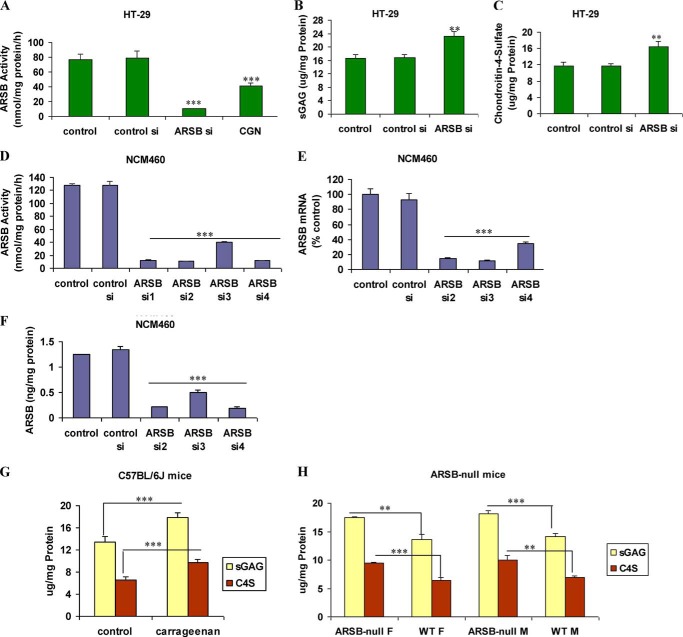
Impact of carrageenan on sulfated glycosaminoglycans and chondroitin 4-sulfate in HT-29 cells and in mouse models. A, ARSB activity was significantly inhibited by both ARSB siRNA and carrageenan exposure in the HT-29 cells (p < 0.001). B, consistent with the decline in ARSB, the total sulfated GAGs increased significantly following ARSB silencing (p < 0.01). C, the majority of the increase in the sulfated GAGs was attributable to the increase in C4S following ARSB silencing (p < 0.01). D, ARSB siRNA markedly reduced the ARSB activity in the NCM460 cells. E, ARSB protein was significantly reduced by ARSB siRNA in the NCM460 cells. F, QRT-PCR for ARSB demonstrated marked decline in ARSB mRNA expression following ARSB siRNA treatment. G, in the C57BL/6J mice exposed to carrageenan in their water supply, sulfated GAGs and C4S were significantly increased over the unexposed controls (p < 0.0001, unpaired t test, two-tailed). H, in both female and male ARSB-deficient mice, the total sulfated GAGs (p = 0.002 (female), p = 0.0012 (male), unpaired t test, two-tailed), and the C4S (p = 0.0009 (female), p = 0.0026 (male), unpaired t test, two-tailed) were significantly increased over the values in the control mice. sGAG, sulfated glycosaminoglycan; CGN, carrageenan; WT, wild-type; F, female; M, male; si, siRNA.
FIGURE 2.
FIGURE 2.
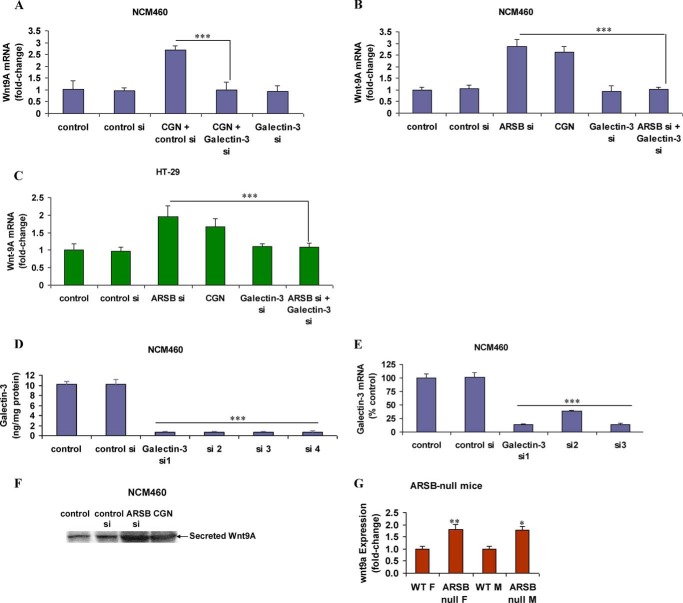
Increase in Wnt9A expression following ARSB silencing and carrageenan with inhibition by galectin-3 silencing. A, following carrageenan expression, the Wnt9A mRNA expression was significantly increased in the NCM460 cells and was inhibited by galectin-3 silencing (p < 0.001). B and C, in the NCM460 and HT-29 cells, galectin-3 silencing inhibited the ARSB siRNA-induced increase in Wnt9A expression (p < 0.001). ARSB silencing had a greater impact on Wnt9A expression than carrageenan, consistent with their effects on ARSB activity and expression. D, galectin-3 ELISA demonstrated the effectiveness of galectin-3 silencing by siRNA in the NCM460 cells. E, QRT-PCR for galectin-3 following silencing indicated marked decline in mRNA expression in the NCM460 cells. F, Western blot demonstrated increase in secreted Wnt9A following carrageenan exposure and ARSB silencing in the NCM460 cells. G, Wnt9A expression was increased in the female and male ARSB-deficient mice, compared with ARSB female and male wild-type mice (p = 0.009 and p = 0.03, respectively, unpaired t test, two-tailed). ***, p < 0.001, **, p < 0.01, and *, p < 0.05. ARSB, arylsulfatase B; CGN, carrageenan; si, siRNA; WT, wild-type; F, female; M, male.
FIGURE 3.
FIGURE 3.
ARSB decline and corresponding increase in C4S mediate decline in galectin-3 that co-immunoprecipitates with C4S and increase in nuclear galectin-3. A and B, after carrageenan exposure or ARSB silencing, the galectin-3 that co-immunoprecipitated with C4S declined significantly in the NCM460 cells and in the HT-29 cells (p < 0.001). C and D, following carrageenan exposure or ARSB silencing, the nuclear galectin-3 was significantly increased in the NCM460 and HT-29 cells (p < 0.001) compared with controls. In the HT-29 cells, the increase following ARSB silencing by siRNA was significantly greater (p < 0.01) than the increase following carrageenan. E, following carrageenan ingestion, the colonic nuclear galectin-3 increased significantly (p < 0.001) over the value in the control C57BL/6J mice. F, in the ARSB-deficient mice (male and female), the nuclear galectin-3 was significantly higher than in the wild-type mice (p < 0.001). CGN, carrageenan; WT, wild-type; F, female; M, male. ***, p < 0.001.
FIGURE 4.
FIGURE 4.
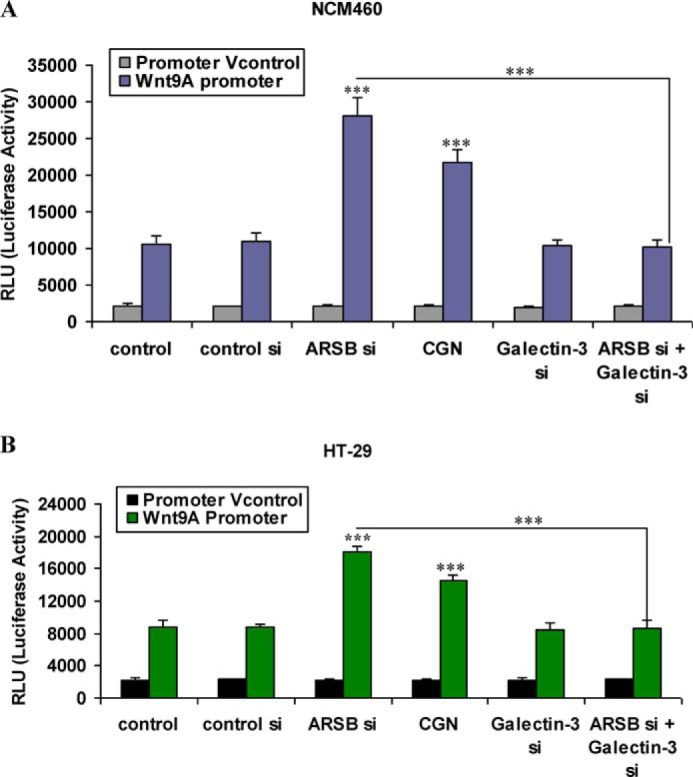
Carrageenan exposure or ARSB silencing increase Wnt9A promoter activity, and galectin-3 silencing inhibits the increase in Wnt9A promoter activity. A and B, Renilla luciferase assay showed significant increase in activation following carrageenan exposure or ARSB silencing. These increases were inhibited when galectin-3 was silenced in the NCM460 and HT-29 cells (p < 0.001). The increase following carrageenan was significantly less than from ARSB siRNA. CGN, carrageenan; RLU, relative luciferase unit; si, siRNA; Vcontrol, vector control.
FIGURE 5.
FIGURE 5.
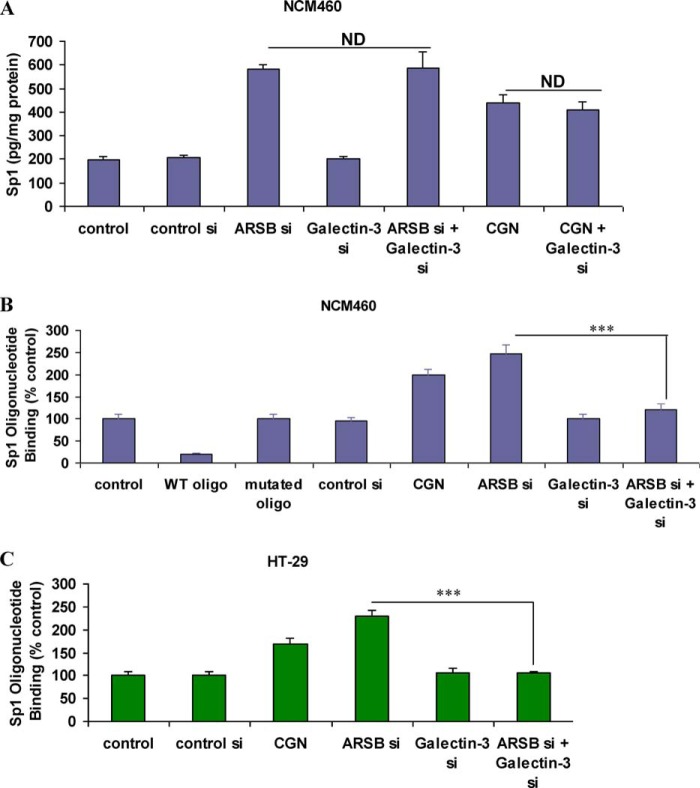
Nuclear Sp1 and Sp1 oligonucleotide binding increased following carrageenan and ARSB silencing. A, in the NCM460 cells, nuclear Sp1 was significantly increased following exposure to carrageenan or ARSB silencing by siRNA (p < 0.001). Galectin-3 silencing did not inhibit the increase in the nuclear Sp1. ARSB silencing produced greater increase in nuclear Sp1 than carrageenan exposure (p < 0.01; 2.98 times control versus 2.26 times control). B, in NCM460 cells, oligonucleotide binding assay demonstrated an increase in Sp1 binding to the Sp1 oligonucleotide consensus sequence following ARSB silencing (p < 0.001). This increase was inhibited when galectin-3 was silenced. Addition of exogenous Sp1 wild-type consensus oligonucleotide completely inhibited the nuclear Sp1 binding as detected by Sp1 antibody. Baseline binding was unaffected by addition of mutated Sp1 consensus oligonucleotide. C, In HT-29 cells, oligonucleotide binding assay indicated an increase in Sp1 binding to the Sp1 oligonucleotide consensus sequence following ARSB silencing (p < 0.001) and inhibition when galectin-3 was silenced. CGN, carrageenan; oligo, oligonucleotide; si, siRNA; WT, wild-type; ND, no difference.
FIGURE 6.
FIGURE 6.
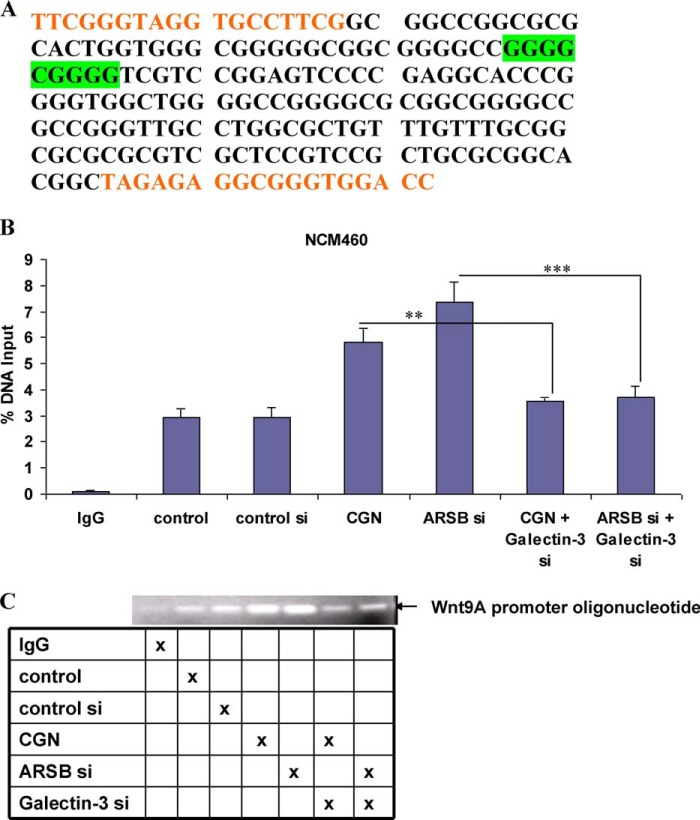
Chromatin immunoprecipitation demonstrates increase in Sp1 binding to the Wnt9A promoter following carrageenan and ARSB silencing and inhibition of the increases when galectin-3 is silenced. A, consensus oligonucleotide sequence for Sp1 in the Wnt9A promoter is highlighted in green. The primers used to amplify this region are in orange type. B, ChIP assay showed significant increases in the measured RT-PCR product following carrageenan or ARSB silencing (p < 0.001). These increases were inhibited when galectin-3 was silenced in the NCM460 cells. C, the agarose gel confirms the increases as measured above by RT-PCR in the Sp1 binding to the Wnt9A promoter oligonucleotide with the targeted Sp1 binding site (as indicated in A) following ARSB silencing or carrageenan exposure, and the inhibition of these increases by galectin-3 silencing. CGN, carrageenan; si, siRNA.
FIGURE 7.
FIGURE 7.
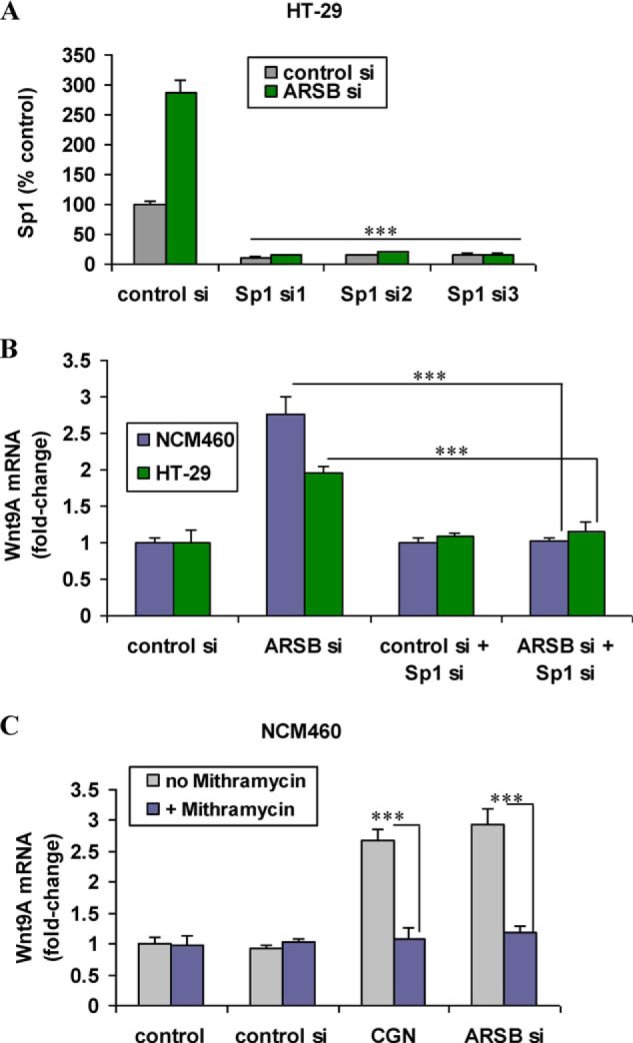
Sp1 siRNA and mithramycin A inhibit the effect of carrageenan and of ARSB silencing on Wnt9A expression in the colonic epithelial cells. A, Sp1 siRNA effectively inhibited expression of Sp1 in HT-29 cells. B, Sp1 siRNA suppressed mRNA expression of Wnt9A in the HT-29 and NCM460 cells. The mRNA expression of Wnt9A was similar in the control and with the combination of ARSB silencing and Sp1 silencing. C, when NCM460 cells were exposed to mithramycin A, a specific inhibitor of Sp1 oligonucleotide binding, the increases in Wnt9A expression that followed carrageenan exposure or ARSB silencing were inhibited (p < 0.001). CGN, carrageenan; si, siRNA.

References

    1. Clevers H. (2006) Wnt/β-catenin signaling in development and disease. Cell 127, 469–480 - PubMed
    1. Reya T., Clevers H. (2005) Wnt signaling in stem cells and cancer. Nature 434, 843–850 - PubMed
    1. Bhattacharyya S., Feferman L., Borthakur S., Tobacman J. K. (2014) Common food additive carrageenan stimulates Wnt/β-catenin signaling in colonic epithelium by inhibition of nucleoredoxin reduction. Nutr. Cancer 66, 117–127 - PubMed
    1. Funato Y., Miki H. (2010) Redox regulation of Wnt signaling via nucleoredoxin. Free Radic. Res. 44, 379–388 - PubMed
    1. Schwarz-Romond T., Fiedler M., Shibata N., Butler P. J., Kikuchi A., Higuchi Y, Bienz M. (2007) The DIX domain of Dishevelled confers Wnt signaling by dynamic polymerization. Nat. Struct. Mol. Biol. 14, 484–492 - PubMed

MeSH terms

LinkOut - more resources