Incidence of and risk factors for hospital-acquired diarrhea in three tertiary care public hospitals in Bangladesh
- PMID: 24778198
- PMCID: PMC4080557
- DOI: 10.4269/ajtmh.13-0484
Incidence of and risk factors for hospital-acquired diarrhea in three tertiary care public hospitals in Bangladesh
Abstract
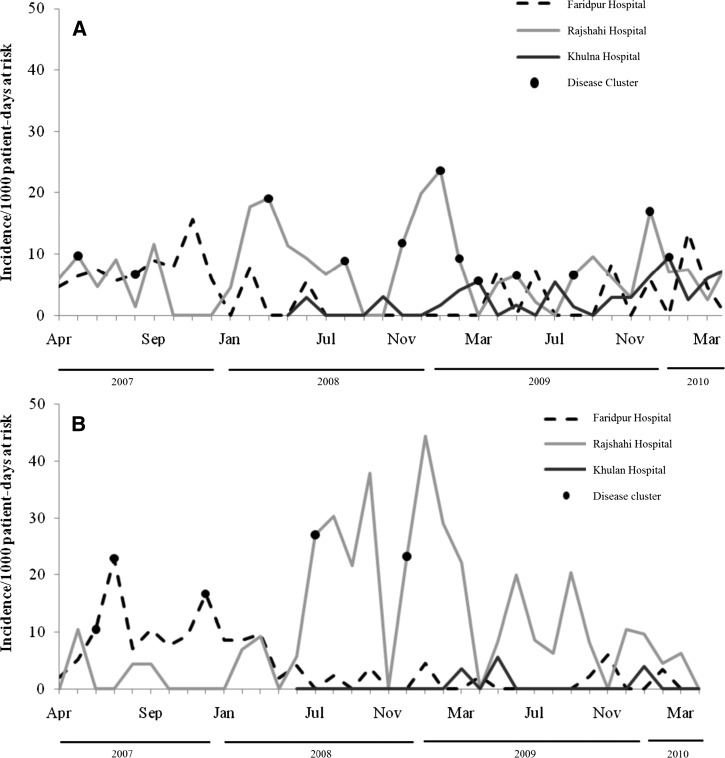
During April 2007-April 2010, surveillance physicians in adult and pediatric medicine wards of three tertiary public hospitals in Bangladesh identified patients who developed hospital-acquired diarrhea. We calculated incidence of hospital-acquired diarrhea. To identify risk factors, we compared these patients to randomly selected patients from the same wards who were admitted > 72 hours without having diarrhea. The incidence of hospital-acquired diarrhea was 4.8 cases per 1,000 patient-days. Children < 1 year of age were more likely to develop hospital-acquired diarrhea than older children. The risk of developing hospital-acquired diarrhea increased for each additional day of hospitalization beyond 72 hours, whereas exposure to antibiotics within 72 hours of admission decreased the risk. There were three deaths among case-patients; all were infants. Patients, particularly young children, are at risk for hospital-acquired diarrhea and associated deaths in Bangladeshi hospitals. Further research to identify the responsible organisms and transmission routes could inform prevention strategies.
© The American Society of Tropical Medicine and Hygiene.
Conflict of interest statement
Disclosure: None of the authors have any conflicts of interest.
Figures
References
-
- Bennet R, Hedlund KO, Ehrnst A, Eriksson M. Nosocomial gastroenteritis in two infant wards over 26 months. Acta Paediatr. 1995;84:667–671. - PubMed
-
- Dutta P, Mitra U, Rasaily R, Bhattacharya SK, De SP, Sen D, Saha MR, Nair GB, Niyogi SK, Das P. Prospective study of nosocomial enteric infections in a pediatric hospital, Calcutta. Indian Pediatr. 1993;30:187–194. - PubMed
-
- Garcia C, Samalvides F, Vidal M, Gotuzzo E, Dupont HL. Epidemiology of Clostridium difficile-associated diarrhea in a Peruvian tertiary care hospital. Am J Trop Med Hyg. 2007;77:802–805. - PubMed
-
- Kamalaratnam CN, Kang G, Kirubakaran C, Rajan DP, Daniel DJ, Mathan MM, Mathan VI. A prospective study of nosocomial enteric pathogen acquisition in hospitalized children in South India. J Trop Pediatr. 2001;47:46–49. - PubMed
Publication types
MeSH terms
Grants and funding
LinkOut - more resources
Full Text Sources
Other Literature Sources
Medical
Miscellaneous