Comparative evaluation of immunohistochemistry, histopathology and conventional radiography in differentiating periapical lesions
- PMID: 24778515
- PMCID: PMC4001275
- DOI: 10.4103/0972-0707.128061
Comparative evaluation of immunohistochemistry, histopathology and conventional radiography in differentiating periapical lesions
Abstract
Background and aim: Periapical lesions often present differently on the radiograph resulting in a dilemma in the mind of the dentist to arrive at a final diagnosis. Although, histopathologic diagnosis has been used for confirmation of the true nature of periapical lesion, the concept of transformation of periapical granulomas containing epithelium without cystification into cyst remains controversial. The aim of this in vivo study was to evaluate the efficacy of conventional radiography and histopathology in differentiating periapical lesions in adjunct with immunohistochemical analysis.
Aim: Periapical lesions often present differently on the radiograph resulting in a dilemma in the mind of the dentist to arrive at a final diagnosis. Although, histopathologic diagnosis has been used for confirmation of the true nature of periapical lesion, the concept of transformation of periapical granulomas containing epithelium without cystification into cyst remains controversial. The aim of this in vivo study was to evaluate the efficacy of conventional radiography and histopathology in differentiating periapical lesions in adjunct with immunohistochemical analysis.
Materials and method: Thirty patients having large periapical radiolucency that do not heal successfully with routine endodontic therapy in relation to either maxillary or mandibular anterior teeth were selected for the study. Intraoral periapical radiographs were obtained and provisional diagnosis of the apical areas were made. Endodontic surgery was performed to enable histopathogical investigation. The histopathological interpretation was done to arrive at a final diagnosis and selected questionable granulomas were subjected for cytokeratin (CK-14) stain.
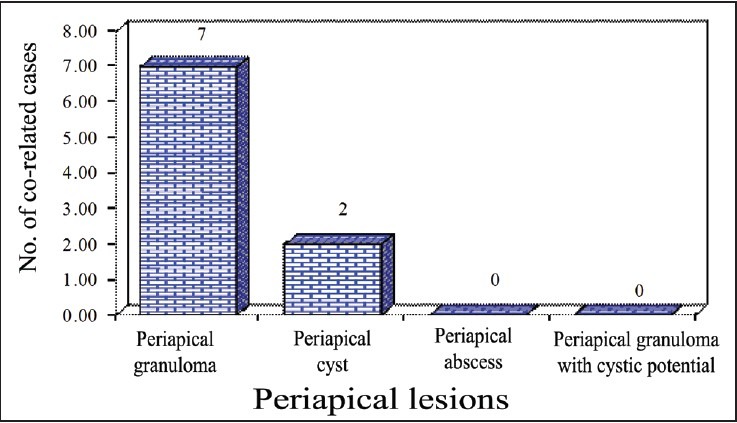
Results: The histopathological profile of lesions consisted of 66.66% periapical granulomas, 10% cysts, 6.67% abscess and 16.67% granulomas with cystic potential. The radiographic and histopathologic correlation was found in only 30% of these cases. Strong CK-14 expression was observed in all five cases of periapical granuloma with cystic potential.
Conclusion: The radiographic diagnosis of periapical lesions remains inconclusive. Although histopathologic examination of periapical lesions gives true nature, the precise nature of subsets of periapical granulomas may be achieved with adjunct use of immunohistochemical markers.
Keywords: Conventional radiography; Cytokeratin-14; Periapical lesions.
Conflict of interest statement
Figures


References
-
- Cohen S, Hargreaves KM. Pathways of the pulp. 9th ed. Mosby: Elsevier; 2006. p. 543.
-
- Gundappa M, Ng SY, Whaites EJ. Comparison of ultrasound, digital and conventional radiography in differentiating periapical lesions. Dentomaxillofac Radiol. 2006;35:326–33. - PubMed
-
- Ramachandran Nair PN. Light and electron microscopic studies of root canal flora and periapical lesions. J Endod. 1987;13:29–39. - PubMed
-
- Block RM, Bushell A, Rodrigeus H, Langeland K. A histopathologic, histobacteriologic, and radiographic study of periapical endodontic surgical specimens. J Endod. 1976;12:656–78. - PubMed
-
- Langeland K, Block RM, Va R, Grossman LI. A histopathological and histobacteriologic study of 35 periapical endodontic surgical specimens. J Endod. 1977;3:8–23. - PubMed
LinkOut - more resources
Full Text Sources
Other Literature Sources
Research Materials