


Secretion of bacterial lipoproteins: through the cytoplasmic membrane, the periplasm and beyond
- PMID: 24780125
- PMCID: PMC4070597
- DOI: 10.1016/j.bbamcr.2014.04.022
Secretion of bacterial lipoproteins: through the cytoplasmic membrane, the periplasm and beyond
Abstract
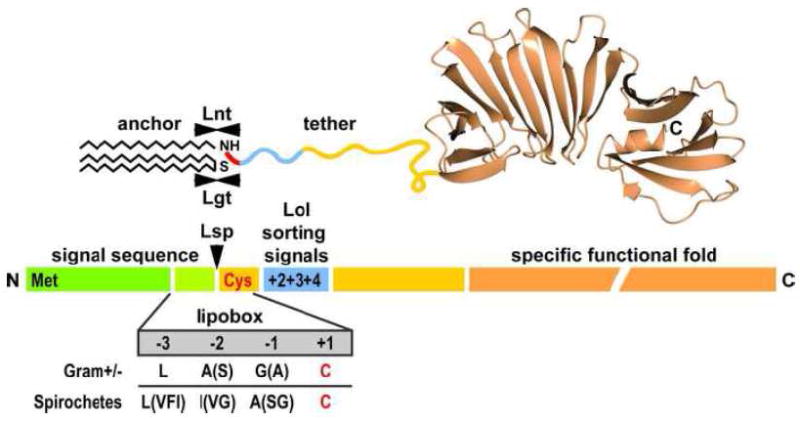
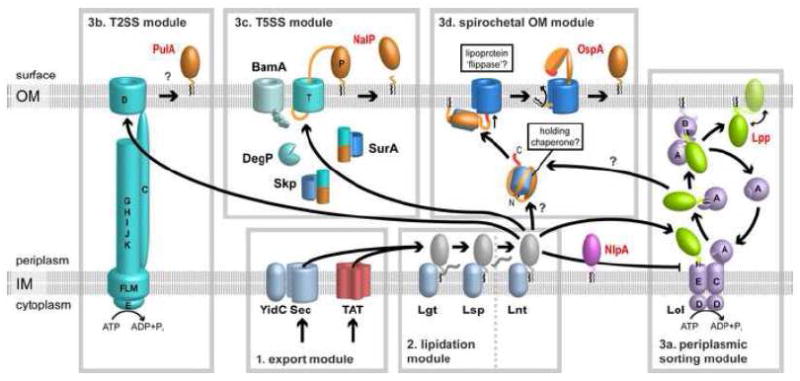
Bacterial lipoproteins are peripherally anchored membrane proteins that play a variety of roles in bacterial physiology and virulence in monoderm (single membrane-enveloped, e.g., gram-positive) and diderm (double membrane-enveloped, e.g., gram-negative) bacteria. After export of prolipoproteins through the cytoplasmic membrane, which occurs predominantly but not exclusively via the general secretory or Sec pathway, the proteins are lipid-modified at the cytoplasmic membrane in a multistep process that involves sequential modification of a cysteine residue and cleavage of the signal peptide by the signal II peptidase Lsp. In both monoderms and diderms, signal peptide processing is preceded by acylation with a diacylglycerol through preprolipoprotein diacylglycerol transferase (Lgt). In diderms but also some monoderms, lipoproteins are further modified with a third acyl chain through lipoprotein N-acyl transferase (Lnt). Fully modified lipoproteins that are destined to be anchored in the inner leaflet of the outer membrane (OM) are selected, transported and inserted by the Lol (lipoprotein outer membrane localization) pathway machinery, which consists of the inner-membrane (IM) ABC transporter-like LolCDE complex, the periplasmic LolA chaperone and the OM LolB lipoprotein receptor. Retention of lipoproteins in the cytoplasmic membrane results from Lol avoidance signals that were originally described as the "+2 rule". Surface localization of lipoproteins in diderms is rare in most bacteria, with the exception of several spirochetal species. Type 2 (T2SS) and type 5 (T5SS) secretion systems are involved in secretion of specific surface lipoproteins of γ-proteobacteria. In the model spirochete Borrelia burgdorferi, surface lipoprotein secretion does not follow established sorting rules, but remains dependent on N-terminal peptide sequences. Secretion through the outer membrane requires maintenance of lipoproteins in a translocation-competent unfolded conformation, likely through interaction with a periplasmic holding chaperone, which delivers the proteins to an outer membrane lipoprotein flippase. This article is part of a Special Issue entitled: Protein trafficking and secretion in bacteria. Guest Editors: Anastassios Economou and Ross Dalbey.
Keywords: Bacterial envelope; Chaperone; Lipoprotein; Membrane protein; Postranslational modification; Protein secretion.
Copyright © 2014 Elsevier B.V. All rights reserved.
Figures
References
-
- Braun V, Rehn K. Chemical characterization, spatial distribution and function of a lipoprotein (murein-lipoprotein) of the E. coli cell wall. The specific effect of trypsin on the membrane structure. Eur J Biochem. 1969;10:426–438. - PubMed
-
- Hantke K, Braun V. Covalent binding of lipid to protein. Diglyceride and amidelinked fatty acid at the N-terminal end of the murein-lipoprotein of the Escherichia coli outer membrane. Eur J Biochem. 1973;34:284–296. - PubMed
-
- von Heijne G. The structure of signal peptides from bacterial lipoproteins. Protein Eng. 1989;2:531–534. - PubMed
-
- Sankaran K, Wu HC. Bacterial lipoproteins. In: Schlesinger MJ, editor. Lipid Modifications of Proteins. CRC Press; Boca Raton: 1993. pp. 163–181.
Publication types
MeSH terms
Substances
Grants and funding
LinkOut - more resources
Full Text Sources
Other Literature Sources
