


The magnitude of nocebo effects in pain: a meta-analysis
- PMID: 24780622
- PMCID: PMC4213146
- DOI: 10.1016/j.pain.2014.04.016
The magnitude of nocebo effects in pain: a meta-analysis
Abstract
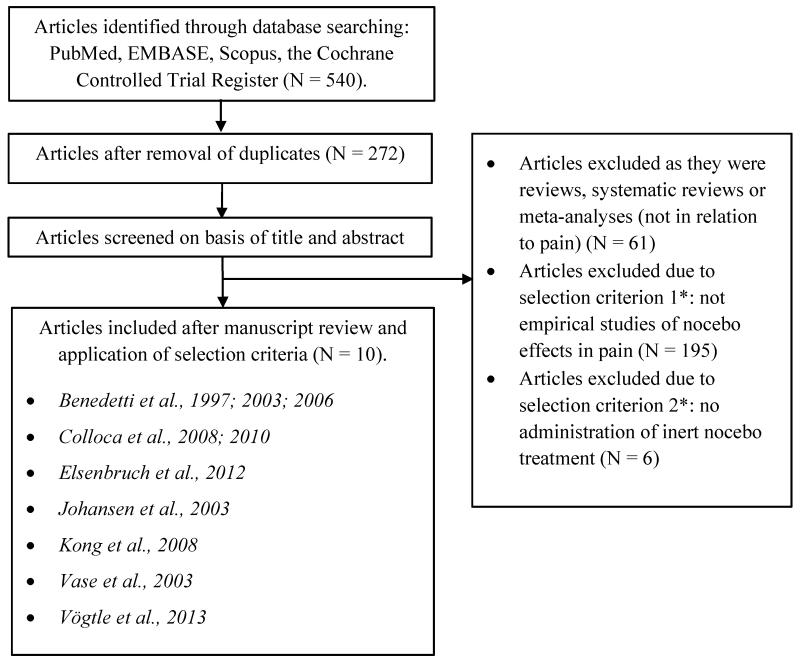
The investigation of nocebo effects is evolving, and a few literature reviews have emerged, although so far without quantifying such effects. This meta-analysis investigated nocebo effects in pain. We searched the databases PubMed, EMBASE, Scopus, and the Cochrane Controlled Trial Register with the term "nocebo." Only studies that investigated nocebo effects as the effects that followed the administration of an inert treatment along with verbal suggestions of symptom worsening and that included a no-treatment control condition were eligible. Ten studies fulfilled the selection criteria. The effect sizes were calculated using Cohen's d and Hedges' g. The overall magnitude of the nocebo effect was moderate to large (lowest g=0.62 [0.24-1.01] and highest g=1.03 [0.63-1.43]) and highly variable (range of g=-0.43 to 4.05). The magnitudes and range of effect sizes was similar to those of placebo effects (d=0.81) in mechanistic studies. In studies in which nocebo effects were induced by a combination of verbal suggestions and conditioning, the effect size was larger (lowest g=0.76 [0.39-1.14] and highest g=1.17 [0.52-1.81]) than in studies in which nocebo effects were induced by verbal suggestions alone (lowest g=0.64 [-0.25 to 1.53] and highest g=0.87 [0.40-1.34]). These findings are similar to those in the placebo literature. As the magnitude of the nocebo effect is variable and sometimes large, this meta-analysis demonstrates the importance of minimizing nocebo effects in clinical practice.
Keywords: Conditioning; Magnitude; Nocebo; Pain; Placebo; Verbal suggestion.
Copyright © 2014 International Association for the Study of Pain. Published by Elsevier B.V. All rights reserved.
Figures
Comment in
-
The nocebo effect might affect treatment expectations in patients with burning mouth syndrome.Pain. 2015 Feb;156(2):356. doi: 10.1097/01.j.pain.0000460317.65734.e4. Pain. 2015. PMID: 25599458 No abstract available.
References
-
- Amanzio M. Do we need a new procedure for the assessment of adverse events in anti-migraine clinical trials. Recent Pat CNS Drug Disc. 2011;6:41–7. - PubMed
-
- Amanzio M, Corazzini LL, Vase L, Benedetti F. A systematic review of adverse effects in placebo groups of anti-migraine clinical trials. Pain. 2009;146:261–9. - PubMed
-
- Barsky AJ, Saintfort R, Rogers MP, Borus JF. Nonspecific medication side effects and the nocebo phenomenon. JAMA. 2002;287:622–7. - PubMed
-
- Beecher HK. The powerful placebo. J Am Med Assoc. 1955;159(17):1602–6. - PubMed
-
- Beedie CJ, Coleman DA, Foad AJ. Positive and negative placebo effects resulting from the deceptive administration of an ergogenic aid. Int J Sport Nutr Exerc Metab. 2007;17(3):259–69. - PubMed
Publication types
MeSH terms
Grants and funding
LinkOut - more resources
Full Text Sources
Other Literature Sources
Medical
Research Materials
