


Psychological associations of poststroke fatigue: a systematic review and meta-analysis
- PMID: 24781083
- PMCID: PMC4928705
- DOI: 10.1161/STROKEAHA.113.004584
Psychological associations of poststroke fatigue: a systematic review and meta-analysis
Abstract
Background and purpose: Fatigue is common after stroke but has no effective treatments. Psychological interventions improve fatigue in other conditions by targeting psychological factors such as mood. If psychological factors correlate with fatigue in stroke, this would justify the development of similar interventions for poststroke fatigue (PSF). We used systematic review and meta-analysis to determine psychological associations of PSF.
Methods: We systematically searched for studies that reported psychological associations of PSF. We used odds ratios (ORs) to estimate the strength of associations and random-effects modeling to calculate summary estimates of ORs. We used stratified meta-analysis to investigate the impact of study design and conducted sensitivity analyses limited to studies that excluded patients with clinical depression and to studies that used depression scales without fatigue items.
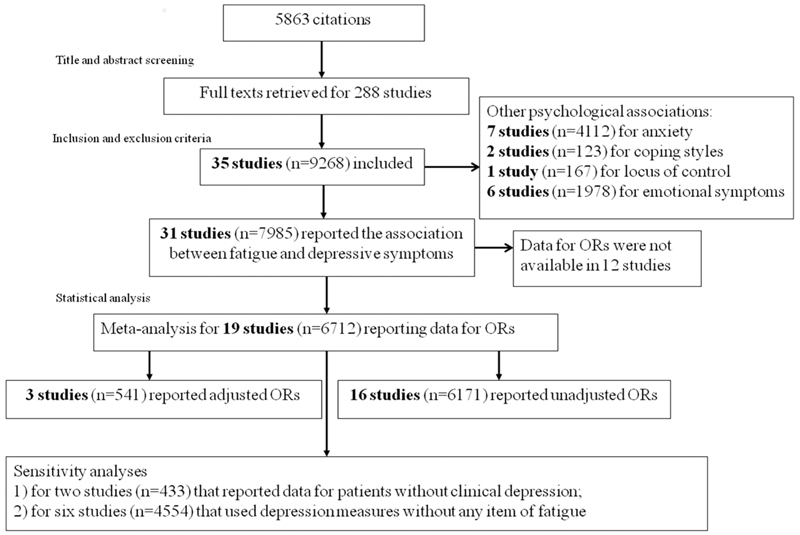
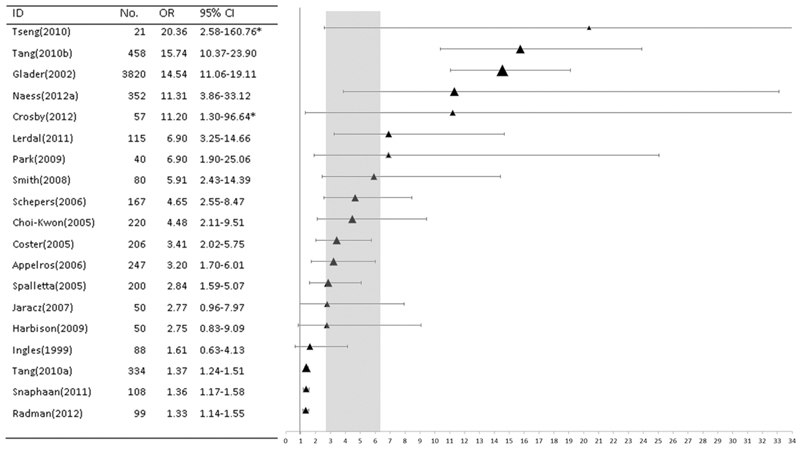
Results: Thirty-five studies (n=9268) reported the association between PSF and ≥1 psychological factor. For PSF and depressive symptoms, we identified 19 studies (n=6712; pooled OR=4.14; 95% confidence interval, 2.73-6.27); this association existed in patients without clinical depression (pooled OR=1.39; 95% confidence interval, 1.27-1.53) and in studies using depression scales without fatigue items (pooled OR=5.41; 95% confidence interval, 1.54-18.93). For PSF and anxiety, we identified 4 studies (n=3884; pooled OR=2.34; 95% confidence interval, 0.98-5.58). Two studies (n=123) found an association with poor coping styles and 1 study (n=167) with loss of control. Six studies (n=1978) reported other emotional or behavioral associations.
Conclusions: PSF is associated with depressive symptoms, anxiety, poor coping, loss of control, emotional, and behavioral symptoms. These factors are potential targets for treatment of PSF.
Keywords: behavior; fatigue; rehabilitation; stroke.
© 2014 American Heart Association, Inc.
Conflict of interest statement
None.
Figures
References
-
- Lerdal A, Bakken LN, Kouwenhoven SE, Pedersen G, Kirkevold M, Finset A, et al. Poststroke fatigue–a review. J Pain Symptom Manage. 2009;38:928–949. - PubMed
-
- McGeough E, Pollock A, Smith LN, Dennis M, Sharpe M, Lewis S, et al. Interventions for post-stroke fatigue. Cochrane Database Syst Rev. 2009:CD007030. - PubMed
-
- Annoni JM, Staub F, Bogousslavsky J, Brioschi A. Frequency, characterisation and therapies of fatigue after stroke. Neurol Sci. 2008;29(suppl 2):S244–S246. - PubMed
-
- Barker-Collo S, Feigin VL, Dudley M. Post stroke fatigue–where is the evidence to guide practice? N Z Med J. 2007;120:U2780. - PubMed
Publication types
MeSH terms
Grants and funding
LinkOut - more resources
Full Text Sources
Other Literature Sources
Medical
