


Review
doi: 10.3389/fmicb.2014.00126.
eCollection 2014.
New insights into an X-traordinary viral protein
Affiliations
- PMID: 24782834
- PMCID: PMC3986551
- DOI: 10.3389/fmicb.2014.00126
Item in Clipboard
Review
New insights into an X-traordinary viral protein
Front Microbiol.
.
Abstract
Vpx is a protein encoded by members of the HIV-2/SIVsmm and SIVrcm/SIVmnd-2 lineages of primate lentiviruses, and is packaged into viral particles. Vpx plays a critical role during the early steps of the viral life cycle and has been shown to counteract SAMHD1, a restriction factor in myeloid and resting T cells. However, it is becoming evident that Vpx is a multifunctional protein in that SAMHD1 antagonism is likely not its sole role. This review summarizes the current knowledge on this X-traordinary protein.
Keywords: HIV-1; HIV-2; SAMHD1; SIVsmm; interferon type I; myeloid cells; restriction factor; vpx.
Figures
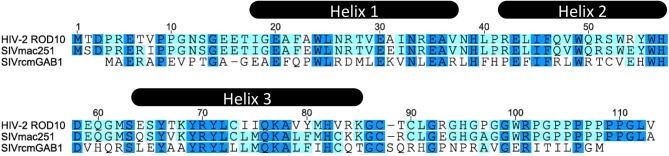
HIV-2 ROD, SIVmac, and SIVrcm Vpx aminoacid sequence alignment.
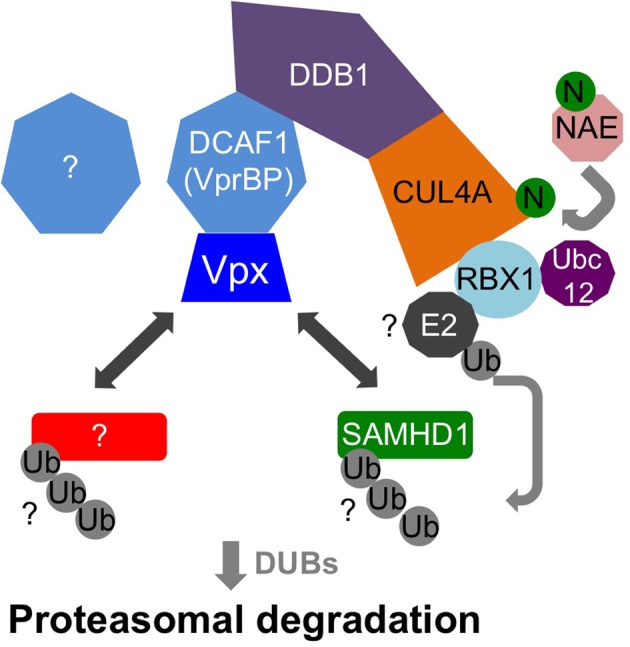
Model of DCAF1-DDB1-CUL4A recruitment by Vpx. Vpx hijacks the DDB1-CUL4A-RBX1 E3 ubiquitin ligase complex through recruitment of DCAF1 (also known as VprBP). Vpx targets (i.e., SAMHD1 and possibly unknown proteins) are ubiquitinated through the activity of RBX1 and an E2 ligase that interacts with RBX1. In addition, RBX1 interacts with the ubiquitin-conjugating enzyme UBC12, which is important for neddylation of CUL4A through transfer of the NEDD8 group from NEDD8 activating enzyme (NAE).
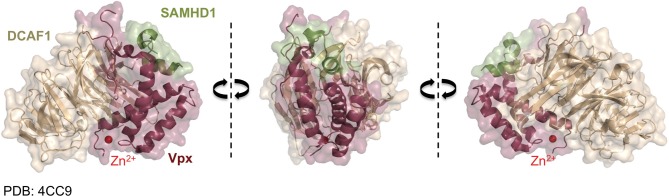
Vpx/SAMHD1 CtD/DCAF1 CtD complex structure. Shown is the co-crystal structure of DCAF1 CtD (brown) with SAMHD1 CtD (green) in complex with Vpx from SIVsmm (dark red) (Schwefel et al., 2014) (PDB:4CC9) from three different sites. The zinc ion coordinated by Vpx is shown in red.
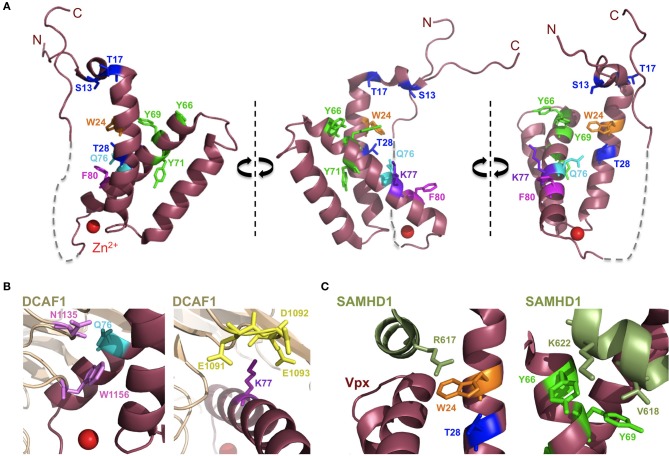
Vpx structure. (A) Depicted is the structure of Vpx from SIVsmm as obtained in the co-crystallization with the C-terminus of DCAF1 and the C-terminus of SAMHD1 (both not shown) with critical amino acids highlighted (PDB:4CC9) (Schwefel et al., 2014). SIVsmm Vpx comprises an anti-parallel bundle of three helices, resembling the shape of a V. Vpx coordinates a zinc ion (red) with amino acids H39, H82, C87, and C89. The structure between Vpx residues 90–100 is absent (dashed gray line). (B) Critical aminoacid residues in the interface between DCAF1 and Vpx are highlighted. Vpx Q76 residue (cyan) may form hydrogen bonds with N1135 and W1156 residues (lilac) of DCAF1. The acidic region in DCAF1 comprising E1091, D1092 and E1093 residues (yellow) may interact with positively charged K77 residue (purple) of Vpx. (C) Critical amino acid residues for the interaction of SAMHD1 and Vpx are highlighted. SAMHD1 R617 residue (light green) stacks with the indole ring of Vpx W24 residue (orange). Vpx Y66 and Y69 residues (fluorescent green) are in close proximity to SAMHD1 K622 and V618 residues (light green), the latter being positively selected (Laguette et al., 2012).
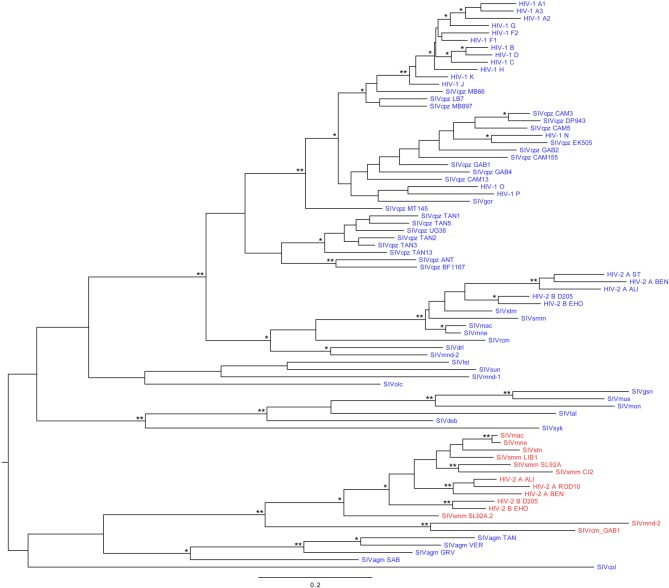
Maximum likelihood phylogeny of primate lentiviruses vpr and vpx genes. vpr are represented in blue and vpx in red. Branch lengths represent nucleotide substitutions per site, as indicated in the scale. Branch supports are indicated by one asterisk (≥90% confidence) or two asterisks (≥99%). The tree was rooted using the midpoint rooting method. Abbreviations: HIV, human immunodeficiency virus; SIV, simian immunodeficiency virus; cpz, chimpanzee (Pan troglodytes); gor, gorilla (Gorilla gorilla); stm, stump-tailed macaque (Macaca arctoides); smm, sooty mangabey monkey (Cercocebus atys); mac, rhesus macaque (Macaca mulatta); mne, pig-tailed macaque (Macaca nemestrina); rcm, red-capped mangabey (Cercocebus torquatus); drl, drill monkey (Mandrillus leucophaeus); mnd, mandrill (Mandrillus sphinx); lst, L'Hoest's monkey (Cercopithecus lhoesti); sun, sun-tailed monkey (Cercopithecus solatus); olc, olive Colobus (Procolobus verus); gsn, greater spot-nosed monkey (Cercopithecus nictitans); mus, mustached monkey (Cercopithecus cephus); mon, mona monkey (Cercopithecus mona); tal, northern talapoins (Miopithecus ogouensis); deb, De Brazza's monkey (Cercopithecus neglectus); syk, Sykes' monkey (Cercopithecus mitis); agm TAN, tantalus African green monkey (Chlorocebus tantalus); agm VER, vervet African green monkey (Chlorocebus pygerythrus); agm GRV, grivet African green monkey (Chlorocebus aethiops); agm SAB, sabaeus African green monkey (Chlorocebus aethiops sabaeus); col, guereza colobus monkey (Colobus guereza).
References
-
- Ahn J., Hao C., Yan J., Delucia M., Mehrens J., Wang C., et al. (2012). HIV/simian immunodeficiency virus (SIV) accessory virulence factor Vpx loads the host cell restriction factor SAMHD1 onto the E3 ubiquitin ligase complex CRL4DCAF1. J. Biol. Chem. 287, 12550–12558 10.1074/jbc.M112.340711 - DOI - PMC - PubMed
Publication types
Grants and funding
LinkOut - more resources
Full Text Sources
Other Literature Sources
Miscellaneous
