Review
. 2014 Apr 11:5:142.
doi: 10.3389/fpls.2014.00142. eCollection 2014.

Competence and regulatory interactions during regeneration in plants

Affiliations
Review

Competence and regulatory interactions during regeneration in plants

Ajai J Pulianmackal et al. Front Plant Sci. .

Abstract

The ability to regenerate is widely exploited by multitudes of organisms ranging from unicellular bacteria to multicellular plants for their propagation and repair. But the levels of competence for regeneration vary from species to species. While variety of living cells of a plant display regeneration ability, only a few set of cells maintain their stemness in mammals. This highly pliable nature of plant cells in-terms of regeneration can be attributed to their high developmental plasticity. De novo organ initiation can be relatively easily achieved in plants by proper hormonal regulations. Elevated levels of plant hormone auxin induces the formation of proliferating mass of pluripotent cells called callus, which predominantly express lateral root meristem markers and hence is having an identity similar to lateral root primordia. Organ formation can be induced from the callus by modulating the ratio of hormones. An alternative for de novo organogenesis is by the forced expression of plant specific transcription factors. The mechanisms by which plant cells attain competence for regeneration on hormonal treatment or forced expression remain largely elusive. Recent studies have provided some insight into how the epigenetic modifications in plants affect this competence. In this review we discuss the present understanding of regenerative biology in plants and scrutinize the future prospectives of this topic. While discussing about the regeneration in the sporophyte of angiosperms which is well studied, here we outline the regenerative biology of the gametophytic phase and discuss about various strategies of regeneration that have evolved in the domain of life so that a common consensus on the entire process of regeneration can be made.

Keywords: De novo organ initiation; auxin; callus; competence for regeneration; cytokinin; epigenetic modifications.


Figures
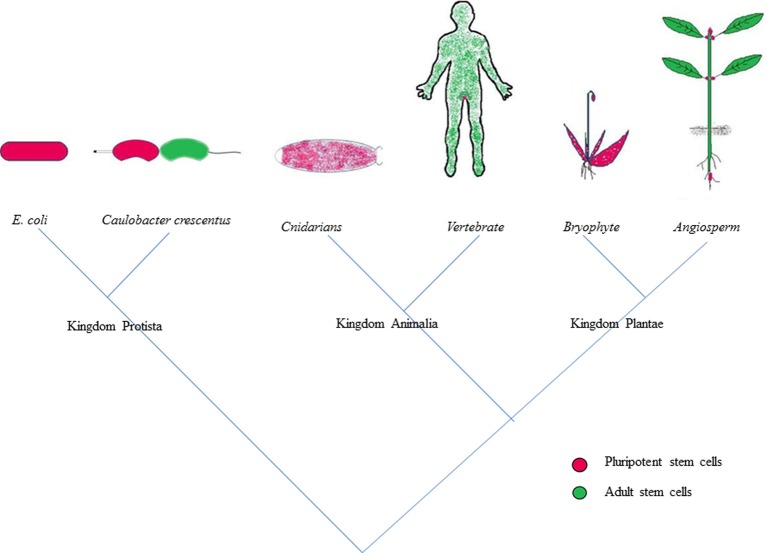
Figure 1
Figure 1
Tree of regeneration; depicting the competence for regeneration across the kingdoms of life. Adult stem cells are partly differentiated cells that can give rise to a limited number of cell types while the pluripotent stem cells are competent to give rise to all lineages of cells. The pluripotent stem cells which play a major role in executing the regenerative duties in the lower organisms of each kingdom gave way to adult stem cells and occupy confined niches in higher organisms.
Figure 2
Figure 2
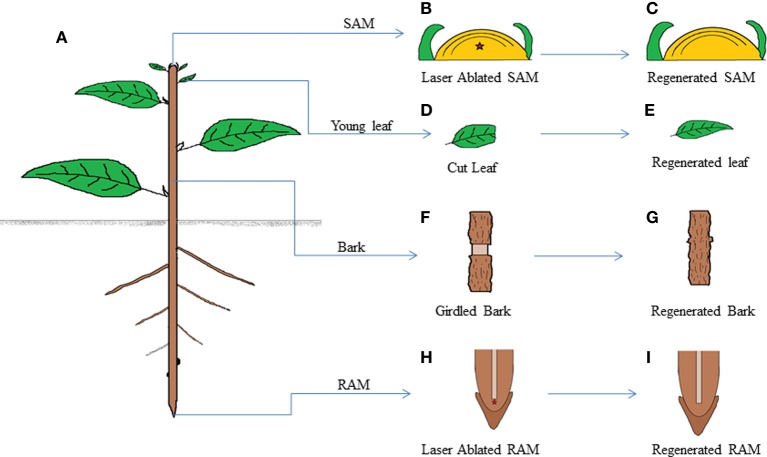
Schematic drawing showing regeneration ability of various parts of a plant. A plant shows high levels of regeneration (A). When SAM of the plant is laser ablated, (B) the wound gets regenerated without external hormonal application (C). Similarly various plant organs like young leaf (D,E), bark (F,G), and RAM (H,I) are able to regenerate the complete organ from the ablated organ without any extraneous hormonal application.
Figure 3
Figure 3
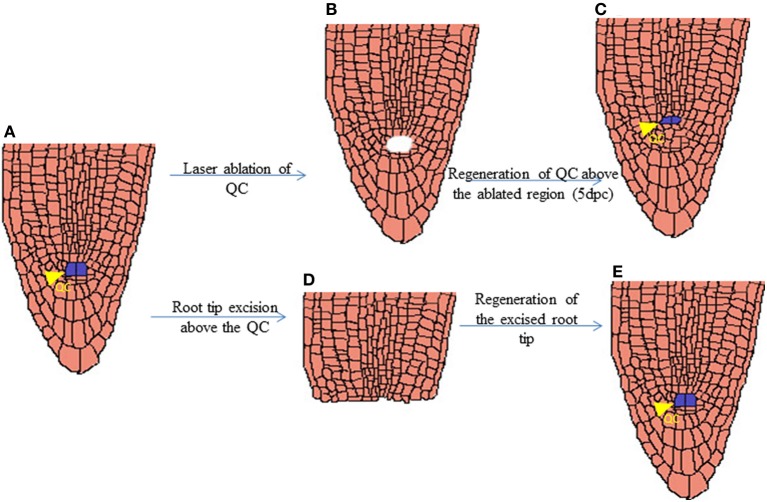
Schematic representation of regenerated QC after laser ablation and root tip excision. Arabidopsis root tip with Quiescence cells (QC) marked in Blue (A). Root tip after Laser Ablation of QC cells (B). Regenerated QC cells above the ablated region just 5 days post laser ablation (C). Excision of root tip above the QC region (D). Regenerated Root tip (E).
Figure 4
Figure 4
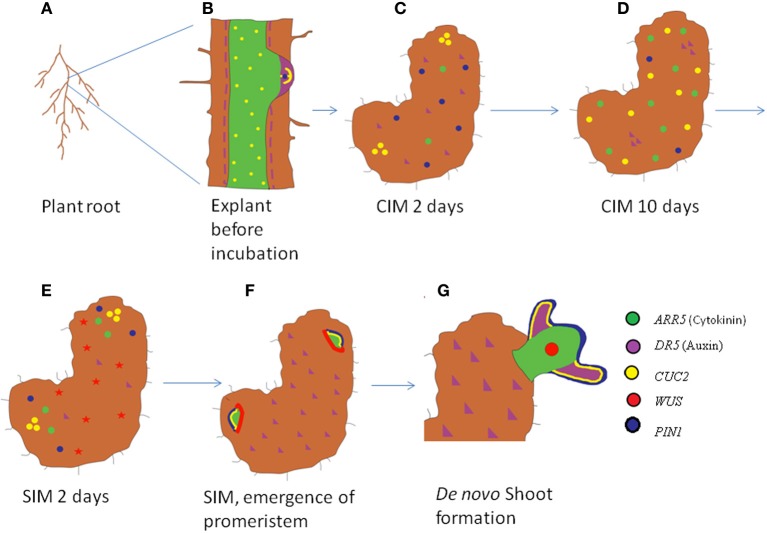
Schematic of expression dynamics of regulatory genes during de novo shoot organogenesis. The root explant of Arabidopsis (A,B) with an emerging lateral root expresses auxin responsive DR5 at the tip of the LRP (purple) coinciding with the expression domain of PIN1 (magenta), cytokinin responsive ARR5 (green) in LRP and root stele and CUC2 (yellow) in a subset of cells in lateral root meristem and root stele (B). The expression domain of auxin and PIN1 expands in the proliferating callus 2 days after CIM treatment, while CUC2 gets accumulated in patches and cytokinin level start rising (C). Ten days after CIM induction, CUC2 and ARR5 expression is seen throughout the callus while PIN1 and DR5 are weakly expressed in callus (D). Two days post SIM induction, CUC2, and ARR5 get confined to patches while WUS expression is induced throughout the callus (E). Regions of high CUC2 and ARR5 expression marked the emerging shoot promeristem while WUS is expressed in the peripheral cells. DR5 expression is low at the area of shoot meristem emergence (F). Once the de novo shoot emerges out, WUS occupies the central niche with high auxin and CUC2 levels are confined to primordial (G).
Figure 5
Figure 5
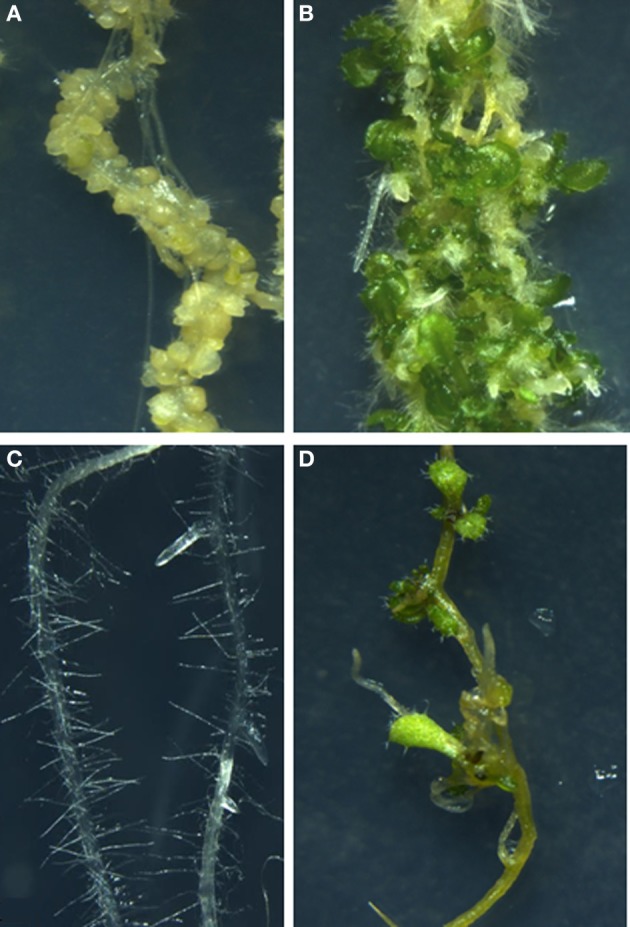
Direct and Indirect de novo organogenesis. Callus formation from Arabidopsis root explant on auxin rich callus inducing medium (CIM) (A). De novo shoot regeneration on callus incubated on cytokinin rich shoot inducing medium (SIM) (B). Arabidopsis root explant with lateral root primordia from where lateral root emerges out incubated on normal MS medium (C). Direct shoot regeneration from lateral root primordia of Arabidopsis root upon incubation on cytokinin rich medium (D).
Figure 6
Figure 6
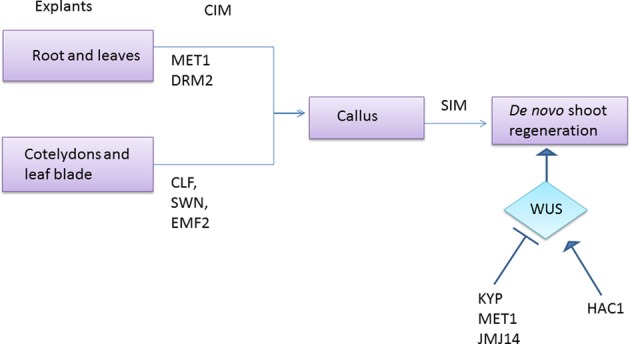
Role of epigenetic modifiers in de novo shoot formation. Explants from various parts of the plant are having different epigenetic modifiers to control gene expression during callus formation. When MET1 and DRM2 are involved in the callus formation from root and leaves, CLF, SWN, and EMF2 does the same in explants derived from cotyledon and leaf blade. Further control on shoot organogenesis is achieved by monitoring the expression of WUS, which is epigenetically inhibited by KYP, MET1, and JMJ14 and is enhanced by HAC1.

References

    1. Abel S., Nguyen M. D., Chow W., Theologis A. (1995). ACS4, a primary indoleacetic acid-responsive gene encoding 1-aminocyclopropane-1-carboxylate synthase in Arabidopsis thaliana. Structural characterization, expression in Escherichia coli, and expression characteristics in response to auxin [corrected]. J. Biol. Chem. 270, 19093–19099 10.1074/jbc.270.32.19093 - DOI - PubMed
    1. Abul Y., Mene'ndez V., Go'mez-Campo C., Revilla M. A., Lafont F., Ferna'ndez H. (2010). Occurrence of phytohormones in Psilotumnudum. J. Plant Physiol. 167, 1211–1213 10.1016/j.jplph.2010.03.015 - DOI - PubMed
    1. Aguirre-Lipperheide M., Estrada-Rodríyuez F. J., Evans L. V. (1995). Facts, problems, and needs in seaweed tissue culture: an appraisal. J. Phycol. 31, 677–688 10.1111/j.0022-3646.1995.00677 - DOI
    1. Aida M., Beis D., Heidstra R., Willemsen V., Blilou I., Galinha C., et al. (2004). The PLETHORA genes mediate patterning of the Arabidopsis root stem cell niche. Cell 119, 109–120 10.1016/j.cell.2004.09.018 - DOI - PubMed
    1. Atta R., Laurens L., Boucheron-Dubuisson E., Guivarc'h A., Carnero E., Giraudat-Pautot V., et al. (2009). Pluripotency of Arabidopsis xylem pericycle underlies shoot regeneration from root and hypocotyl explants grown in vitro. Plant J. 57, 626–644 10.1111/j.1365-313X.2008.03715 - DOI - PubMed

LinkOut - more resources