. 2014 May 13;53(18):2926-40.
doi: 10.1021/bi500002n. Epub 2014 May 2.

Mössbauer, EPR, and modeling study of iron trafficking and regulation in Δccc1 and CCC1-up Saccharomyces cerevisiae

Affiliations

Mössbauer, EPR, and modeling study of iron trafficking and regulation in Δccc1 and CCC1-up Saccharomyces cerevisiae

Allison Cockrell et al. Biochemistry. .

Abstract

Strains lacking and overexpressing the vacuolar iron (Fe) importer CCC1 were characterized using Mössbauer and EPR spectroscopies. Vacuolar Fe import is impeded in Δccc1 cells and enhanced in CCC1-up cells, causing vacuolar Fe in these strains to decline and accumulate, respectively, relative to WT cells. Cytosolic Fe levels should behave oppositely. The Fe content of Δccc1 cells grown under low-Fe conditions was similar to that in WT cells. Most Fe was mitochondrial with some nonheme high spin (NHHS) Fe(II) present. Δccc1 cells grown with increasing Fe concentration in the medium contained less total Fe, less vacuolar HS Fe(III), and more NHHS Fe(II) than in comparable WT cells. As the Fe concentration in the growth medium increased, the concentration of HS Fe(III) in Δccc1 cells increased to just 60% of WT levels, while NHHS Fe(II) increased to twice WT levels, suggesting that the NHHS Fe(II) was cytosolic. Δccc1 cells suffered more oxidative damage than WT cells, suggesting that the accumulated NHHS Fe(II) promoted Fenton chemistry. The Fe concentration in CCC1-up cells was higher than in WT cells; the extra Fe was present as NHHS Fe(II) and Fe(III) and as Fe(III) oxyhydroxide nanoparticles. These cells contained less mitochondrial Fe and exhibited less ROS damage than Δccc1 cells. CCC1-up cells were adenine-deficient on minimal medium; supplementing with adenine caused a decline of NHHS Fe(II) suggesting that some of the NHHS Fe(II) that accumulated in these cells was associated with adenine deficiency rather than the overexpression of CCC1. A mathematical model was developed that simulated changes in Fe distributions. Simulations suggested that only a modest proportion of the observed NHHS Fe(II) in both strains was the cytosolic form of Fe that is sensed by the Fe import regulatory system. The remainder is probably generated by the reduction of the vacuolar NHHS Fe(III) species.


Figures

Figure 1
Figure 1
Six K, 0.05 T Mössbauer spectra of DY150 cell grown with [Femed] = 40 (A) and 1 (B) μM 57FC. The orange line simulates NHHS FeIII using D = 0.5 cm–1, E/D = 0.33, AoNβN = −228 KG, δ = 0.54 mm/sec, ΔEQ = 0.39 mm/sec, and η = 2. The blue line simulates NHHS FeII using δ = 1.3 mm/s and ΔEQ = 3.0 mm/s. The purple line simulates the CD, using δ = 0.45 mm/s and ΔEQ = 1.14 mm/s. The green line simulates FeIII nanoparticles using δ = 0.53 mm/s and ΔEQ = 0.45 mm/s. The red lines that overlay the data are composite simulations using percentages in Table 1.
Figure 2
Figure 2
EPR of WT, Δccc1, and CCC1-up whole cells. A, WT1; B, Δ1; C, UP1; D, UP1+A; E, WT40; F, Δ40; G, UP40; H, UP40+A cells. Spectra were collected at 4 K with a microwave frequency of 9.63 GHz and microwave power 0.2 mW.
Figure 3
Figure 3
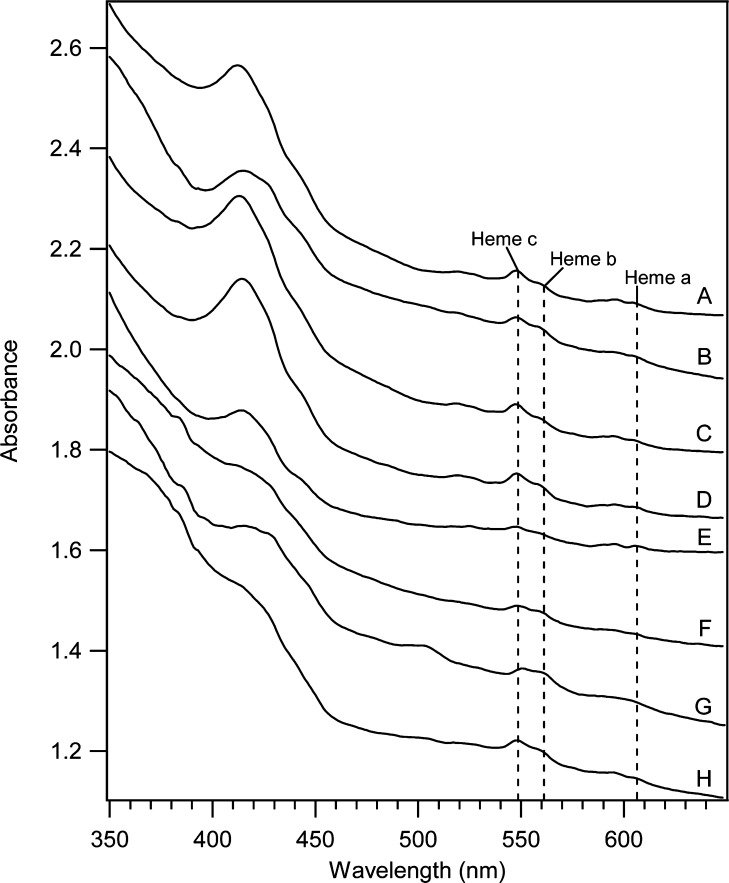
Electronic absorption spectroscopy of WT, Δccc1, and CCC1-up whole cells. A, WT1; B, WT40; C, Δ1; D, Δ40; E, UP1; F, UP40; G, UP1+A; H, UP40+A. Quantifications of individual heme centers are listed in Table S1.
Figure 4
Figure 4
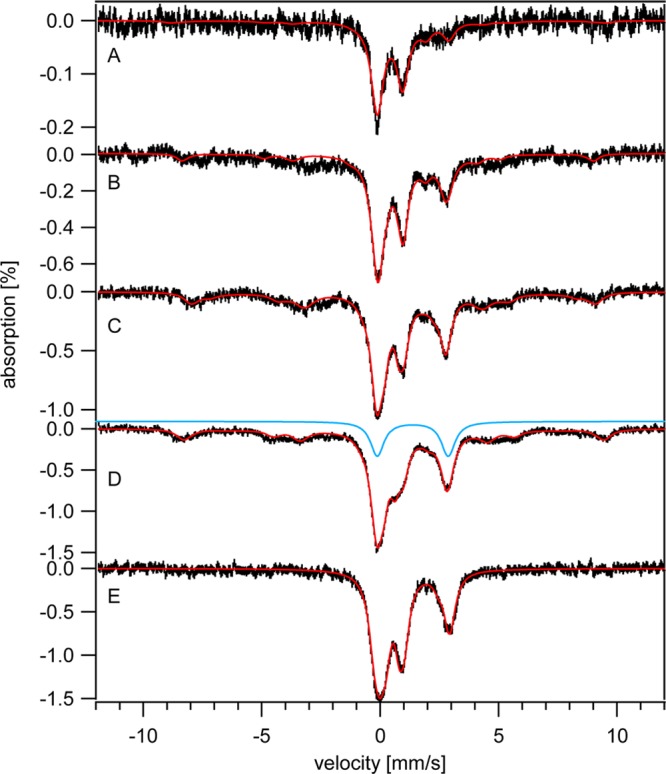
Five K, 0.05 T Mössbauer spectra of Δccc1 cells and isolated mitochondria. A, Δ1 cells; B, Δ10 cells; C, Δ20 cells; D, Δ40 cells; E, mitochondria isolated from Δ40 cells. Red lines are simulations of the entire spectrum using the percentages given in Table 1. The blue line is a simulation of the NHHS FeII feature generated with parameters specified in Figure 1.
Figure 5
Figure 5
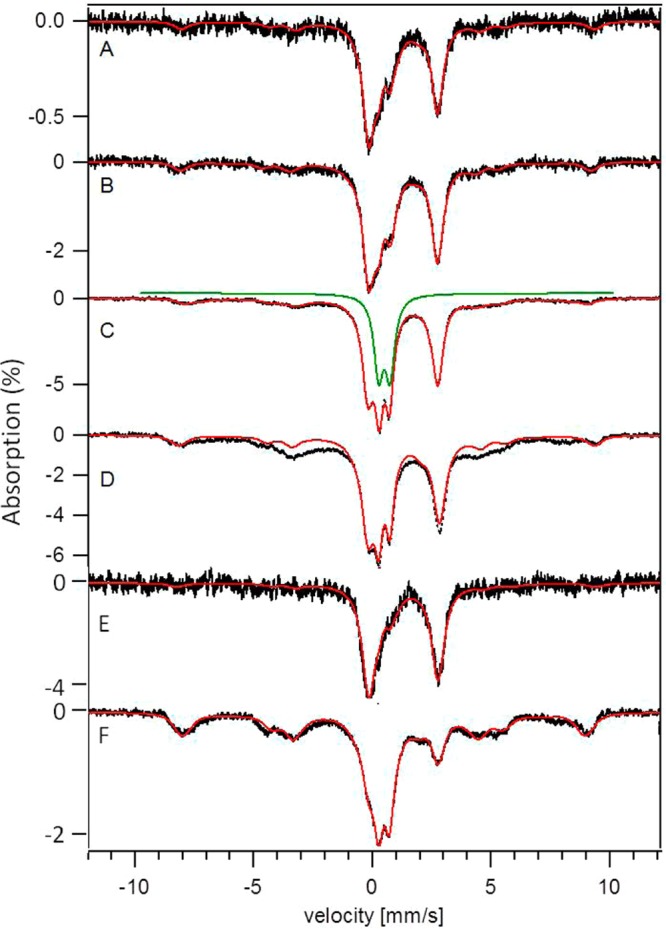
Five K, 0.05 T Mössbauer spectra of CCC1-up cells grown at various FC concentrations. A, UP1; B, UP10; C, UP20; D, UP40; E, UP1+A; F, UP40+A. The red lines are simulations of the entire spectrum using the percentages in Table 1. The green line is a simulation of the nanoparticle feature generated using parameters specified in Figure 1.
Figure 6
Figure 6
Variable temperature EPR spectra of UP40 cells. The red spectrum was collected at 10 K; the black spectrum at 79 K. Spectra were collected using microwave frequency 9.63 GHz and microwave power 0.2 mW. Spectra were normalized and plotted using SpinCount software (http://www.chem.cmu.edu/groups/hendrich).
Figure 7
Figure 7
Models of Fe trafficking in WT, Δccc1, and CCC1-up cells. In WT cells, Fe import is regulated by the concentration of cytosolic Fe C. Mitochondria and vacuoles compete to import C. The majority of C enters the vacuoles via Ccc1p. Once in the vacuole, vacuolar iron F2 is oxidized to HS FeIII (F3); at high pH, a portion of this Fe is converted into nanoparticles P. In Δccc1 cells, there is no Ccc1p-dependent Fe influx into vacuoles, so cytosolic Fe increases in concentration. This concentration exceeds a threshold value such that further import into the cell is inhibited. In CCC1-up cells, overexpression of CCC1 increases the flux of Fe into the vacuole, thereby decreasing the concentration of cytosolic Fe below a threshold value, such that Fe import into the cell is upregulated.
Figure 8
Figure 8
Simulation of iron-containing species in WT(W303) (black), WT(DY150) (blue), Δccc1 (red), CCC1-up (green), and CCC1-up plus adenine (pink) cells at different concentration of FC in minimal medium. Solid lines are simulations for a particular strain/condition. Circles are data with the same color-coding. The dashed lines indicate the threshold concentration for cytosolic Fe. Parameters used in all simulations: kin = 16 h–1; km = 4 h–1; α = 0.5 h–1; Kc = 21 μM; nc =5; Km1 = 24 μM; nm1 = 3; Km2 = 90 μM; mn2 = 3; Kv1 = 17 μM; nv1= 6; Kv2 = 200 μM; nv2 = 4. Parameters specific for the following strains, including kccc1 (h–1), k23 (h–1), K32 (μM), n32, and knp (h–1): WT(W303), 38, 16, 18, 9, and 0.04; WT(DY150), 38, 13, 18, 9, and 0.2; Δccc1, 4, 1, 16, 9, and 0.15; CCC1-up, 400, 1, 12, 3, and 2; CCC1-up + adenine, 400, 9, 16, 9, and 0.3. Specific simulation and data values, along with residuals, are given in Table S3.

References

    1. Crichton R. R.; Pierre J. L. (2001) Old iron, young copper: From Mars to Venus. Biometals 14, 99–112. - PubMed
    1. Flint D. H.; Allen R. M. (1996) Iron-sulfur proteins with nonredox functions. Chem. Rev. 96, 2315–2334. - PubMed
    1. Lill R.; Hoffmann B.; Molik S.; Pierik A. J.; Rietzschel N.; Stehling O.; Uzarska M. A.; Webert H.; Wilbrecht C.; Mühlenhoff U. (2012) The role of mitochondria in cellular iron-sulfur protein biogenesis and iron metabolism. Biochim. Biophys. Acta 1823, 1491–1508. - PubMed
    1. Li L. T.; Chen O. S.; Ward D. M.; Kaplan J. (2001) CCC1 is a transporter that mediates vacuolar iron storage in yeast. J. Biol. Chem. 276, 29515–29519. - PubMed
    1. Urbanowski J. L.; Piper R. C. (1999) The iron transporter fth1p forms a complex with the Fet5 iron oxidase and resides on the vacuolar membrane. J. Biol. Chem. 274, 38061–38070. - PubMed

Publication types

MeSH terms