


Age- and health-related quality of life after total hip replacement: decreasing gains in patients above 70 years of age
- PMID: 24786908
- PMCID: PMC4062790
- DOI: 10.3109/17453674.2014.916492
Age- and health-related quality of life after total hip replacement: decreasing gains in patients above 70 years of age
Abstract
Background: While age is a common confounder, its impact on health-related quality of life (HRQoL) after total hip replacement is uncertain. This could be due to improper statistical modeling of age in previous studies, such as treating age as a linear variable or by using age categories. We hypothesized that there is a non-linear association between age and HRQoL.
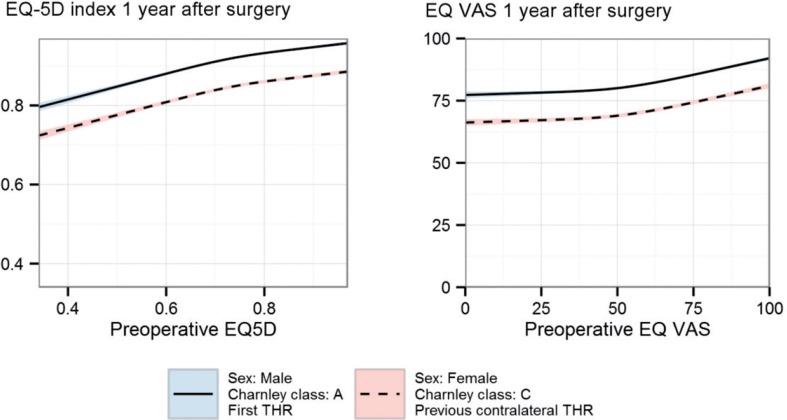
Methods: We selected a nationwide cohort from the Swedish Hip Arthroplasty Register of patients operated with total hip replacements due to primary osteoarthritis between 2008 and 2010. For estimating HRQoL, we used the generic health outcome questionnaire EQ-5D of the EuroQol group that consits or 2 parts: the EQ-5D index and the EQ VAS estimates. Using linear regression, we modeled the EQ-5D index and the EQ VAS against age 1 year after surgery. Instead of using a straight line for age, we applied a method called restricted cubic splines that allows the line to bend in a controlled manner. Confounding was controlled by adjusting for preoperative HRQoL, sex, previous contralateral hip surgery, pain, and Charnley classification.
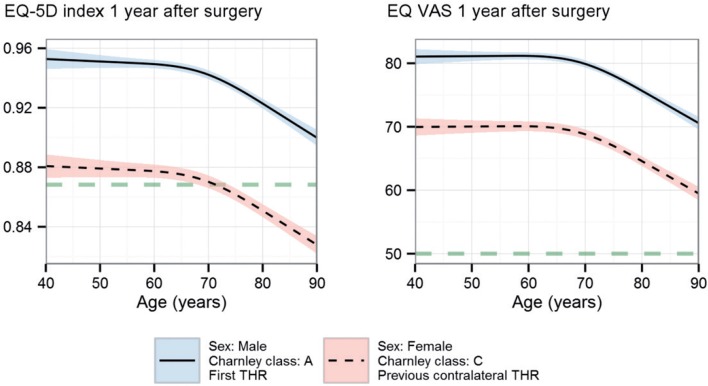
Results: Complete data on 27,245 patients were available for analysis. Both the EQ-5D index and EQ VAS showed a non-linear relationship with age. They were fairly unaffected by age until the patients were in their late sixties, after which age had a negative effect.
Interpretation: There is a non-linear relationship between age and HRQoL, with improvement decreasing in the elderly.
Figures
Comment in
-
Patient-reported outcome measures in arthroplasty registries Report of the Patient-Reported Outcome Measures Working Group of the International Society of Arthroplasty Registries Part II. Recommendations for selection, administration, and analysis.Acta Orthop. 2016 Jul;87 Suppl 1(Suppl 1):9-23. doi: 10.1080/17453674.2016.1181816. Epub 2016 May 26. Acta Orthop. 2016. PMID: 27228230 Free PMC article.
References
-
- Altman DG, Lausen B, Sauerbrei W, Schumacher M. Dangers of using “optimal” cutpoints in the evaluation of prognostic fac... . J Natl Cancer Inst. 1994;86(11):829–35. - PubMed
-
- Birdsall PD, Hayes JH, Cleary R, Pinder IM, Moran CG, Sher JL. Health outcome after total knee replacement in the very elderly . J Bone Joint Surg (Br) 1999;81(4):660–2. - PubMed
-
- Brenner H, Blettner M. Controlling for continuous confounders in epidemiologic research . Epidemiology. 1997;8:429–34. - PubMed
-
- Burström K, Johannesson M, Diderichsen F. A comparison of individual and social time trade-off values for health s... . Health Policy. 2006;76(3):359–70. - PubMed
-
- Charnley J. The long-term results of low-friction arthroplasty of the hip performed ... . J Bone Joint Surg (Br) 1972;54(1):61–76. - PubMed
Publication types
MeSH terms
LinkOut - more resources
Full Text Sources
Other Literature Sources
Medical