


Long-term outcome of subthalamic nucleus deep brain stimulation for Parkinson's disease using an MRI-guided and MRI-verified approach
- PMID: 24790212
- PMCID: PMC4451170
- DOI: 10.1136/jnnp-2013-306907
Long-term outcome of subthalamic nucleus deep brain stimulation for Parkinson's disease using an MRI-guided and MRI-verified approach
Abstract
Background: Subthalamic nucleus (STN) deep brain stimulation (DBS) represents a well-established treatment for patients with advanced Parkinson's disease (PD) insufficiently controlled with medical therapies. This study presents the long-term outcomes of patients with PD treated with STN-DBS using an MRI-guided/MRI-verified approach without microelectrode recording.
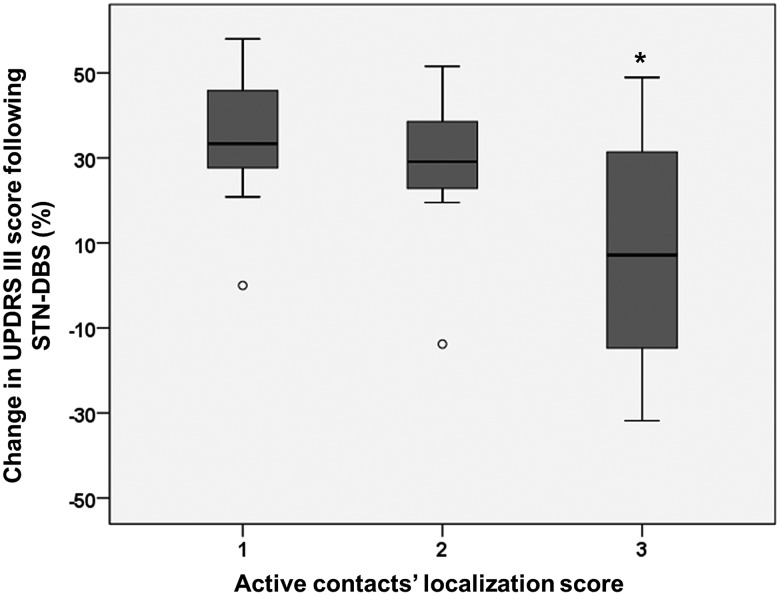
Methods: A cohort of 41 patients who underwent STN-DBS were followed for a minimum period of 5 years, with a subgroup of 12 patients being followed for 8-11 years. Motor status was evaluated using part III of the Unified Parkinson's Disease Rating Scale (UPDRS-III), in on- and off-medication/on-stimulation conditions. Preoperative and postoperative assessments further included activities of daily living (UPDRS-II), motor complications (UPDRS-IV), neuropsychological and speech assessments, as well as evaluation of quality of life. Active contacts localisation was calculated and compared with clinical outcomes.
Results: STN-DBS significantly improved the off-medication UPDRS-III scores, compared with baseline. However, UPDRS scores increased over time after DBS. Dyskinesias, motor fluctuations and demands in dopaminergic medication remained significantly reduced in the long term. Conversely, UPDRS-III on-medication scores deteriorated at 5 and 8 years, mostly driven by axial and bradykinesia subscores. Quality of life, as well as depression and anxiety scores, did not significantly change at long-term follow-up compared with baseline. In our series, severe cognitive decline was observed in 17.1% and 16.7% of the patients at 5 and 8 years respectively.
Conclusions: Our data confirm that STN-DBS, using an MRI-guided/MRI-verified technique, remains an effective treatment for motor 'off' symptoms of PD in the long term with low morbidity.
Keywords: NEUROSURGERY; PARKINSON'S DISEASE.
Published by the BMJ Publishing Group Limited. For permission to use (where not already granted under a licence) please go to http://group.bmj.com/group/rights-licensing/permissions.
Figures
References
-
- Goetz CG, Poewe W, Rascol O, et al. Evidence-based medical review update: pharmacological and surgical treatments of Parkinson's disease: 2001 to 2004. Mov Disord 2005;20:523–39. - PubMed
-
- Ferreira JJ, Katzenschlager R, Bloem BR, et al. Summary of the recommendations of the EFNS/MDS-ES review on therapeutic management of Parkinson's disease. Eur J Neurol 2013;20:5–15. - PubMed
-
- Limousin P, Pollak P, Benazzouz A, et al. Effect of parkinsonian signs and symptoms of bilateral subthalamic nucleus stimulation. Lancet 1995;345:91–5. - PubMed
-
- Limousin P, Krack P, Pollak P, et al. Electrical stimulation of the subthalamic nucleus in advanced Parkinson's disease. N Eng J Med 1998;339:1105–11. - PubMed
-
- Kleiner-Fisman G, Herzog J, Fisman DN, et al. Subthalamic nucleus deep brain stimulation: summary and meta-analysis of outcomes. Mov Disord 2006;21(Suppl 1):S290–304. - PubMed
Publication types
MeSH terms
LinkOut - more resources
Full Text Sources
Other Literature Sources
Medical
