


Preparation and properties of poly(vinyl alcohol)/chitosan blend bionanocomposites reinforced with cellulose nanocrystals/ZnO-Ag multifunctional nanosized filler
- PMID: 24790433
- PMCID: PMC4003268
- DOI: 10.2147/IJN.S60274
Preparation and properties of poly(vinyl alcohol)/chitosan blend bionanocomposites reinforced with cellulose nanocrystals/ZnO-Ag multifunctional nanosized filler
Abstract
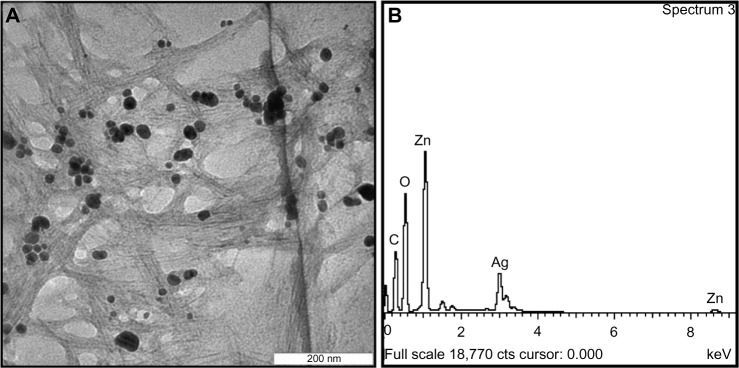
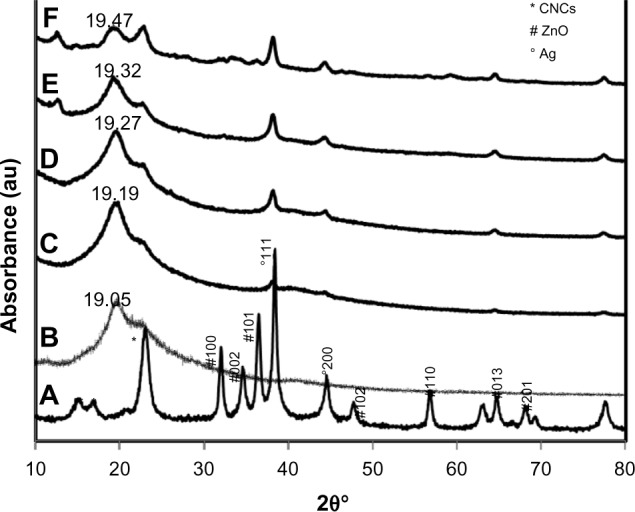
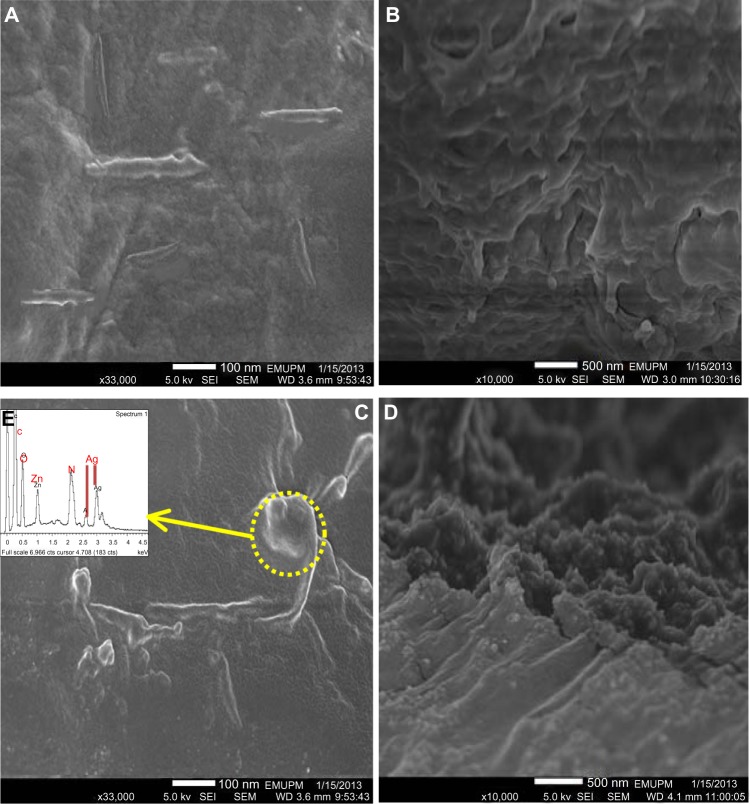
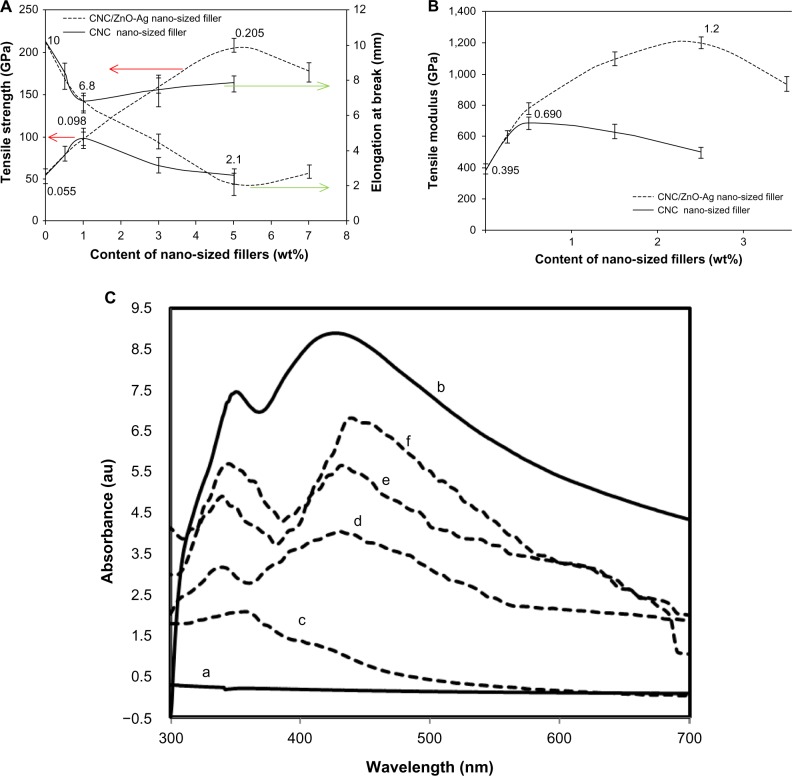
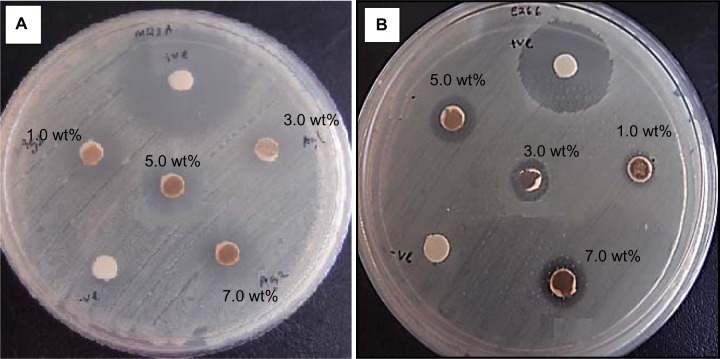
A series of novel bionanocomposites were cast using different contents of zinc oxide-silver nanoparticles (ZnO-AgNPs) stabilized by cellulose nanocrystals (CNC) as multifunctional nanosized fillers in poly(vinyl alcohol)/chitosan (PVA/Cs) matrices. The morphological structure, mechanical properties, ultraviolet-visible absorption, and antimicrobial properties of the prepared films were investigated as a function of their CNC/ZnO-AgNP content and compared with PVA/chitosan/CNC bionanocomposite films. X-ray diffraction and field emission scanning electron microscopic analyses showed that the CNC/ZnO-AgNPs were homogeneously dispersed in the PVA/Cs matrix and the crystallinity increased with increasing nanosized filler content. Compared with pure PVA/Cs, the tensile strength and modulus in the films increased from 0.055 to 0.205 GPa and from 0.395 to 1.20 GPa, respectively. Ultraviolet and visible light can be efficiently absorbed by incorporating ZnO-AgNPs into a PVA/Cs matrix, suggesting that these bionanocomposite films show good visibility and ultraviolet-shielding effects. The bionanocomposite films had excellent antimicrobial properties, killing both Gram-negative Salmonella choleraesuis and Gram-positive Staphylococcus aureus. The enhanced physical properties achieved by incorporating CNC/ZnO-AgNPs could be beneficial in various applications.
Keywords: antimicrobial properties; bionanocomposite; cellulose nanocrystals; multifunctional nanofiller; poly(vinyl alcohol)/chitosan blend.
Figures
References
-
- Dufresne A. Nanocellulose: From Nature to High Performance Tailored Materials. Boston, MA, USA: Walter De Gruyter Inc.; 2012.
-
- Habibi Y, Lucia LA, Rojas OJ. Cellulose nanocrystals: chemistry, self-assembly, and applications. Chem Rev. 2010;110:3479–3500. - PubMed
-
- Xu W, Qin ZY, Yu HY, et al. Cellulose nanocrystals as organic nanofillers for transparent polycarbonate films. J Nanopart Res. 2013;15:1562–1570.
-
- Yu HY, Qin ZY, Liang BL, Liu N, Zhou Z, Chen L. Facile preparation of thermally stable cellulose nanocrystals with high yield of 93% through hydrochloric acid hydrolysis under hydrothermal condition. J Mater Chem A. 2013;1:3938–3944.
-
- Gao Z, Peng J, Zhong T, Sun J, Wang X, Yue C. Biocompatible elastomer of waterborne polyrethane based on castor oil and polyethylene glycol with cellulose nanocrystals. Carbohydr Polym. 2012;87:2068–2075.
Publication types
MeSH terms
Substances
LinkOut - more resources
Full Text Sources
Other Literature Sources
Medical
Miscellaneous
