


Webinar software: a tool for developing more effective lectures (online or in-person)
- PMID: 24791102
- PMCID: PMC4005175
- DOI: 10.4103/0974-9233.129756
Webinar software: a tool for developing more effective lectures (online or in-person)
Abstract
Purpose: To describe the use of online seminars (webinars) to improve learning experience for medical residents and fostering critical thinking.
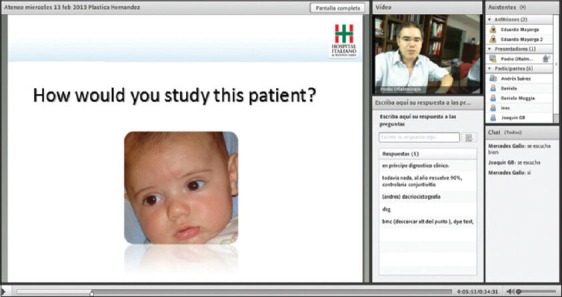
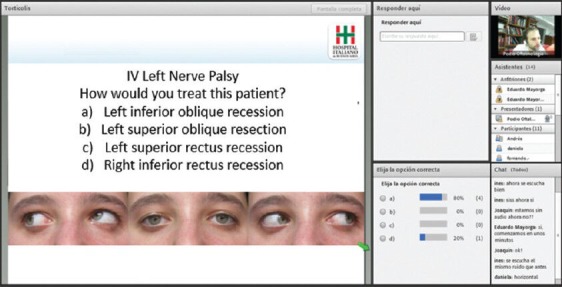
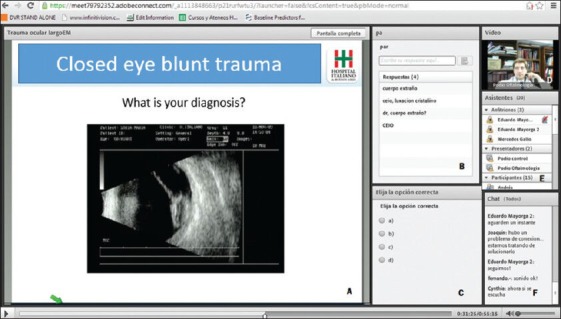
Materials and methods: Sixty-one online seminars (webinars) for residents were developed from April 2012 to February 2013. Residents attended the lectures in the same room as the presenter or from distant locations. Residents interacted with the presenter using their personal computers, tablets, or smartphones. They were able to ask questions and answer the instructor's multiple choice or open-ended questions. The lecture dynamics consisted of: (1) The presentation of a clinical case by an expert on the clinical topic; (2) the instructor asked open-ended and multiple-choice questions about the problem-resolution process; (3) participants responded questions individually; (4) participants received feedback on their answers; (5) a brief conference was given on the learning objectives and the content, also fostering interactive participation; (6) lectures were complemented with work documents.
Results: This method allowed for exploration of learning of scientific knowledge and the acquisition of other medical competences (such as patient care, interpersonal and communication skills, and professionalism). The question-and-answer activity and immediate feedback gave attendees the chance to participate actively in the conference, reflect on the topic, correct conceptual errors, and exercise critical thinking. All these factors are necessary for learning.
Conclusions: This modality, which facilitates interaction, active participation, and immediate feedback, could allow learners to acquire knowledge more effectively.
Keywords: Generational Learning; New Technologies; Residents; Webinars.
Conflict of interest statement
Figures
Similar articles
-
Webcasts for resident education.Ophthalmology. 2012 Jan;119(1):199-200.e1. doi: 10.1016/j.ophtha.2011.08.037. Ophthalmology. 2012. PMID: 22214944 No abstract available.
-
Impact of ophthalmic webinars on the resident's learning experience during COVID-19 pandemic: An insight into its present and future prospects.Indian J Ophthalmol. 2021 Jan;69(1):145-150. doi: 10.4103/ijo.IJO_2279_20. Indian J Ophthalmol. 2021. PMID: 33323600 Free PMC article.
-
Gamification as a tool for enhancing graduate medical education.Postgrad Med J. 2014 Dec;90(1070):685-93. doi: 10.1136/postgradmedj-2013-132486. Epub 2014 Oct 28. Postgrad Med J. 2014. PMID: 25352673 Free PMC article.
-
Incorporating a virtual curriculum into ophthalmology education in the coronavirus disease-2019 era.Curr Opin Ophthalmol. 2020 Sep;31(5):380-385. doi: 10.1097/ICU.0000000000000681. Curr Opin Ophthalmol. 2020. PMID: 32694267 Review.
-
Misconceptions and realities about teaching online.Sci Eng Ethics. 2005 Jul;11(3):329-40. doi: 10.1007/s11948-005-0002-7. Sci Eng Ethics. 2005. PMID: 16190274 Review.
Cited by
-
'Learning from home': role of e-learning methodologies and tools during novel coronavirus pandemic outbreak.Postgrad Med J. 2021 Sep;97(1151):590-597. doi: 10.1136/postgradmedj-2020-137989. Epub 2020 Nov 5. Postgrad Med J. 2021. PMID: 33154099 Free PMC article.
-
Tips to optimize digital education in ophthalmology: Results from ESASO survey.Eur J Ophthalmol. 2022 Apr 13;33(2):11206721221093187. doi: 10.1177/11206721221093187. Online ahead of print. Eur J Ophthalmol. 2022. PMID: 35414278 Free PMC article.
-
The millennial generation plastic surgery trainees in sub-Saharan Africa and social media: A review of the application of blogs, podcasts, and twitter as web-based learning tools.Ann Afr Med. 2020 Apr-Jun;19(2):75-79. doi: 10.4103/aam.aam_25_17. Ann Afr Med. 2020. PMID: 32499462 Free PMC article. Review.
-
Perceptions of Saudi Plastic Surgery Residents and Attendings of Online Education during the COVID-19 Pandemic.Plast Reconstr Surg Glob Open. 2021 Jun 22;9(6):e3658. doi: 10.1097/GOX.0000000000003658. eCollection 2021 Jun. Plast Reconstr Surg Glob Open. 2021. PMID: 34168946 Free PMC article.
-
Preventing Prescription Drug Misuse in Work Settings: Efficacy of a Brief Intervention in Health Consciousness.J Med Internet Res. 2017 Jul 6;19(7):e242. doi: 10.2196/jmir.7828. J Med Internet Res. 2017. PMID: 28684383 Free PMC article.
References
-
- Wilson M, Gerber LE. How generational theory can improve teaching: Strategies for working with the millennials. Curr Teach Learn. 2008;1:29–44.
-
- Mangold K. Educating a new generation. Teaching baby boomer faculty about millennial students. Nurse Educ. 2007;32:21–3. - PubMed
-
- Moreno-Walton L, Brunett P, Akhtar S, DeBlieux PM. Teaching across the generation gap: A consensus from the Council of Emergency Medicine Residency Directors 2009 academic assembly. Acad Emerg Med. 2009;16:S19–24. - PubMed
-
- Paterson T. Generational considerations in providing critical care education. Crit Care Nurs Q. 2010;33:67–74. - PubMed
-
- Twenge JM. Generational changes and their impact in the classroom: Teaching Generation Me. Med Educ. 2009;43:398–405. - PubMed
MeSH terms
LinkOut - more resources
Full Text Sources
Other Literature Sources
Miscellaneous
