


Does academic achievement during childhood and adolescence benefit later health?
- PMID: 24792585
- PMCID: PMC4037140
- DOI: 10.1016/j.annepidem.2014.02.008
Does academic achievement during childhood and adolescence benefit later health?
Abstract
Purpose: Educational disparities in health persist after adjustment for income and occupation, suggesting that other purely cognitive and psychosocial mechanisms may be involved. Unlike occupation- or income-mediated effects, effects of cognitive and psychosocial gains-as reflected in academic achievement-may be apparent even before schooling is completed.
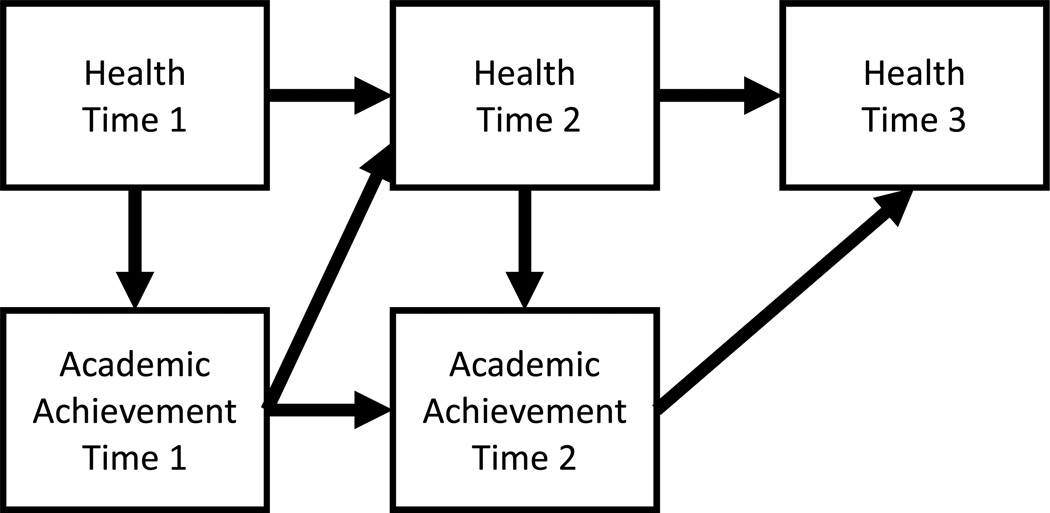
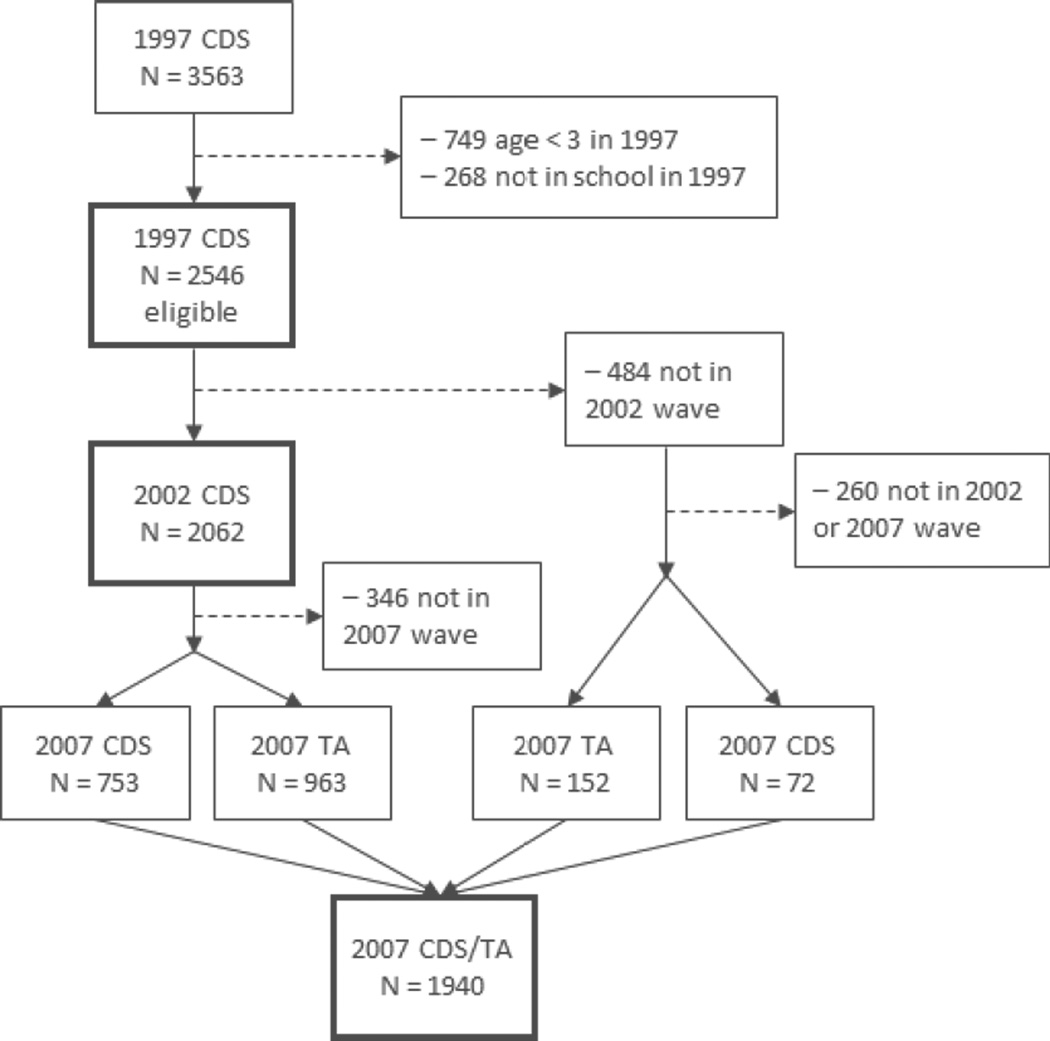
Methods: We used data spanning 10 years on a national U.S. cohort of 2546 children aged 3-14 years at baseline to estimate the effects of academic achievement, measured by standardized tests of cognitive achievement, on future health. We used marginal structural models to address potential mutual influence of achievement and health on each other over time.
Results: One SD higher academic achievement 1997-2002 was associated with a lower prevalence of poorer health status in 2007 in girls (prevalence ratio = 0.87 [(95% confidence interval) 0.78-0.97]) but not in boys (prevalence ratio = 0.96 [0.86-1.08]). Higher achievement was also weakly associated with lower body mass index and less psychological distress among girls only.
Conclusions: Academic achievement may benefit future health but a number of questions remain unanswered, including reasons for the gender differences and how academic achievement-related health disparities may progress over the life course and interact with other social determinants of health.
Keywords: Academic achievement; Body mass index; Children and adolescents; Education; Gender; Health status; Marginal structural models; Mental health.
Copyright © 2014 Elsevier Inc. All rights reserved.
Figures
Similar articles
-
Academic success across the transition from primary to secondary schooling among lower-income adolescents: understanding the effects of family resources and gender.J Youth Adolesc. 2013 Sep;42(9):1331-47. doi: 10.1007/s10964-013-9987-4. Epub 2013 Aug 1. J Youth Adolesc. 2013. PMID: 23904002
-
Trajectories of socioeconomic inequalities in health, behaviours and academic achievement across childhood and adolescence.J Epidemiol Community Health. 2013 Apr;67(4):358-64. doi: 10.1136/jech-2012-201892. Epub 2013 Jan 15. J Epidemiol Community Health. 2013. PMID: 23322849 Free PMC article.
-
Physical activity and obesity mediate the association between childhood motor function and adolescents' academic achievement.Proc Natl Acad Sci U S A. 2013 Jan 29;110(5):1917-22. doi: 10.1073/pnas.1214574110. Epub 2012 Dec 31. Proc Natl Acad Sci U S A. 2013. PMID: 23277558 Free PMC article.
-
Childhood Maltreatment and Educational Outcomes.Trauma Violence Abuse. 2015 Oct;16(4):418-37. doi: 10.1177/1524838014537908. Epub 2014 Jun 11. Trauma Violence Abuse. 2015. PMID: 24920354 Review.
-
Disparities in academic achievement and health: the intersection of child education and health policy.Pediatrics. 2009 Mar;123(3):1073-80. doi: 10.1542/peds.2008-0533. Pediatrics. 2009. PMID: 19255042 Review.
Cited by
-
The bidirectional longitudinal association between health-related quality of life and academic performance in adolescents: DADOS study.Qual Life Res. 2023 Mar;32(3):729-738. doi: 10.1007/s11136-022-03291-z. Epub 2022 Nov 16. Qual Life Res. 2023. PMID: 36383281 Free PMC article.
-
Circulating inflammatory biomarkers and academic performance in adolescents: DADOS study.PLoS One. 2020 Nov 6;15(11):e0242016. doi: 10.1371/journal.pone.0242016. eCollection 2020. PLoS One. 2020. PMID: 33156854 Free PMC article.
-
The role of social adversity on emotional dysregulation during infancy and early childhood.J Pediatr Nurs. 2023 Sep-Oct;72:26-35. doi: 10.1016/j.pedn.2023.03.010. Epub 2023 Apr 8. J Pediatr Nurs. 2023. PMID: 37037102 Free PMC article.
-
Disruption to test scores after hurricanes in the United States.Environ Res Health. 2025 Jun 1;3(2):025003. doi: 10.1088/2752-5309/adb32b. Epub 2025 Feb 14. Environ Res Health. 2025. PMID: 40034829 Free PMC article.
-
Bidirectional longitudinal associations of mental health with academic performance in adolescents: DADOS study.Pediatr Res. 2024 May;95(6):1617-1624. doi: 10.1038/s41390-023-02880-z. Epub 2023 Nov 6. Pediatr Res. 2024. PMID: 37932488
References
-
- Julian T, Kominski R. Educational Resources Information Center (U.S.), US Census Bureau. Education and Synthetic Work-Life Earnings Estimates. American Community Survey Reports. ACS-14 [Numeric (Numerical Quantitative Data) Text (Reports, Research)]. [S.l.]: Distributed by ERIC Clearinghouse. 2011 Available from: http://www.eric.ed.gov/contentdelivery/servlet/ERICServlet?accno=ED523770.
-
- Kawachi I, Adler NE, Dow WH. Money, schooling, and health: mechanisms and causal evidence. Ann N Y Acad Sci. 2010 Feb;1186:56–68. PubMed PMID: 20201868. Epub 2010/03/06. eng. - PubMed
-
- Cutler DM, Lleras-Muney A. Education and Health: Evaluating Theories and Evidence. Cambridge, MA: National Bureau of Economic Research; 2006. Jun, Report No.: Contract No.: 12352.
-
- Grossman M. On the concept of health capital and the demand for health. The Journal of Political Economy. 1972;80(2):223–255.
Publication types
MeSH terms
Grants and funding
LinkOut - more resources
Full Text Sources
Other Literature Sources
Medical
