. 2014 May 2;9(5):e96578.
doi: 10.1371/journal.pone.0096578. eCollection 2014.

The refinement of genetic predictors of multiple sclerosis

Affiliations

The refinement of genetic predictors of multiple sclerosis

Giulio Disanto et al. PLoS One. .

Abstract

A recent genome wide association study (GWAS) demonstrated that more than 100 genetic variants influence the risk of multiple sclerosis (MS). We investigated what proportion of the general population can be considered at high genetic risk of MS, whether genetic information can be used to predict disease development and how the recently found genetic associations have influenced these estimates. We used summary statistics from GWAS in MS to estimate the distribution of risk within a large simulated general population. We profiled MS associated loci in 70 MS patients and 79 healthy controls (HC) and assessed their position within the distribution of risk in the simulated population. The predictive performance of a weighted genetic risk score (wGRS) on disease status was investigated using receiver operating characteristic statistics. When all known variants were considered, 40.8% of the general population was predicted to be at reduced risk, 49% at average, 6.9% at elevated and 3.3% at high risk of MS. Fifty percent of MS patients were at either reduced or average risk of disease. However, they showed a significantly higher wGRS than HC (median 13.47 vs 12.46, p = 4.08×10(-10)). The predictive performance of the model including all currently known MS associations (area under the curve = 79.7%, 95%CI = 72.4%-87.0%) was higher than that of models considering previously known associations. Despite this, considering the relatively low prevalence of MS, the positive predictive value was below 1%. The increasing number of known associated genetic variants is improving our ability to predict the development of MS. This is still unlikely to be clinically useful but a more complete understanding of the complexity underlying MS aetiology and the inclusion of environmental risk factors will aid future attempts of disease prediction.


Conflict of interest statement

Competing Interests: GD, RD, JP, RA, RIE report no competing interests. JK is supported by an ECTRIMS Research Fellowship Programme and by the “Forschungsfonds” of the University of Basel, Switzerland and has received research support from the Swiss MS Society, Swiss ALS Society, Protagen AG, Roche and Novartis and served in scientific advisory boards for Genzyme/Sanofi-Aventis, Merck Serono and Novartis Pharma. GG serves on scientific advisory boards for Merck Serono and Biogen Idec and Vertex Pharmaceuticals; served on the editorial board of Multiple Sclerosis; has received speaker honoraria from Bayer Schering Pharma, Merck Serono, Biogen Idec, Pfizer Inc, Teva Pharmaceutical Industries Ltd.–sanofiaventis, Vertex Pharmaceuticals, Genzyme Corporation, Ironwood, and Novartis; has served as a consultant for Bayer Schering Pharma, Biogen Idec,GlaxoSmithKline, Merck Serono, Protein Discovery Laboratories, Teva Pharmaceutical Industries Ltd.–sanofi-aventis, UCB, Vertex Pharmaceuticals, GW Pharma, Novartis, and FivePrime; serves on the speakers bureau for Merck Serono; and has received research support from Bayer Schering Pharma, Biogen Idec, Merck Serono, Novartis, UCB, Merz Pharmaceuticals, LLC, Teva Pharmaceutical Industries Ltd.–sanofi-aventis, GW Pharma, and Ironwood. This does not alter the authors’ adherence to PLOS ONE policies on sharing data and materials.

Figures

Figure 1
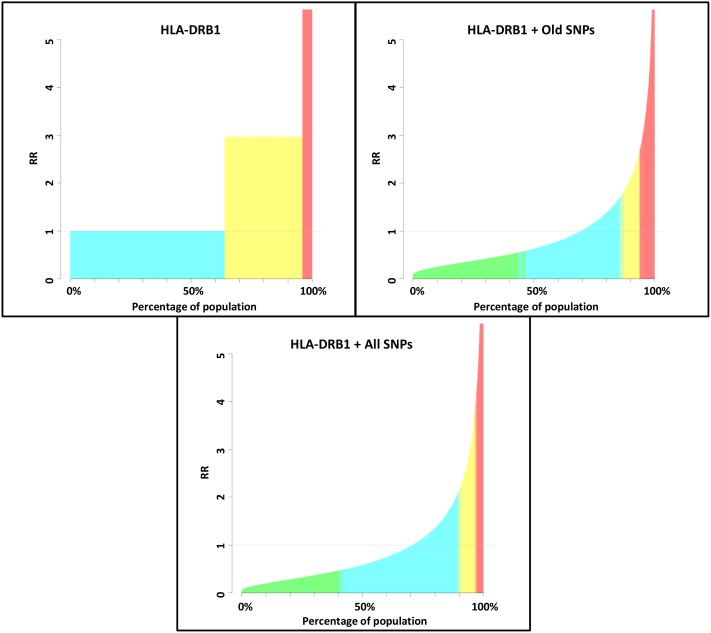
Figure 1. GWAS statistics (OR and risk allele frequencies) were used to simulate a population of 100,000 individuals under different models considering: only HLA-DRB1, HLA-DRB1 + MS associations known in 2011 and HLA-DRB1 + all currently known MS associations.
Categories of risk were defined based on the 95%CI of risk of each individual (see methods). Green = reduced risk, blue = average risk, yellow = elevated risk, red = high risk.
Figure 2
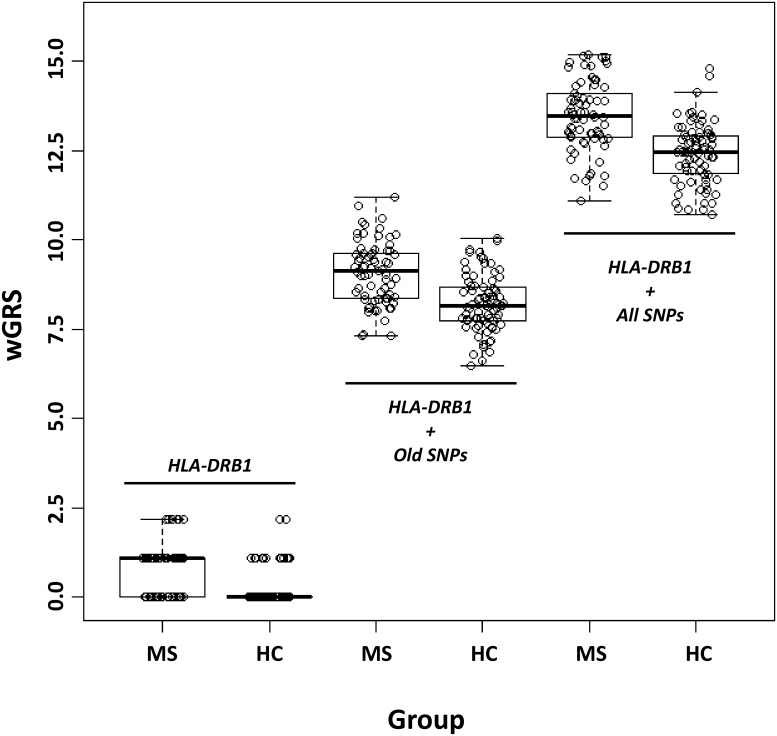
Figure 2. Boxplots of weighted genetic risk score (wGRS) in MS patients and HC considering only HLA-DRB1, HLA-DRB1 + MS associations known in 2011 and HLA-DRB1 + all currently known MS associations.
The wGRS was calculated by multiplying the number of risk alleles by the weight of each SNP and then taking the sum across all associations (see methods). The whiskers extend to the most extreme data point which is no more than 1.5 times the IQR from the box.
Figure 3
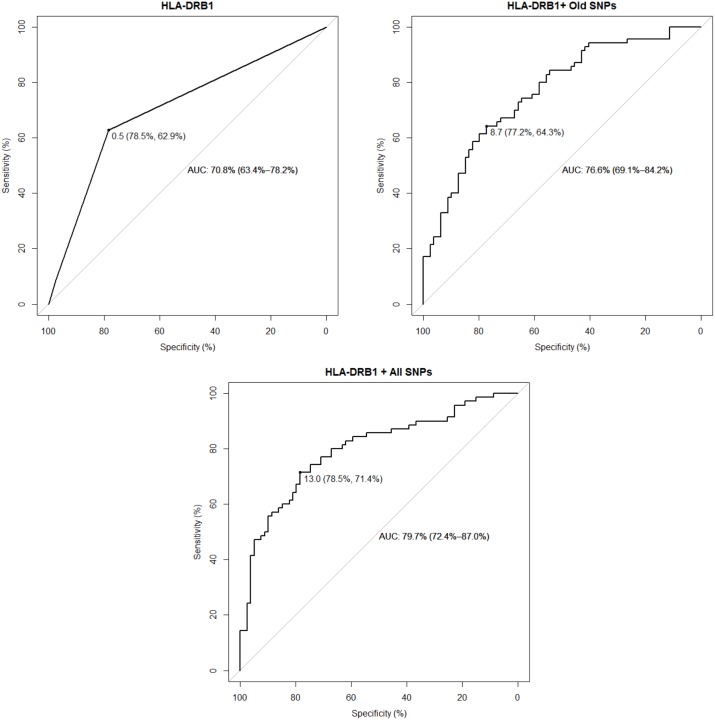
Figure 3. Predictive performance of the wGRS assessed using receiver operating characteristic (ROC) curves when considering only HLA-DRB1, HLA-DRB1 + MS associations known in 2011 and HLA-DRB1 + all currently known MS associations.
The wGRS threshold providing the best predictive performance is also shown (specificity and sensitivity within brackets).

References

    1. Compston A, Coles A (2008) Multiple sclerosis. Lancet 372: 1502–1517. - PubMed
    1. Willer CJ, Dyment DA, Risch NJ, Sadovnick AD, Ebers GC (2003) Twin concordance and sibling recurrence rates in multiple sclerosis. Proc Natl Acad Sci U S A 100: 12877–12882. - PMC - PubMed
    1. Jersild C, Fog T, Hansen GS, Thomsen M, Svejgaard A, et al. (1973) Histocompatibility determinants in multiple sclerosis, with special reference to clinical course. Lancet 2: 1221–1225. - PubMed
    1. Sawcer S, Hellenthal G, Pirinen M, Spencer CC, Patsopoulos NA, et al. (2011) Genetic risk and a primary role for cell-mediated immune mechanisms in multiple sclerosis. Nature 476: 214–219. - PMC - PubMed
    1. Patsopoulos NA, Esposito F, Reischl J, Lehr S, Bauer D, et al. (2011) Genome-wide meta-analysis identifies novel multiple sclerosis susceptibility loci. Ann Neurol 70: 897–912. - PMC - PubMed

Publication types