. 2014 Jul;196(14):2552-62.
doi: 10.1128/JB.01652-14. Epub 2014 May 2.

The terminal oxidase cbb3 functions in redox control of magnetite biomineralization in Magnetospirillum gryphiswaldense

Affiliations

The terminal oxidase cbb3 functions in redox control of magnetite biomineralization in Magnetospirillum gryphiswaldense

Yingjie Li et al. J Bacteriol. 2014 Jul.

Abstract

The biomineralization of magnetosomes in Magnetospirillum gryphiswaldense and other magnetotactic bacteria occurs only under suboxic conditions. However, the mechanism of oxygen regulation and redox control of biosynthesis of the mixed-valence iron oxide magnetite [FeII(FeIII)2O4] is still unclear. Here, we set out to investigate the role of aerobic respiration in both energy metabolism and magnetite biomineralization of M. gryphiswaldense. Although three operons encoding putative terminal cbb3-type, aa3-type, and bd-type oxidases were identified in the genome assembly of M. gryphiswaldense, genetic and biochemical analyses revealed that only cbb3 and bd are required for oxygen respiration, whereas aa3 had no physiological significance under the tested conditions. While the loss of bd had no effects on growth and magnetosome synthesis, inactivation of cbb3 caused pleiotropic effects under microaerobic conditions in the presence of nitrate. In addition to their incapability of simultaneous nitrate and oxygen reduction, cbb3-deficient cells had complex magnetosome phenotypes and aberrant morphologies, probably by disturbing the redox balance required for proper growth and magnetite biomineralization. Altogether, besides being the primary terminal oxidase for aerobic respiration, cbb3 oxidase may serve as an oxygen sensor and have a further role in poising proper redox conditions required for magnetite biomineralization.


Figures

FIG 1
FIG 1
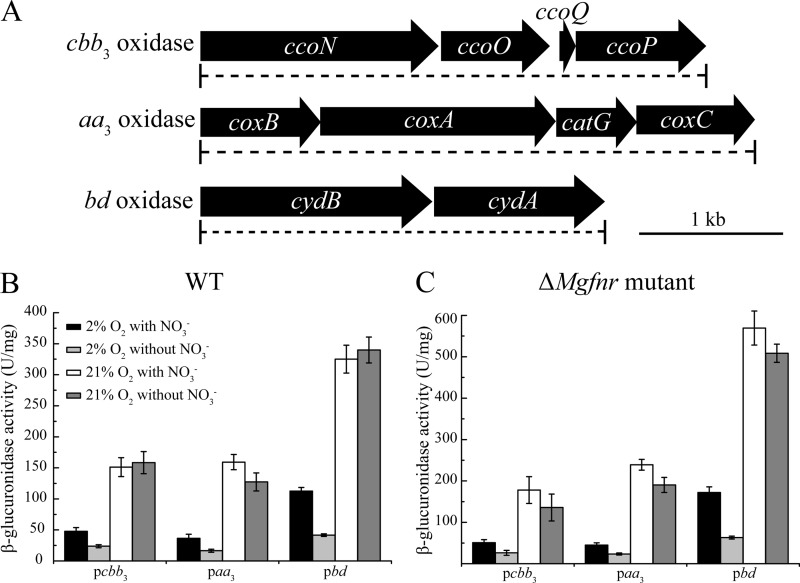
(A) Molecular organization of putative terminal oxidase in the genome assembly of MSR-1. Dashed lines indicate the extent of deletions in mutant strains. (B and C) Transcription of putative terminal oxidase operons with gusA as a reporter in WT (B) and ΔMgfnr mutant (C) cells. Cultures were grown aerobically (21% O2) in nitrate and ammonium medium or microaerobically (2% O2) in nitrate and ammonium medium. Expression was measured by β-glucuronidase activities.
FIG 2
FIG 2
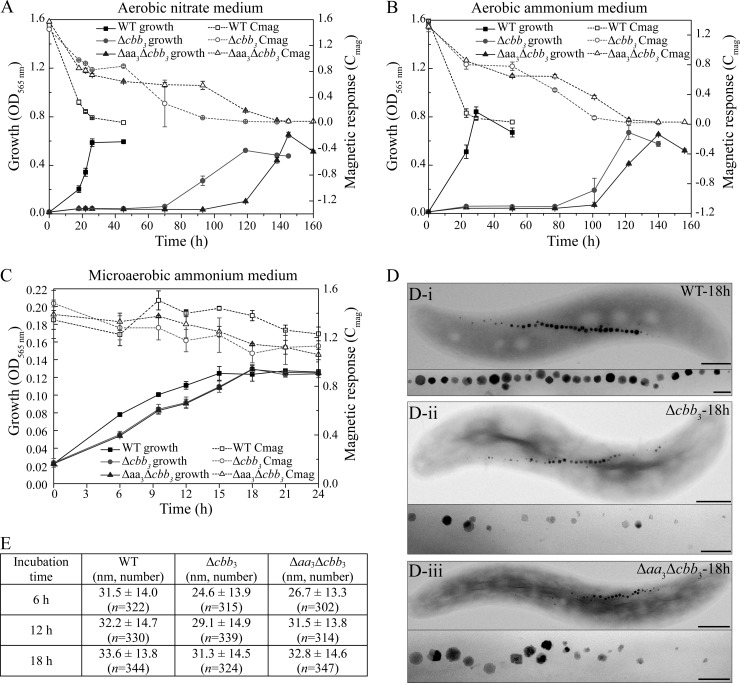
(A to C) Growth (OD565) and magnetic response (Cmag) of MSR-1 WT, Δcbb3, and Δaa3 Δcbb3 strains under different conditions. (A) Aerobic conditions in nitrate medium; (B) aerobic conditions in ammonium medium; (C) microaerobic conditions in ammonium medium. (D) TEM images of microaerobically grown WT (i), Δcbb3 mutant (ii), and Δaa3 Δcbb3 mutant (iii) strains in ammonium medium. Bars, 500 nm (whole cells) and 100 nm (magnetosomes). (E) Measurements of crystal sizes for MSR-1 WT, Δcbb3, and Δaa3 Δcbb3 strains at different time points in microaerobic ammonium medium. Results from representative experiments were determined in triplicate, and values are given as means and standard deviations.
FIG 3
FIG 3
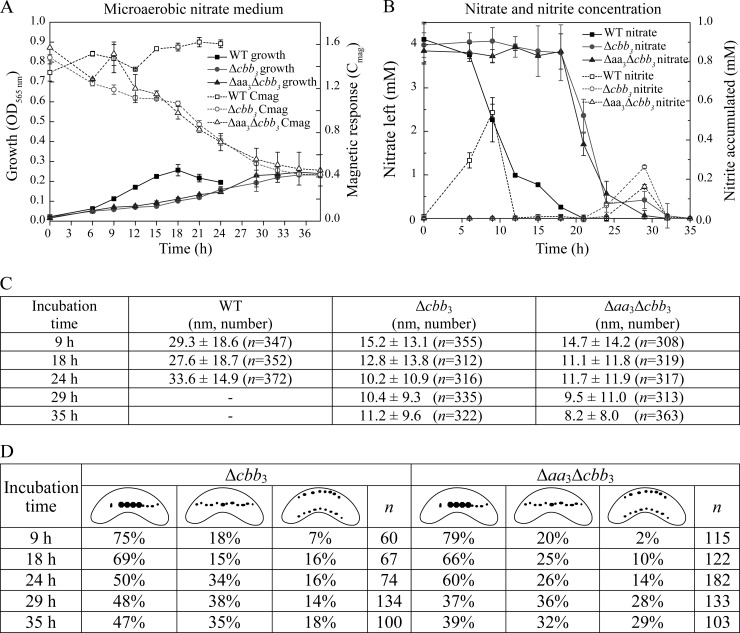
(A) Growth (OD565) and magnetic response (Cmag) of MSR-1 WT, Δcbb3, and Δaa3 Δcbb3 strains in microaerobic nitrate medium. (B) Time courses of nitrate and nitrite utilization during microaerobic growth in nitrate medium. (C) Measurements of crystal sizes for MSR-1 WT, Δcbb3, and Δaa3 Δcbb3 strains at different time points in microaerobic nitrate medium. The number of crystals measured for each strain (n) is shown. (D) Magnetosome morphotypes in Δcbb3 and Δaa3 Δcbb3 mutants and proportion of each morphotype at different time points. The number of cells measured for each strain is presented.
FIG 4
FIG 4
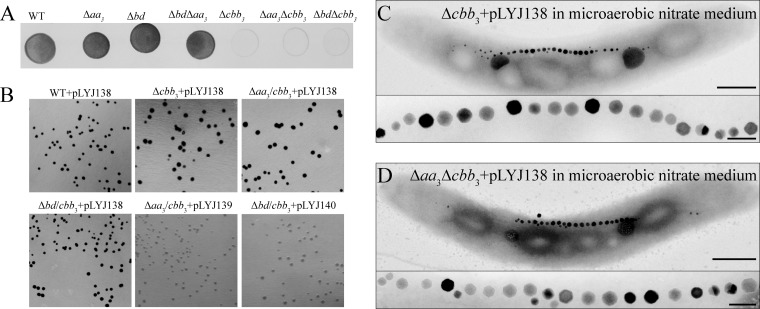
(A) Nadi assay of the WT and various mutant strains. This method is commonly used to specifically detect cytochrome c oxidase activity (26), which is based on the rapid formation of indophenol blue from colorless α-naphthol catalyzed by cytochrome c oxidases with N,N-dimethyl-p-phenylenediamine monohydrochloride as an exogenous electron donor. Five microliters of cultures grown anaerobically for 24 h, which were adjusted to about 107 CFU/ml, were dropped onto an agar plate in the presence of nitrate. Strains were incubated at 30°C for 4 days under anaerobic conditions and photographed after a 5-min Nadi reaction. (B) Nadi assay of anaerobically grown complementation strains. Plasmid pLYJ138 contains a WT cbb3 allele, while pLYJ139 and pLYJ140 harbor WT aa3 and bd alleles, respectively. (C) TEM images of Δcbb3 and Δaa3 Δcbb3 strains complemented with plasmid pLY138, harboring the WT cbb3 allele, grown in microaerobic nitrate medium. Bars, 500 nm (whole cells) and 100 nm (magnetosomes).
FIG 5
FIG 5
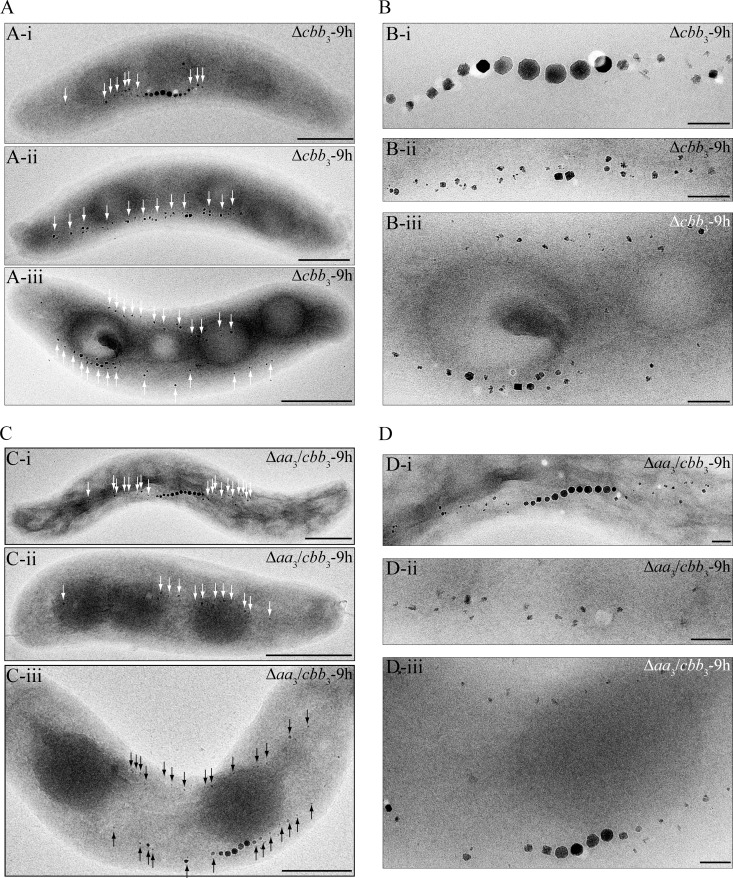
Biomineralization phenotypes of Δcbb3 and Δaa3 Δcbb3 mutants incubated for 9 h in microaerobic nitrate medium. (A and C) TEM images of whole cells of the Δcbb3 (A) and Δaa3 Δcbb3 (C) mutants. Bar, 500 nm. (B and D) Close-up views of magnetosome crystals shown in panels A and C, respectively. Bar, 100 nm. Irregularly shaped particles are indicated by arrows.
FIG 6
FIG 6
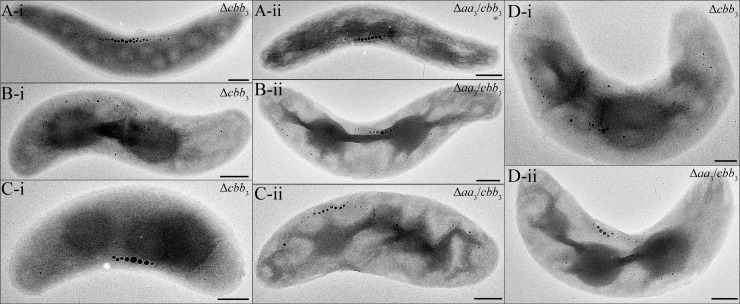
Morphologies found in different cells of the Δcbb3 and Δaa3 Δcbb3 mutants in microaerobic nitrate medium. (A) WT-like spiral-shaped mutant cells; (B) thicker spiral cells; (C and D) thicker and smaller vibrioid cells. Bar, 500 nm.
FIG 7
FIG 7
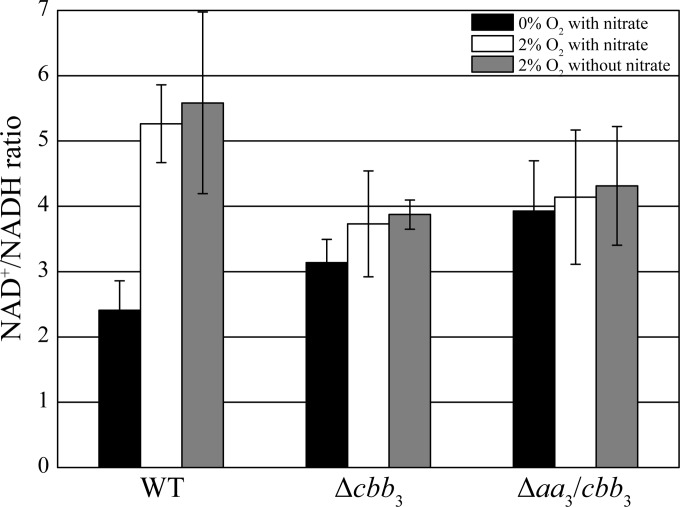
Cellular NAD+/NADH ratio measurements of WT, Δcbb3, and Δaa3 Δcbb3 strains under different conditions. NAD+ and NADH were extracted from cells grown in liquid medium, measured, normalized by the luminescence signal, and plotted. Means ± standard deviations are shown (n = 3).

References

    1. Jogler C, Schüler D. 2009. Genomics, genetics, and cell biology of magnetosome formation. Annu. Rev. Microbiol. 63:501–521. 10.1146/annurev.micro.62.081307.162908 - DOI - PubMed
    1. Schübbe S, Kube M, Scheffel A, Wawer C, Heyen U, Meyerdierks A, Madkour MH, Mayer F, Reinhardt R, Schüler D. 2003. Characterization of a spontaneous nonmagnetic mutant of Magnetospirillum gryphiswaldense reveals a large deletion comprising a putative magnetosome island. J. Bacteriol. 185:5779–5790. 10.1128/JB.185.19.5779-5790.2003 - DOI - PMC - PubMed
    1. Ullrich S, Kube M, Schübbe S, Reinhardt R, Schüler D. 2005. A hypervariable 130-kilobase genomic region of Magnetospirillum gryphiswaldense comprises a magnetosome island which undergoes frequent rearrangements during stationary growth. J. Bacteriol. 187:7176–7184. 10.1128/JB.187.21.7176-7184.2005 - DOI - PMC - PubMed
    1. Murat D, Quinlan A, Vali H, Komeili A. 2010. Comprehensive genetic dissection of the magnetosome gene island reveals the step-wise assembly of a prokaryotic organelle. Proc. Natl. Acad. Sci. U. S. A. 107:5593–5598. 10.1073/pnas.0914439107 - DOI - PMC - PubMed
    1. Lohsse A, Ullrich S, Katzmann E, Borg S, Wanner G, Richter M, Voigt B, Schweder T, Schüler D. 2011. Functional analysis of the magnetosome island in Magnetospirillum gryphiswaldense: the mamAB operon is sufficient for magnetite biomineralization. PLoS One 6:e25561. 10.1371/journal.pone.0025561 - DOI - PMC - PubMed

Publication types

MeSH terms