Review
. 2014 Jul;22(7):389-98.
doi: 10.1016/j.tim.2014.04.004. Epub 2014 May 1.

Chemosensory signaling systems that control bacterial survival

Affiliations
Review

Chemosensory signaling systems that control bacterial survival

Kuang He et al. Trends Microbiol. 2014 Jul.

Abstract

Recent studies have revealed that several Gram-negative species utilize variations of the well-known chemotaxis signaling cascade to switch lifestyles in order to survive environmental stress. The two survival strategies covered in this review are the development of dormant cyst cells and biofilm formation. Each of these structures involves exopolysaccharide-mediated cell-cell interactions, which result in multicellular communities that confer resistance to stress conditions such as desiccation and antibiotics. This review is centered on recent advances in the understanding of phosphate flow and novel output signals in chemosensory signaling pathways that are involved in cyst formation and biofilms.

Keywords: bacterial survival; biofilm; chemotaxis-like signal transduction systems; cyst formation; phosphate flow.


Figures

Figure 1
Figure 1
Bacterial species with metabolic versatility. (A) Myxococcus xanthus fruiting bodies (yellow), courtesy of Gregory Velicer, ETH Zurich. (B) Encysting Rhodospirillum centenum cysts (brown) among vegetative parent cells (green). (C) Flocculating Azospirillum brasilence (purple). (D) Pseudomonus aeruginosa biofilm (green) on mouse trachea, courtesy of Thomas Moninger, University of Iowa Central Microscopy Research Facilities, Iowa City, IA, USA.
Figure 2
Figure 2
Che pathways in Myxococcus xanthus. (A) The Dif signal transduction pathway. The Dif system lacks homologs of CheB and CheR. The CheY homolog DifD serves as a phosphate sink to the CheA homolog DifE, which is proposed to have unidentified downstream partners that control exopolysaccharide production. A CheC homolog DifG functions as a phosphatase of DifD. (B) The Che3 signal transduction pathway. The Che3 system controlling developmental gene expression during fruiting body formation involves two gene clusters, che3 and crdS. CheA3 negatively regulates the CrdS-CrdA TCS by functioning as a phosphatase to the response regulator CrdA. As part of the che3 and crdS gene clusters, uncharacterized peptidylglycan-binding protein CrdB and penicillin-binding protein Pbp1A may provide additional inputs into the Che3 pathway.
Figure 3
Figure 3
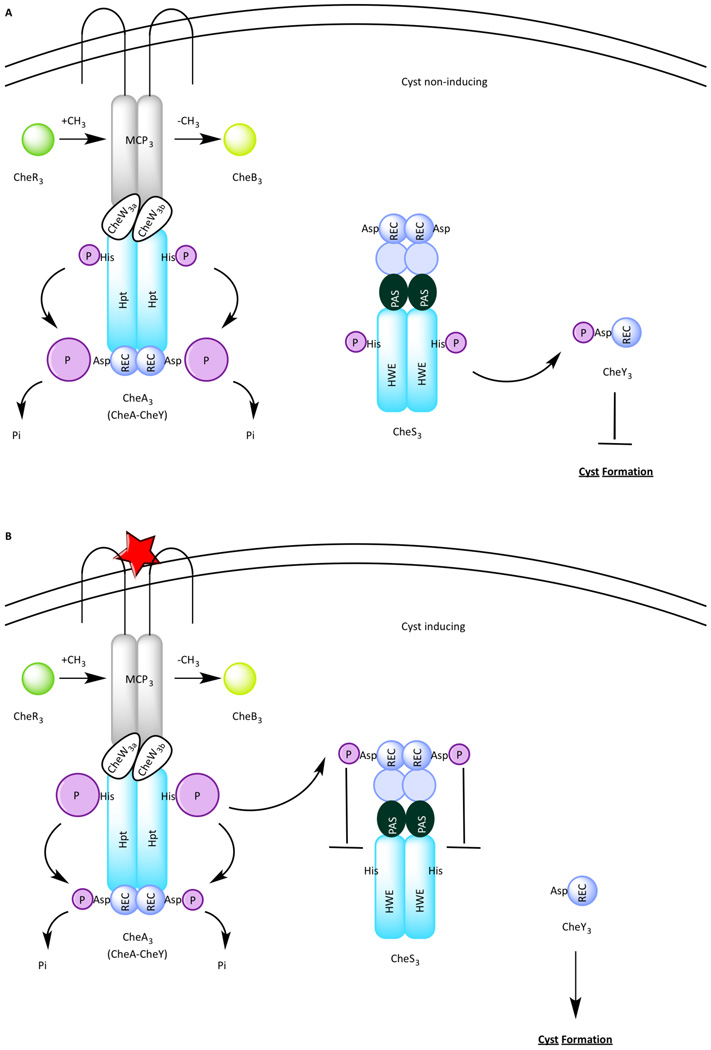
The Che3 pathway in Rhodospirillum centenum. (A) Under cyst non-inducing growth conditions, CheS3 phosphorylates CheY3 to repress cyst formation. (B) Under cyst inducing growth conditions, MCP3 receives a signal thus activating CheA3, which in turn phosphorylates a receiver domain of CheS3, leading to inhibition of the CheS3-CheY3 TCS.
Figure 4
Figure 4
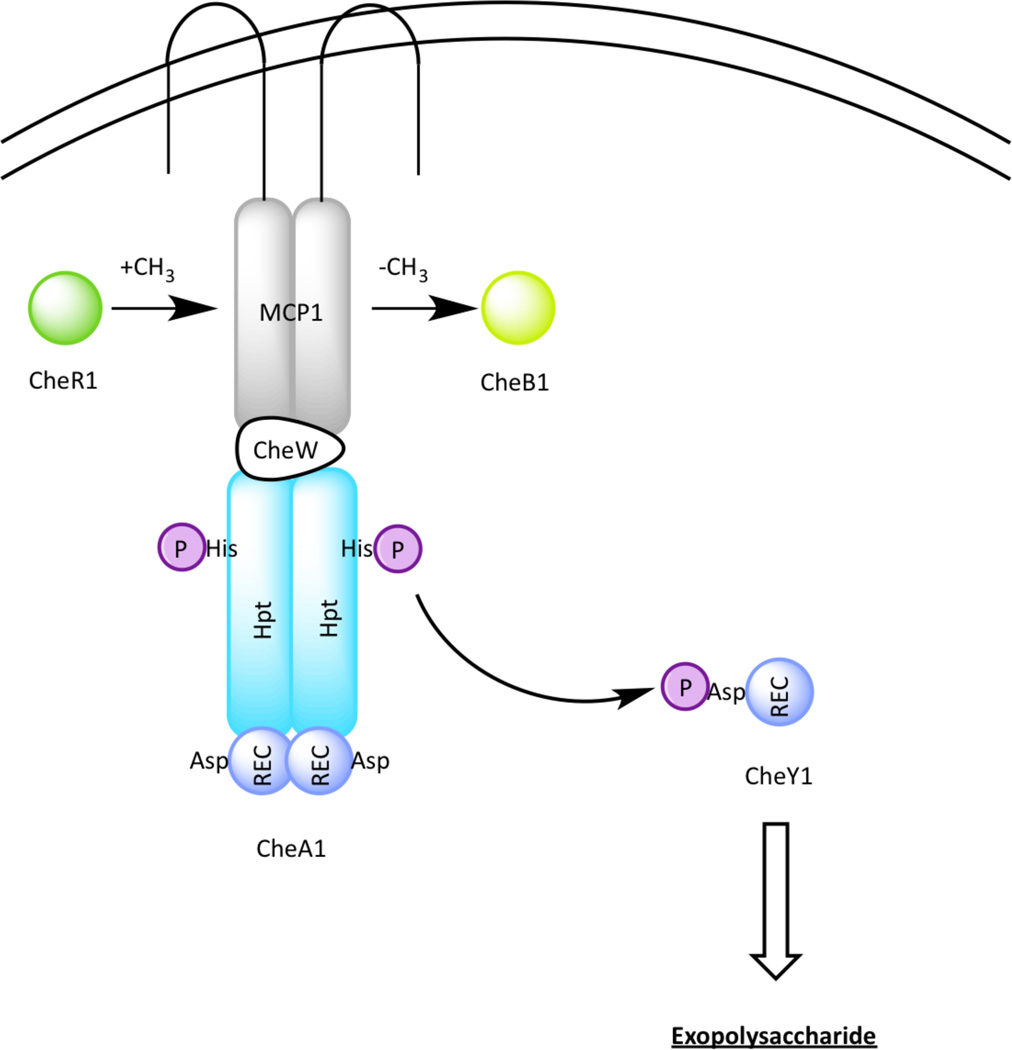
The Che1 pathway in Azospirillum brasilence. The Che1 pathway plays minor roles in chemotaxis and aerotaxis and to modulate production of exopolysaccharide, which is required for clumping and flocculation.
Figure 5
Figure 5
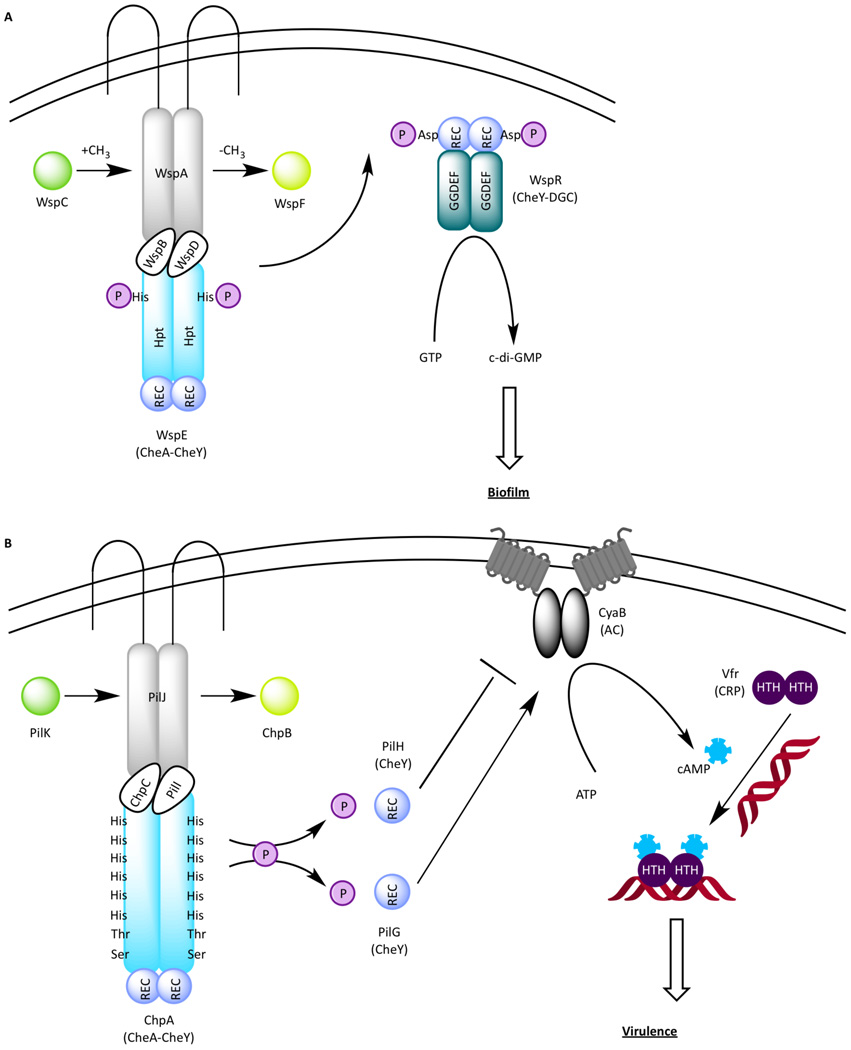
(A) The Wsp signal transduction pathway. A TCS used by the Wsp system consists of WspE, a CheA-CheY hybrid, and WspR containing a N-terminal REC domain followed by a GGDEF module with diguanylate cyclase activity. WspR produces c-di-GMP, which in turn promotes biofilm formation in P. aeruginosa. (B) The Chp signal transduction pathway. Two CheY homologs PilH and PilG differentially regulate the activity of an adenylate cyclase (AC), which produces cAMP to control virulence via Vfr, a transcription factor belonging to the cAMP receptor protein (CRP) family. The novel kinase ChpA contains nine predicted phosphorylatable sites, including six conserved histidines located in Hpt domains, and another two located in Hpt-like domains where the conserved histidines are substutituted with a threonine and a serine, respectively.
BOX Figure
BOX Figure
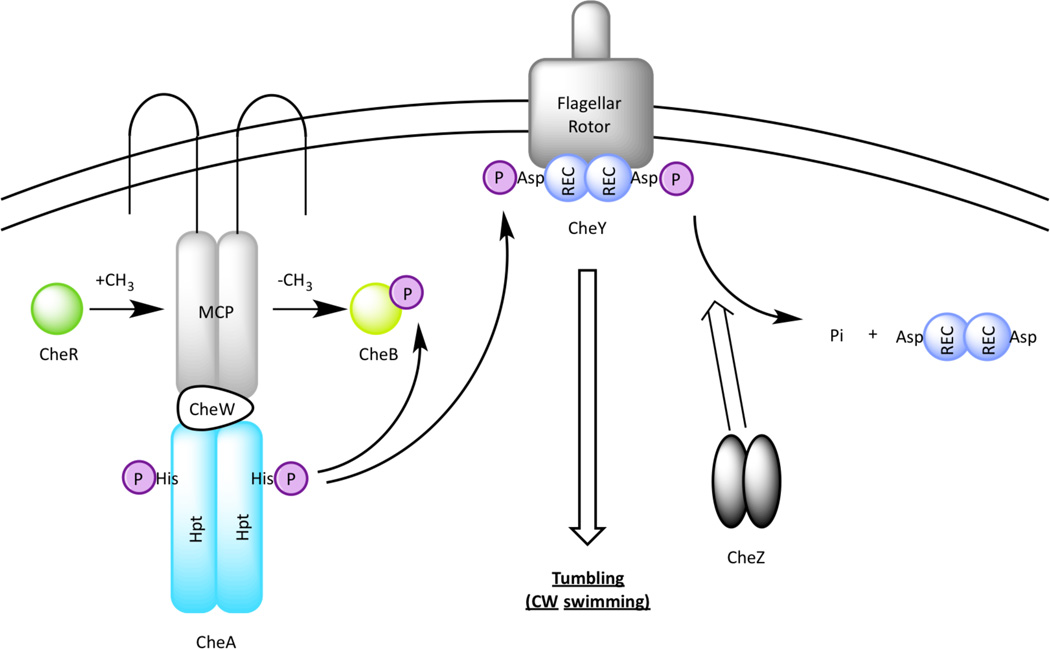
Chemotaxis signal transduction in Escherichia coli. CheA forms a tertiary complex with a chemorecepter (MCP) and the scaffolding protein CheW to receive chemical stimuli in the environment. Once a signal is received by an MCP, CheA autokinase is activated which subsequently phosphorylates CheY. Phosphorylated CheY binds to the flagellar rotor, leading to a change in flagellar rotation. Signal is terminated via the phosphatase activity by CheZ. An adaptation mechanism of the MCPs involves a methyltransferase CheR, which constitutively methylates MCPs, and a methylesterase CheB, which demethylates MCPs only when phosphorylated by CheA.

References

    1. Sudo SZ, Dworkin M. Resistance of vegetative cells and microcysts of Myxococcus xanthus. J Bacteriol. 1969;98:883–887. - PMC - PubMed
    1. Sadasivan L, Neyra CA. Cyst production and brown pigment formation in aging cultures of Azospirillum brasilense ATCC 29145. J Bacteriol. 1987;169:1670–1677. - PMC - PubMed
    1. Sadasivan L, Neyra CA. Flocculation in Azospirillum brasilense and Azospirillum lipoferum: exopolysaccharides and cyst formation. J Bacteriol. 1985;163:716–723. - PMC - PubMed
    1. Tal S, Okon Y. Production of the reserve material poly-β-hydroxybutyrate and its function in Azospirillum brasilense Cd. Can J Microbiol. 1985;31:608–613.
    1. Berleman JE, Bauer CE. Characterization of cyst cell formation in the purple photosynthetic bacterium Rhodospirillum centenum. Microbiology (Reading, Engl) 2004;150:383–390. - PubMed

Publication types

MeSH terms

Substances

LinkOut - more resources