Review
. 2014 Apr 21:5:151.
doi: 10.3389/fphys.2014.00151. eCollection 2014.

Impact of vitamin D on immune function: lessons learned from genome-wide analysis

Affiliations
Review

Impact of vitamin D on immune function: lessons learned from genome-wide analysis

Rene F Chun et al. Front Physiol. .

Abstract

Immunomodulatory responses to the active form of vitamin D (1,25-dihydroxyvitamin D, 1,25D) have been recognized for many years, but it is only in the last 5 years that the potential role of this in normal human immune function has been recognized. Genome-wide analyses have played a pivotal role in redefining our perspective on vitamin D and immunity. The description of increased vitamin D receptor (VDR) and 1α-hydroxylase (CYP27B1) expression in macrophages following a pathogen challenge, has underlined the importance of intracrine vitamin D as key mediator of innate immune function. It is now clear that both macrophages and dendritic cells (DCs) are able to respond to 25-hydroxyvitamin D (25D), the major circulating vitamin D metabolite, thereby providing a link between the function of these cells and the variations in vitamin D status common to many humans. The identification of hundreds of primary 1,25D target genes in immune cells has also provided new insight into the role of vitamin D in the adaptive immune system, such as the modulation of antigen-presentation and T cells proliferation and phenotype, with the over-arching effects being to suppress inflammation and promote immune tolerance. In macrophages 1,25D promotes antimicrobial responses through the induction of antibacterial proteins, and stimulation of autophagy and autophagosome activity. In this way variations in 25D levels have the potential to influence both innate and adaptive immune responses. More recent genome-wide analyses have highlighted how cytokine signaling pathways can influence the intracrine vitamin D system and either enhance or abrogate responses to 25D. The current review will discuss the impact of intracrine vitamin D metabolism on both innate and adaptive immunity, whilst introducing the concept of disease-specific corruption of vitamin D metabolism and how this may alter the requirements for vitamin D in maintaining a healthy immune system in humans.

Keywords: CYP27B1; VDR; antibacterial; antigen-presentation; dendritic cell; intracrine; macrophage.


Figures
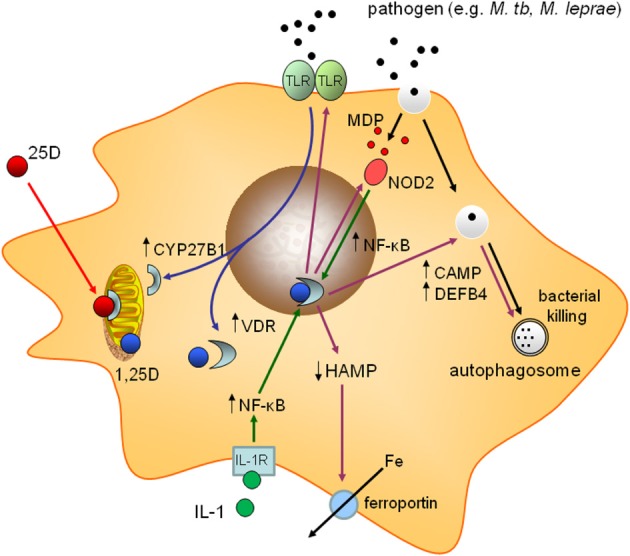
Figure 1
Figure 1
Mechanisms for induction of vitamin D-mediated antibacterial responses in monocytes. Schematic representation of monocyte/macrophage responses to infection with a pathogen such as Mycobacterium tuberculosis (M. tb). Pattern recognition receptors (TLR2/1) sense M. tb and signal to induce expression of 1α-hydroxylase (CYP27B1) and the vitamin D receptor (VDR). The resulting intracrine system for vitamin D (blue arrows) converts 25-hydroxyvitamin D (25D) to 1,25-dihydroxyvitamin D (1,25D), which then binds to VDR and promotes transcriptional regulation. Prominent responses to intracrine activation of vitamin D (pink arrows) include: induction of antibacterial cathelicidin (CAMP) and β-defensin 2 (DEFB4); suppression of iron-regulatory hepcidin (HAMP); promotion of autophagy; induction of NOD2 expression; feedback regulation of toll-like receptor (TLR) expression; increased bacterial killing. For some responses (e.g., induction of DEFB4) accessory immune signals (MDP binding to NOD2, and IL-1 responsiveness) cooperate with intracrine vitamin D via nuclear factor-κB (NF-κB) (green arrows).
Figure 2
Figure 2
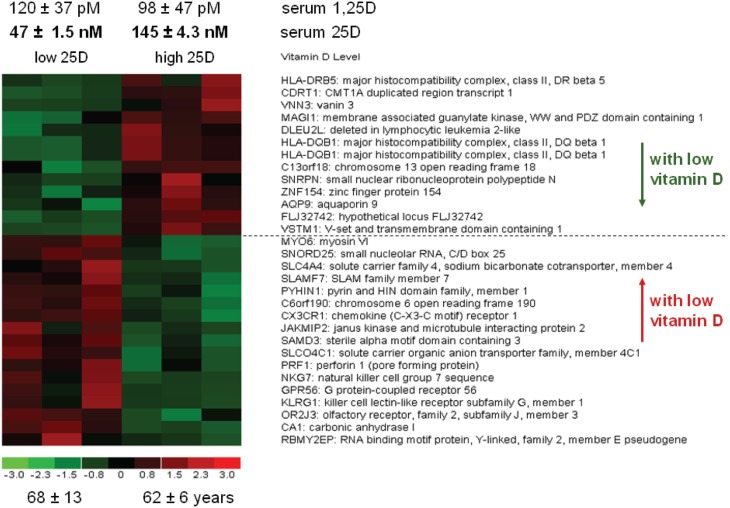
Altered gene expression in leukocytes from vitamin D-deficient donors. Peripheral blood mononuclear cells (PBMC) were obtained from 6 healthy donors who had serum 25D levels that were either low (47 nM, 18.8 ng/ml) or high (145 nM, 58 ng/ml). After isolation of RNA and generation of cDNA, gene expression analyses in the PBMC samples was carried out by DNA array analyses (Affymetrix Exon Expr Chip.HuGene-1_0-st-v1). Data are shown as genes that were either increased (red) or decreased (green) in low 25D donors relative to high 25D donors (>1.5-fold change, p < 0.05, unpaired t-test).
Figure 3
Figure 3
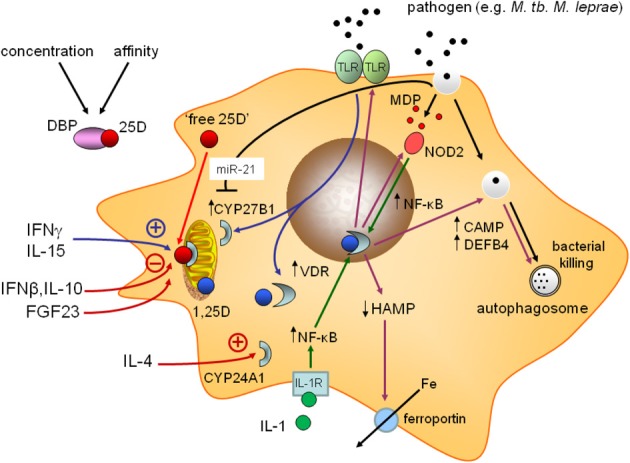
Mechanisms for corruption of vitamin D-mediated antibacterial responses in monocytes. Schematic representation of monocyte/macrophage responses to infection with a pathogen such as Mycobacterium tuberculosis (M. tb), and associated adjunct signals. Positive effects on the vitamin D intracrine system include: induction of CYP27B1 expression by cytokines such as interferon γ (IFNγ) and interleukin-15 (IL-15). Negative effects include suppression of CYP27B1 by IL-10 and IFNβ, and induction of 24-hydroxylase activity by IL-4. Fibroblast growth factor 23 (FGF23) also suppresses CYP27B1 and microRNA-21 (miR-21) associated with some pathogen infections (e.g., M. leprae) can suppress expression of CYP27B1 by degradation of RNA and/or translation. The serum vitamin D binding protein (DBP) may also attenuate intracrine vitamin D by restricting monocyte bioavailability of free 25D.

References

    1. Abbas A. K., Murphy K. M., Sher A. (1996). Functional diversity of helper T lymphocytes. Nature 383, 787–793 10.1038/383787a0 - DOI - PubMed
    1. Adams J., Gacad M. A., Baker A. J., Gonzales B., Rude R. K. (1985). Serum concentrations of 1,25-dihydroxyvitamin D3 in platyrrhini and catarrhini:a phylogenetic appraisal. Am. J. Primatol. 28, 263–270 - PubMed
    1. Adams J. S., Hewison M. (2008). Unexpected actions of vitamin D: new perspectives on the regulation of innate and adaptive immunity. Nat. Clin. Pract. Endocrinol. Metab. 4, 80–90 10.1038/ncpendmet0716 - DOI - PMC - PubMed
    1. Adams J. S., Sharma O. P., Gacad M. A., Singer F. R. (1983). Metabolism of 25-hydroxyvitamin D3 by cultured pulmonary alveolar macrophages in sarcoidosis. J. Clin. Invest. 72, 1856–1860 10.1172/JCI111147 - DOI - PMC - PubMed
    1. Airey F. S. (1946). Vitamin D as a remedy for lupus vulgaris. Med. World 64, 807–810 - PubMed