. 2014 May 27;8(5):4740-6.
doi: 10.1021/nn500550q. Epub 2014 May 5.

Tunable protease-activatable virus nanonodes

Affiliations

Tunable protease-activatable virus nanonodes

Justin Judd et al. ACS Nano. .

Abstract

We explored the unique signal integration properties of the self-assembling 60-mer protein capsid of adeno-associated virus (AAV), a clinically proven human gene therapy vector, by engineering proteolytic regulation of virus-receptor interactions such that processing of the capsid by proteases is required for infection. We find the transfer function of our engineered protease-activatable viruses (PAVs), relating the degree of proteolysis (input) to PAV activity (output), is highly nonlinear, likely due to increased polyvalency. By exploiting this dynamic polyvalency, in combination with the self-assembly properties of the virus capsid, we show that mosaic PAVs can be constructed that operate under a digital AND gate regime, where two different protease inputs are required for virus activation. These results show viruses can be engineered as signal-integrating nanoscale nodes whose functional properties are regulated by multiple proteolytic signals with easily tunable and predictable response surfaces, a promising development toward advanced control of gene delivery.


Figures

Figure 1
Figure 1
Programming AAV capsid with proteolytic regulation. (a) Operation of PAVs. Locked virus cannot interact with cellular HSPG until processed by target protease. Upon virus activation, genetic payload (CMV-GFP transgene) is delivered to cell nucleus. (b) Molecular models of PAV1 (Table 1) in locked (gray) and unlocked (blue) states. Peptide lock leaving group in red. (c) Electron micrographs of PAV1 in the locked (left) and unlocked (right) states indicate capsids remain intact after MMP-7 treatment (scalebar = 20 nm). (d) Western blot with B1 antibody shows cleaved VP after MMP-7 (+) treatment compared to sham (−). (e) Heparin chromatography reveals low-affinity uncleaved virus (gray) elutes in low salt, whereas MMP-7 treated particles require high ionic strength to disrupt tight AAV-heparin interactions. (f) HEK293T cells transduced (gMOI = 700) by PAV1 capsids, packaging a single-stranded (ssDNA) or a self-complementary double-stranded (dsDNA) transgene, show striking increases in gene delivery after treatment by MMP-7 (blue bars) compared to sham (gray bars). Expectedly, the dsDNA transgene increases gene expression from both sham and MMP-7 treated PAV1. Wt capsids shown for comparison (note: dsDNA is saturated at approximately 100% GFP+ cells). (g, h) MMP-7 treated PAV at right, sham at left. (g) Fluorescent micrographs of HEK293T cells transduced with PAV1 (ssDNA) before/after MMP-7 treatment. (h) Dotplots of HEK293T cells transduced by PAV12 (dsDNA, gMOI = 1000). Error bars are SEM from two (panel e) and three (panel f) independent experiments, each performed in duplicate.
Figure 2
Figure 2
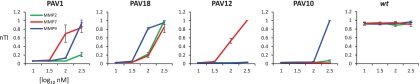
PAV variants display different susceptibilities to MMPs. PAVs treated with MMP-2, -7, or -9 were used to transduce HEK293T cells with a GFP reporter (dsDNA). Y-axes indicate normalized transduction index (nTI) as a measure of virus activity. Sample sizes of independent experiments performed in duplicate: PAV1, n = 4; PAV18, n = 2; PAV12, n = 3; PAV10, n = 2; wt, n = 3. Error bars are SEM.
Figure 3
Figure 3
PAV activation dynamics and transfer function. (a) Transfer function of analogue PAV activity A(UL) (mean relative transduction index, cyan circles) as a function of fraction unlocked (UL), fit to Hill function (eq 2; n = 5.8, K = 0.85). Threshold (dashed line) required to achieve 50% activation (A1/2) is shown (t = 0.77; i.e. ∼46 unlocked peptides or >90 single cleavage events per capsid). (b) Nodal abstraction of PAVs integrating multiple inputs (Ii = fraction unlocked of lock type Li) with tunable weights (wi), generating output virus activity through transfer function in (a).
Figure 4
Figure 4
Tunable PAVs built from mosaic capsids. PAV12 (top, all red capsid) and PAV10 (bottom, all blue capsid) are single-input devices (MMP-7 and MMP-9, respectively). Mosaic capsids (middle three rows) composed of subunits from PAV12/10 (weights indicated by nodal diagrams) demonstrate tunability of devices. Analogue response column shows experimentally obtained heat maps of virus activity (in relative TI, rTI) to different combinations of MMP inputs (0, 1, 1.5, 2, 2.5 log10 nM, 4 h at 37 °C). Bar graphs show the analogue response (in rTI) can be simplified to adhere to a binary AND gate truth table (Inputs: 0 = sham, 1 = 102.5 nM MMP) by using A1/2 as an activation threshold (dashed line), where 0.5/0.5 mosaic performs optimally. Predicted mosaic responses are calculated from pure capsid (entirely PAV12 or PAV10) responses using eqs 1 and 2. Unzeroed data available in Figure S10, Supporting Information. Sample sizes of independent experiments performed in duplicate (top to bottom): n = 2,3,3,2. Truth table error bars show SEM.

References

    1. Park S. H.; Zarrinpar A.; Lim W. A. Rewiring MAP Kinase Pathways Using Alternative Scaffold Assembly Mechanisms. Science 2003, 299, 1061–1064. - PubMed
    1. Lee Y. J.; Yi H.; Kim W. J.; Kang K.; Yun D. S.; Strano M. S.; Ceder G.; Belcher A. M. Fabricating Genetically Engineered High-Power Lithium-Ion Batteries Using Multiple Virus Genes. Science 2009, 324, 1051–1055. - PubMed
    1. Miller R. A.; Presley A. D.; Francis M. B. Self-Assembling Light-Harvesting Systems from Synthetically Modified Tobacco Mosaic Virus Coat Proteins. J. Am. Chem. Soc. 2007, 129, 3104–3109. - PubMed
    1. Lee B. Y.; Zhang J.; Zueger C.; Chung W. J.; Yoo S. Y.; Wang E.; Meyer J.; Ramesh R.; Lee S. W. Virus-Based Piezoelectric Energy Generation. Nat. Nanotechnol 2012, 7, 351–356. - PubMed
    1. Lewis J. D.; Destito G.; Zijlstra A.; Gonzalez M. J.; Quigley J. P.; Manchester M.; Stuhlmann H. Viral Nanoparticles as Tools for Intravital Vascular Imaging. Nat. Med. 2006, 12, 354–360. - PMC - PubMed

Publication types

MeSH terms

Substances