


Abuse-related effects of dual dopamine/serotonin releasers with varying potency to release norepinephrine in male rats and rhesus monkeys
- PMID: 24796848
- PMCID: PMC4067459
- DOI: 10.1037/a0036595
Abuse-related effects of dual dopamine/serotonin releasers with varying potency to release norepinephrine in male rats and rhesus monkeys
Abstract
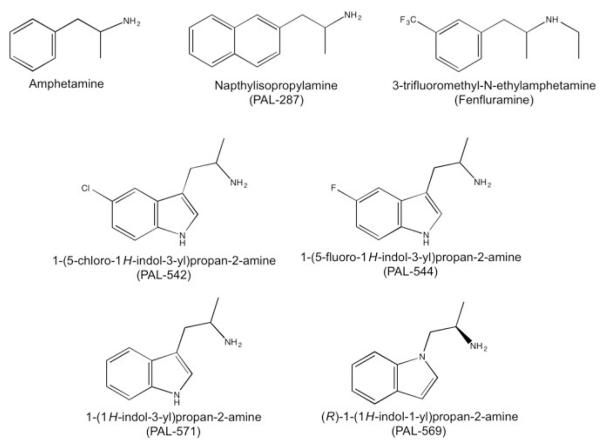
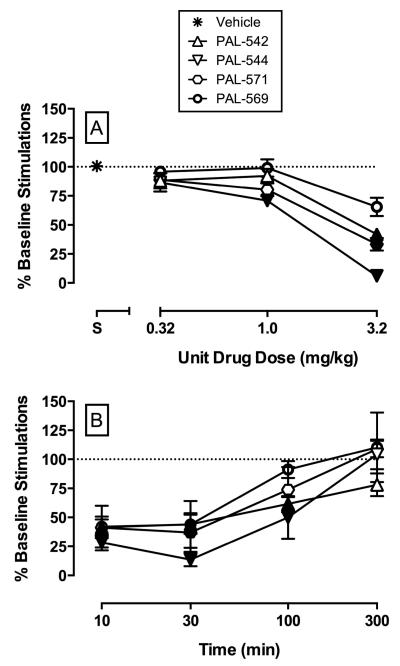
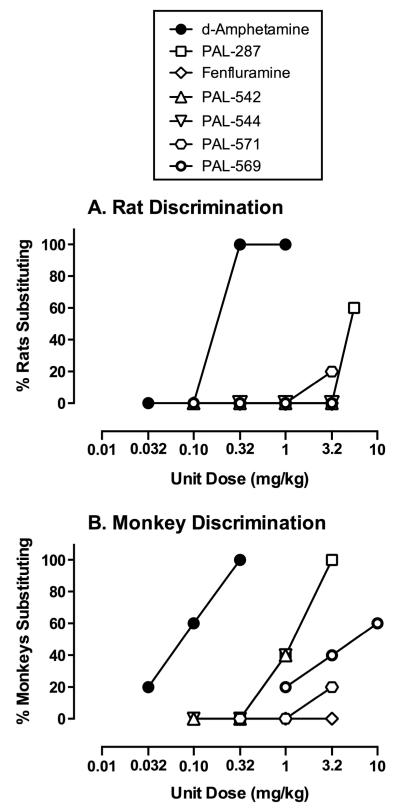
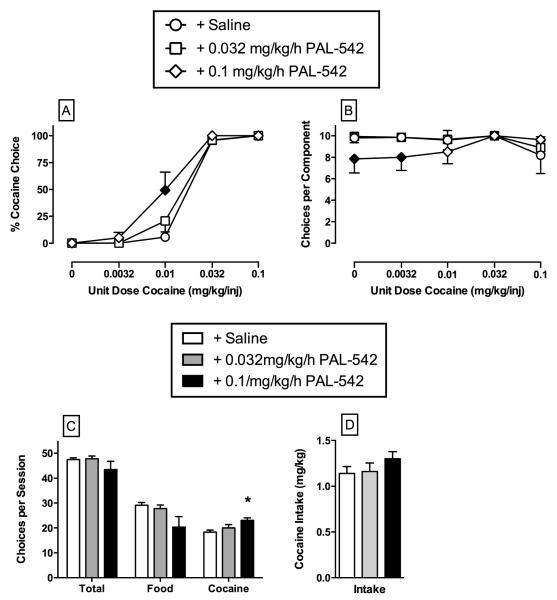
d-Amphetamine selectively promotes release of both dopamine (DA) and norepinephrine (NE) versus serotonin (5HT), and chronic d-amphetamine treatment decreases cocaine-taking behavior in rats, nonhuman primates, and humans. However, abuse liability limits the clinical utility of amphetamine maintenance for treating cocaine abuse. One strategy to improve safety and efficacy of monoamine releasers as candidate anticocaine medications has been to develop dual DA/5HT releasers like 1-napthyl-2-aminopropane (PAL-287), but the pharmacology of this class of compounds has not been extensively examined. In particular, PAL-287 has similar potencies to release DA, 5HT, and NE, and the role of manipulating NE release potency on abuse-related or anticocaine effects of dual DA/5HT releasers is not known. To address this issue, the present study compared effects of four novel DA/5HT releasers that varied >800-fold in their selectivities to release DA/5HT versus NE: [1-(5-chloro-1H-indol-3-yl)propan-2-amine (PAL-542), 1-(5-fluoro-1H-indol-3-yl)propan-2-amine (PAL-544), 1-(1H-indol-5-yl)propan-2-amine (PAL-571), and (R)-1-(1H-indol-1-yl)propain-2-amine (PAL-569). Abuse-related effects of all four compounds were evaluated in assays of intracranial self-stimulation (ICSS) in rats and cocaine discrimination in rats and monkeys, and none of the compounds reliably facilitated ICSS or substituted for cocaine. Anticocaine effects of the compound with highest selectivity to release DA/5HT versus NE (PAL-542) were tested in an assay of cocaine versus food choice in rhesus monkeys, and PAL-542 failed to reduce cocaine choice. These results suggests that potency to release NE has minimal influence on abuse liability of dual DA/5HT releasers, and reducing relative potency to release NE versus DA/5HT does not improve anticocaine efficacy.
PsycINFO Database Record (c) 2014 APA, all rights reserved.
Figures
References
-
- Anderson KG, Winger G, Woods J, Woolverton WL. Reinforcing and discriminative-stimulus effects of ephedrine isomers in rhesus monkeys. Drug and Alcohol Dependence. 2001;65:45–53. doi: http://dx.doi.org/10.1016/S0376-8716(01)00143-0. - DOI - PubMed
-
- Banks ML, Blough BE, Fennell TR, Snyder RW, Negus SS. Role of phenmetrazine as an active metabolite of phendimetrazine: Evidence from studies of drug discrimination and pharmacokinetics in rhesus monkeys. Drug and Alcohol Dependence. 2013b;130:158–166. doi: http://dx.doi.org/10.1016/j.drugalcdep.2012.10.026. - DOI - PMC - PubMed
-
- Banks ML, Blough BE, Negus SS. Effects of 14-day treatment with the schedule III anorectic phendimetrazine on choice between cocaine and food in rhesus monkeys. Drug and Alcohol Dependence. 2013;131:204–213. doi: http://dx.doi.org/10.1016/j.drugalcdep.2013.05.005. - DOI - PMC - PubMed
Publication types
MeSH terms
Substances
Grants and funding
LinkOut - more resources
Full Text Sources
Other Literature Sources
Medical
