


Alpha-fetoprotein level > 1000 ng/mL as an exclusion criterion for liver transplantation in patients with hepatocellular carcinoma meeting the Milan criteria
- PMID: 24797281
- PMCID: PMC4807739
- DOI: 10.1002/lt.23904
Alpha-fetoprotein level > 1000 ng/mL as an exclusion criterion for liver transplantation in patients with hepatocellular carcinoma meeting the Milan criteria
Abstract
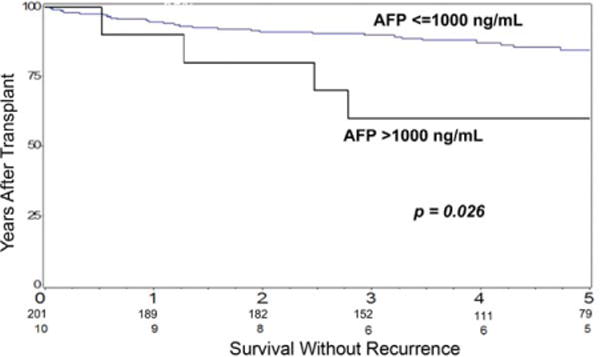
Serum alpha-fetoprotein (AFP) has been increasingly recognized as a marker for a poor prognosis after liver transplantation (LT) for hepatocellular carcinoma (HCC). Many published reports, however, have included a large proportion of patients with HCC beyond the Milan criteria, and the effects of incorporating AFP as an exclusion criterion for LT remain unclear. We studied 211 consecutive patients undergoing LT for HCC within the Milan criteria according to imaging under the Model for End-Stage Liver Disease organ allocation system between June 2002 and January 2009. The majority (93.4%) had locoregional therapy before LT. The median follow-up was 4.5 years (minimum = 2 years). The Kaplan-Meier 1- and 5-year patient survival rates were 94.3% and 83.4%, respectively. In a univariate analysis, significant predictors of HCC recurrence included vascular invasion [hazard ratio (HR) = 10, 95% confidence interval (CI) = 3.9-26, P < 0.001], a pathological tumor stage beyond the University of California San Francisco criteria (HR = 4.1, 95% CI = 1.36-12.6, P = 0.01), an AFP level > 1000 ng/mL (HR = 4.5, 95% CI = 1.3-15.3, P = 0.02), and an AFP level > 500 ng/mL (HR = 3.1, 95% CI = 1.04-9.4, P = 0.04). In a multivariate analysis, vascular invasion was the only significant predictor of tumor recurrence (HR = 5.6, 95% CI = 1.9-19, P = 0.02). An AFP level > 1000 ng/mL was the strongest pretransplant variable predicting vascular invasion (odds ratio = 6.8, 95% CI = 1.6-19.1, P = 0.006). The 1- and 5-year rates of survival without recurrence were 90% and 52.7%, respectively, for patients with an AFP level > 1000 ng/mL and 95% and 80.3%, respectively, for patients with an AFP level ≤ 1000 ng/mL (P = 0.026). Applying an AFP level > 1000 ng/mL as a cutoff would have resulted in the exclusion of 4.7% of the patients fr m LT and a 20% reduction in HCC recurrence. In conclusion, an AFP level > 1000 ng/mL may be a surrogate for vascular invasion and may be used to predict posttransplant HCC recurrence. Incorporating an AFP level > 1000 ng/mL as an exclusion criterion for LT within the Milan criteria may further improve posttransplant outcomes.
© 2014 American Association for the Study of Liver Diseases.
Figures
Comment in
-
Is there an ideal cutoff for α-fetoprotein as an exclusion criterion for liver transplantation?Liver Transpl. 2014 Oct;20(10):1284. doi: 10.1002/lt.23954. Liver Transpl. 2014. PMID: 25044482 No abstract available.
-
α-Fetoprotein and hepatocellular cancer recurrence: a paradigm of the chaos theory.Liver Transpl. 2014 Oct;20(10):1283. doi: 10.1002/lt.23962. Liver Transpl. 2014. PMID: 25060782 No abstract available.
-
Response to letter to the editors.Liver Transpl. 2014 Oct;20(10):1285. doi: 10.1002/lt.23982. Liver Transpl. 2014. PMID: 25155484 No abstract available.
References
-
- El-Serag HB. Hepatocellular carcinoma. N Engl J Med. 2011;365:1118–1127. - PubMed
-
- Pomfret EA, Washburn K, Wald C, Nalesnik MA, Douglas D, Russo M, et al. Report of a national conference on liver allocation in patients with hepatocellular carcinoma in the United States. Liver Transpl. 2010;16:262–278. - PubMed
Publication types
MeSH terms
Substances
Grants and funding
LinkOut - more resources
Full Text Sources
Other Literature Sources
Medical