. 2014 Jul;58(7):3950-6.
doi: 10.1128/AAC.02819-14. Epub 2014 May 5.

Biopharmaceutical characterization of nebulized antimicrobial agents in rats: 2. Colistin

Affiliations

Biopharmaceutical characterization of nebulized antimicrobial agents in rats: 2. Colistin

Aline Vidal Lacerda Gontijo et al. Antimicrob Agents Chemother. 2014 Jul.

Abstract

The purpose of this study was to investigate the pharmacokinetic properties of colistin following intrapulmonary administration of colistin sulfate in rats. Colistin was infused or delivered in nebulized form at a dose of 0.35 mg/kg of body weight in rats, and plasma drug concentrations were measured for 4 h after administration. Bronchoalveolar lavages (BAL) were also conducted at 0.5, 2, and 4 h after intravenous (i.v.) administration and administration via nebulized drug to estimate epithelial lining fluid (ELF) drug concentrations. Unbound colistin plasma concentrations at distribution equilibrium (2 h postdosing) were almost identical after i.v. infusion and nebulized drug inhalation. ELF drug concentrations were undetectable in BAL samples after i.v. administration, but they were about 1,800 times higher than unbound plasma drug levels at 2 h and 4 h after administration of the nebulized drug. Simultaneous pharmacokinetic modeling of plasma and ELF drug concentrations was performed with a model characterized by a fixed physiological volume of ELF (VELF), a passive diffusion clearance (QELF) between plasma and ELF, and a nonlinear influx transfer from ELF to the central compartment, which was assessed by reducing the nebulized dose of colistin by 10-fold (0.035 mg kg(-1)). The km was estimated to be 133 μg ml(-1), and the Vmax, in-to-Km ratio was equal to 2.5 × 10(-3) liter h(-1) kg(-1), which was 37 times higher than the QELF (6.7 × 10(-5) liter h(-1) kg(-1)). This study showed that with the higher ELF drug concentrations after administration via nebulized aerosol than after intravenous administration, for antibiotics with low permeability such as colistin, nebulization offers a real potential over intravenous administration for the treatment of pulmonary infections.


Figures

FIG 1
FIG 1
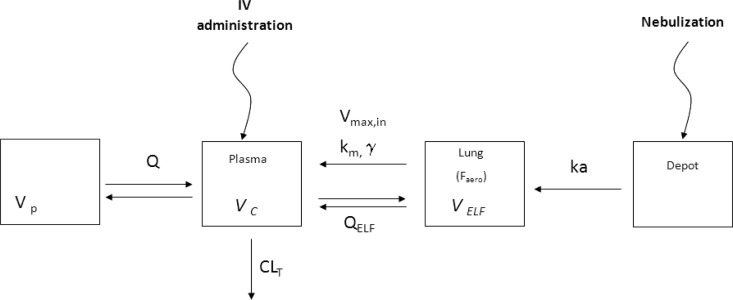
Simultaneous PK model of plasma and ELF colistin concentrations after i.v. administration or intratracheal administration of nebulized colistin, where Vc is the volume of the central compartment, VELF is the fixed volume of the ELF compartment (30 μl/kg), and Vp is the volume of the peripheral compartment. CLT corresponds to total plasma clearance, Q is the equilibrium distribution clearance between the central and peripheral compartments, and QELF is the diffusion clearance between the central compartment and ELF. Vmax, in is the maximum transfer rate from the ELF to the plasma compartment, km corresponds to the concentration at which the rate is half the maximum rate, and γ is the slope factor. Faero is the systemic bioavailability after aerosol administration.
FIG 2
FIG 2
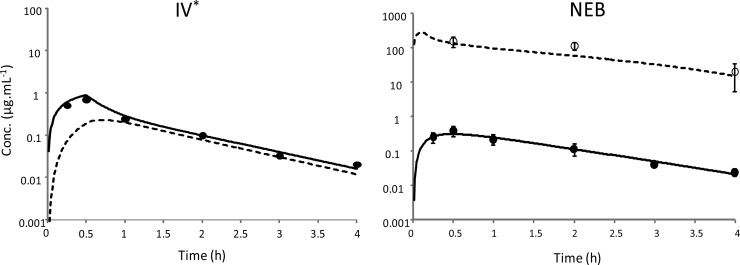
Predicted concentration-time profiles of colistin (0.35 mg kg−1), administered i.v. and intratracheally in nebulized form, in plasma (solid line) and in ELF (dashed line) from simultaneous PK modeling. Closed and open symbols represent mean ± SD values for experimental concentrations in total plasma and in ELF, respectively. *, BAL drug concentrations after i.v. administration were below the limit of quantification and ELF concentrations could not be estimated.
FIG 3
FIG 3
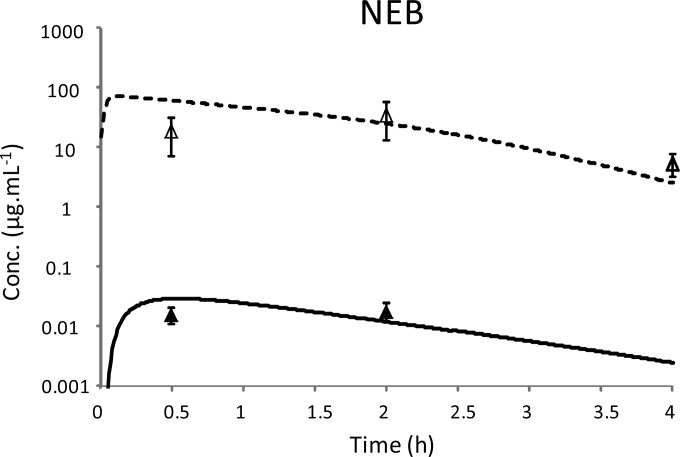
Predicted concentration-time profiles of colistin administered intratracheally in nebulized form at a dose of 0.035 mg kg−1 in plasma (solid line) and in ELF (dashed line) from simultaneous PK modeling. Closed and open symbols represent mean ± SD of experimental concentrations in total plasma and in ELF, respectively.

References

    1. Hagerman JK, Hancock KE, Klepser ME. 2006. Aerosolised antibiotics: a critical appraisal of their use. Exp. Opin. Drug Deliv. 3:71–86. 10.1517/17425247.3.1.71 - DOI - PubMed
    1. Palmer LB. 2011. Aerosolized antibiotics in the intensive care unit. Clin. Chest Med. 32:559–574. 10.1016/j.ccm.2011.05.012 - DOI - PubMed
    1. Michalopoulos A, Papadakis E. 2010. Inhaled anti-infective agents: emphasis on colistin. Infection 38:81–88. 10.1007/s15010-009-9148-6 - DOI - PubMed
    1. Michalopoulos AS. 2012. Aerosolized antibiotics: the past, present and future, with a special emphasis on inhaled colistin. Exp. Opin. Drug Deliv. 9:493–495. 10.1517/17425247.2012.676039 - DOI - PubMed
    1. Bergen PJ, Li J, Rayner CR, Nation RL. 2006. Colistin methanesulfonate is an inactive prodrug of colistin against Pseudomonas aeruginosa. Antimicrob. Agents Chemother. 50:1953–1958. 10.1128/AAC.00035-06 - DOI - PMC - PubMed

Publication types