Fracture prediction after discontinuation of 4 to 5 years of alendronate therapy: the FLEX study
- PMID: 24798675
- PMCID: PMC4409325
- DOI: 10.1001/jamainternmed.2014.1232
Fracture prediction after discontinuation of 4 to 5 years of alendronate therapy: the FLEX study
Abstract
Importance: Discontinuation of bisphosphonate therapy after 3 to 5 years is increasingly considered, but methods to monitor fracture risk after discontinuation have not been established.
Objective: To test methods of predicting fracture risk among women who have discontinued alendronate therapy after 4 to 5 years.
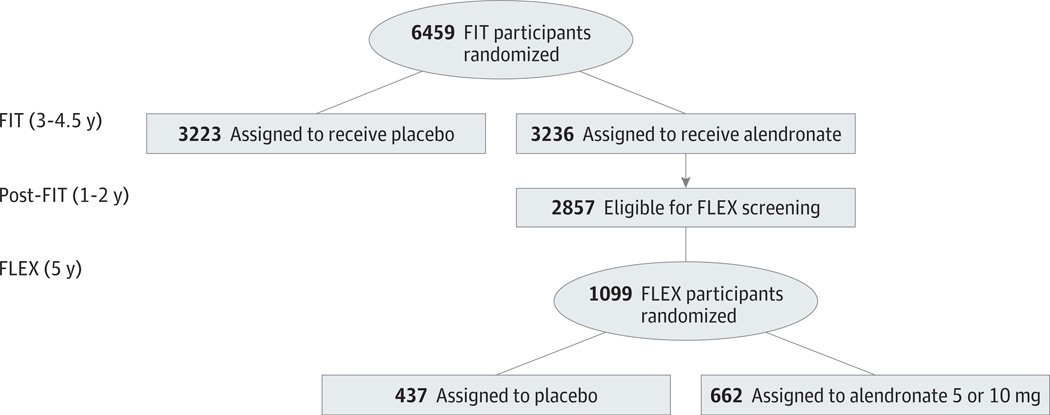
Design, setting, and participants: The prospective Fracture Intervention Trial Long-term Extension (FLEX) study randomized postmenopausal women aged 61 to 86 years previously treated with 4 to 5 years of alendronate therapy to 5 more years of alendronate or placebo from 1998 through 2003; the present analysis includes only the placebo group. Hip and spine dual-energy x-ray absorptiometry (DXA) were measured when placebo was begun (FLEX baseline) and after 1 to 3 years of follow-up. Two biochemical markers of bone turnover, urinary type 1 collagen cross-linked N-telopeptide (NTX) and serum bone-specific alkaline phosphatase (BAP), were measured at FLEX baseline and after 1 and 3 years.
Main outcomes and measures: Symptomatic spine and nonspine fractures occurring after the follow-up measurement of DXA or bone turnover.
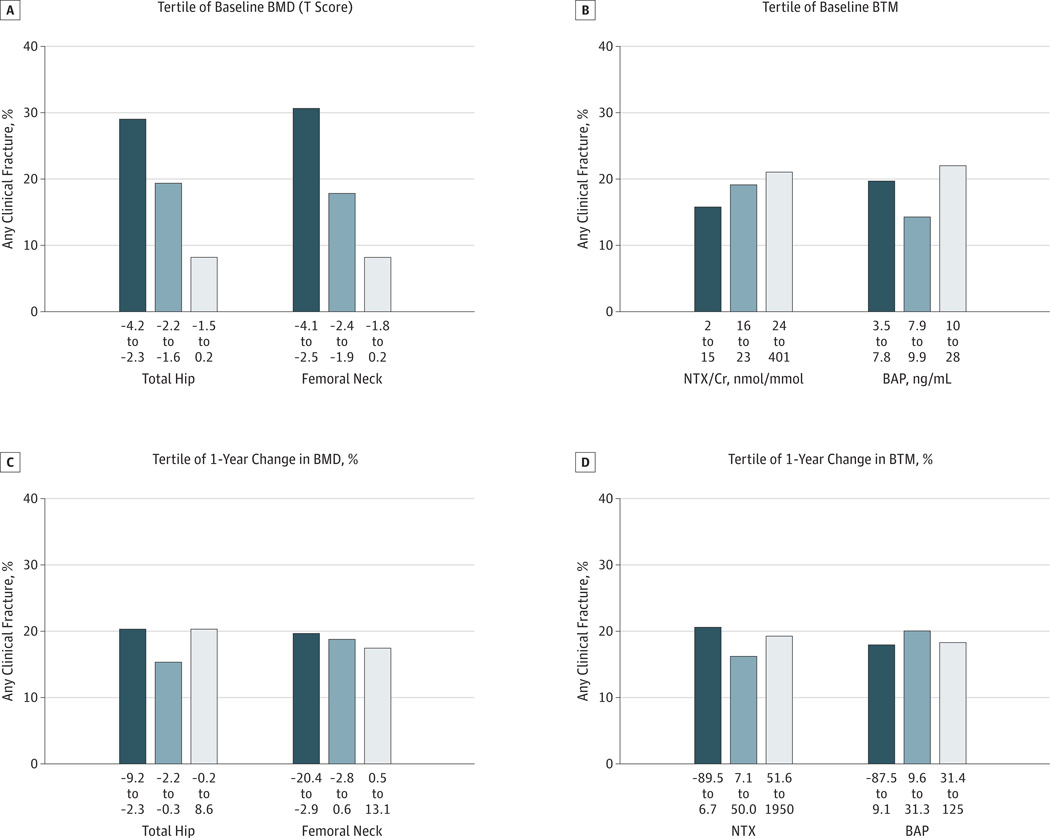
Results: During 5 years of placebo, 94 of 437 women (22%) experienced 1 or more symptomatic fractures; 82 had fractures after 1 year. One-year changes in hip DXA, NTX, and BAP were not related to subsequent fracture risk, but older age and lower hip DXA at time of discontinuation were significantly related to increased fracture risk (lowest tertile of baseline femoral neck DXA vs other 2 tertiles relative hazard ratio, 2.17 [95% CI, 1.38-3.41]; total hip DXA relative hazard ratio, 1.87 [95% CI, 1.20-2.92]).
Conclusions and relevance: Among postmenopausal women who discontinue alendronate therapy after 4 to 5 years, age and hip BMD at discontinuation predict clinical fractures during the subsequent 5 years. Follow-up measurements of DXA 1 year after discontinuation and of BAP or NTX 1 to 2 years after discontinuation are not associated with fracture risk and cannot be recommended.
Trial registration: clinicaltrials.gov Identifier: NCT00398931.
Conflict of interest statement
Figures
Comment in
-
Bone density and bone turnover marker monitoring after discontinuation of alendronate therapy: an evidence-based decision to do less.JAMA Intern Med. 2014 Jul;174(7):1134-5. doi: 10.1001/jamainternmed.2014.162. JAMA Intern Med. 2014. PMID: 24798510 No abstract available.
References
-
- Favus MJ. Bisphosphonates for osteoporosis. N Engl J Med. 2010;363(21):2027–2035. - PubMed
-
- Watts NB, Diab DL. Long-term use of bisphosphonates in osteoporosis. J Clin Endocrinol Metab. 2010;95(4):1555–1565. - PubMed
-
- Recker RR, Lewiecki EM, Miller PD, Reiffel J. Safety of bisphosphonates in the treatment of osteoporosis. Am J Med. 2009;122(2) suppl:S22–S32. - PubMed
-
- Black DM, Schwartz AV, Ensrud KE, et al. FLEX Research Group. Effects of continuing or stopping alendronate after 5 years of treatment: the Fracture Intervention Trial Long-term Extension (FLEX): a randomized trial. JAMA. 2006;296(24):2927–2938. - PubMed
Publication types
MeSH terms
Substances
Associated data
Grants and funding
LinkOut - more resources
Full Text Sources
Other Literature Sources
Medical