


PredictProtein--an open resource for online prediction of protein structural and functional features
- PMID: 24799431
- PMCID: PMC4086098
- DOI: 10.1093/nar/gku366
PredictProtein--an open resource for online prediction of protein structural and functional features
Abstract
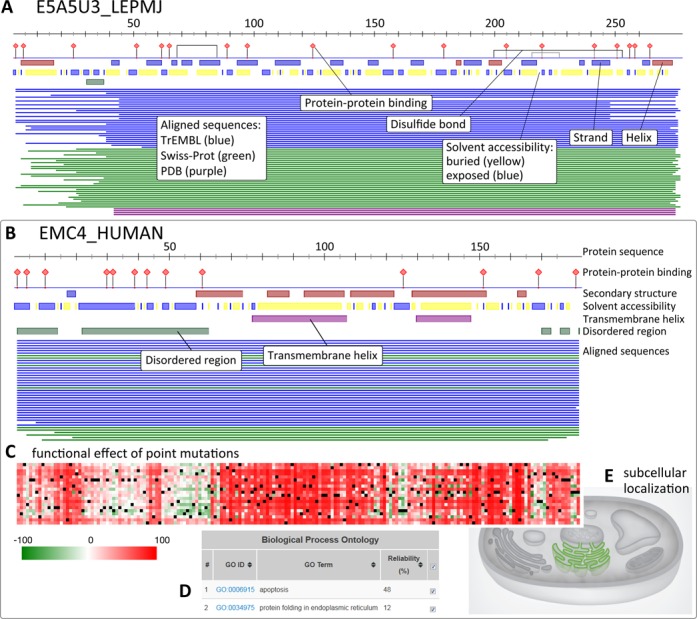
PredictProtein is a meta-service for sequence analysis that has been predicting structural and functional features of proteins since 1992. Queried with a protein sequence it returns: multiple sequence alignments, predicted aspects of structure (secondary structure, solvent accessibility, transmembrane helices (TMSEG) and strands, coiled-coil regions, disulfide bonds and disordered regions) and function. The service incorporates analysis methods for the identification of functional regions (ConSurf), homology-based inference of Gene Ontology terms (metastudent), comprehensive subcellular localization prediction (LocTree3), protein-protein binding sites (ISIS2), protein-polynucleotide binding sites (SomeNA) and predictions of the effect of point mutations (non-synonymous SNPs) on protein function (SNAP2). Our goal has always been to develop a system optimized to meet the demands of experimentalists not highly experienced in bioinformatics. To this end, the PredictProtein results are presented as both text and a series of intuitive, interactive and visually appealing figures. The web server and sources are available at http://ppopen.rostlab.org.
© The Author(s) 2014. Published by Oxford University Press on behalf of Nucleic Acids Research.
Figures
References
-
- Bromberg Y., Yachdav G., Ofran Y., Schneider R., Rost B. New in protein structure and function annotation: hotspots, single nucleotide polymorphisms and the ‘Deep Web’. Curr. Opin. Drug Discov. Devel. 2009;12:408–419. - PubMed
-
- Moult J., Fidelis K., Kryshtafovych A., Rost B., Tramontano A. Critical assessment of methods of protein structure prediction-Round VIII. Proteins. 2009;77:1–4. - PubMed
-
- Rost B., Sander C. Progress of 1D protein structure prediction at last. Proteins: Struct. Funct. Genet. 1995;23:295–300. - PubMed
Publication types
MeSH terms
Substances
Grants and funding
LinkOut - more resources
Full Text Sources
Other Literature Sources
Molecular Biology Databases
