


Health care provider-delivered adherence promotion interventions: a meta-analysis
- PMID: 24799545
- PMCID: PMC4035593
- DOI: 10.1542/peds.2013-3639
Health care provider-delivered adherence promotion interventions: a meta-analysis
Abstract
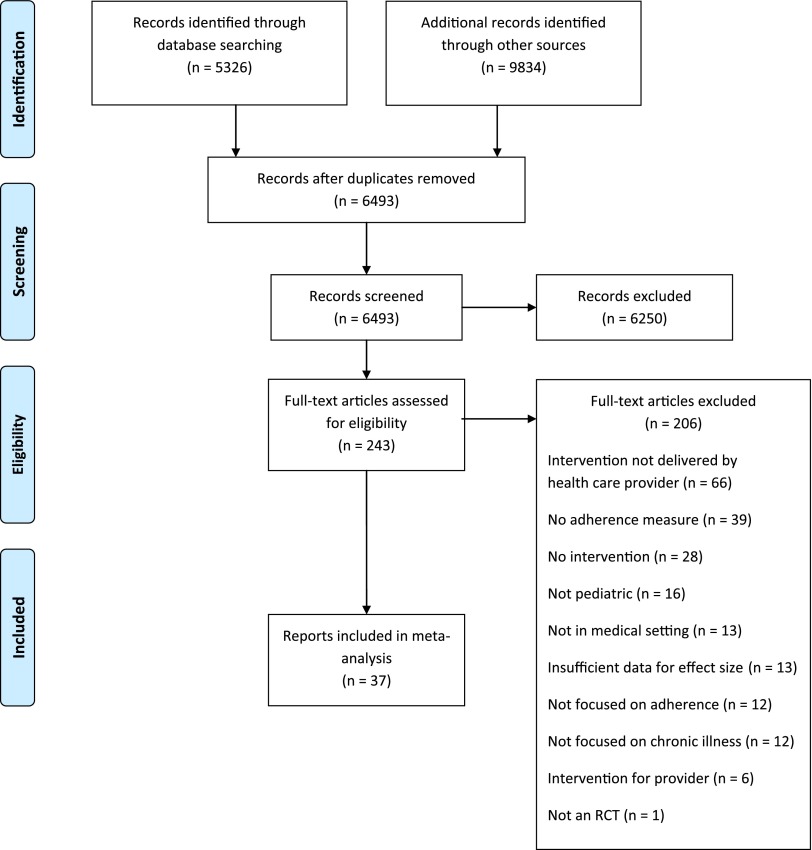
Background and objective: Improving medical regimen adherence is essential for maximizing the therapeutic potential of treatments for pediatric chronic illness. Health care providers are uniquely positioned to deliver adherence promotion interventions. However, no studies have summarized the effectiveness of health care provider-delivered adherence interventions. The objective of this study was to describe the effectiveness of health care provider-delivered adherence promotion interventions in improving adherence among children who have chronic illness. Data sources include PubMed, PsycINFO, CINAHL, and Scopus. Studies were included if they were randomized-controlled trials of pediatric interventions aiming to increase adherence to the primary regimen for a chronic illness and at least 1 health care provider delivered the intervention.
Results: A total of 35 randomized-controlled studies including 4616 children were included. Greater improvements in adherence were observed immediately after health care provider-delivered interventions (d = 0.49; 95% confidence interval, 0.32 to 0.66) than at longer-term follow-up (d = 0.32; 95% confidence interval, 0.10 to 0.54). Treatment effect sizes differed across the adherence behaviors measured. There was significant heterogeneity in treatment effects; however, no moderators of treatment effectiveness were identified. This meta-analysis focused on the published literature. In addition, the majority of studies involved children who had asthma and younger children.
Conclusions: Health care provider-delivered interventions for children who have chronic illness can be effective in improving adherence. Gains in adherence are highest immediately after intervention. Future interventions and studies should include multiple methods of assessing adherence, include active comparators, and address long-term maintenance of adherence gains.
Keywords: chronic disease; health personnel; medication adherence; patient compliance; pediatrics; self care.
Copyright © 2014 by the American Academy of Pediatrics.
Figures

References
-
- Rapoff M. Adherence to Pediatric Medical Regimens. 2nd ed. New York: Springer Science+Business Media; 2010
-
- World Health Organization Adherence to Long-Term Therapies: Evidence for Action. World Health Organization; 2003. Available at: http://whqlibdoc.who.int/publications/2003/9241545992.pdf. Accessed April 9, 2014
-
- Graves M, Roberts M, Rapoff M, Boyer A. The efficacy of adherence interventions for chronically ill children: a meta-analytic review. J Pediatr Psychol. 2010;35(4):368–382 - PubMed
-
- Kahana S, Drotar D, Frazier T. Meta-analysis of psychological interventions to promote adherence to treatment in pediatric chronic health conditions. J Pediatr Psychol. 2008;33(6):590–611 - PubMed
-
- Kripalani S, Yao X, Haynes R. Interventions to enhance medication adherence in chronic medical conditions: a systematic review. Arch Intern Med. 2007;167(6):540–550 - PubMed
Publication types
MeSH terms
Grants and funding
LinkOut - more resources
Full Text Sources
Other Literature Sources
Medical
