


Statin-induced rhabdomyolysis: a comprehensive review of case reports
- PMID: 24799748
- PMCID: PMC4006404
- DOI: 10.3138/ptc.2012-65
Statin-induced rhabdomyolysis: a comprehensive review of case reports
Abstract
Purpose: To identify case reports of statin-induced rhabdomyolysis and summarize common predisposing factors, symptoms, diagnostic findings, functional outcomes, characteristics, treatment, and rehabilitation.
Method: MEDLINE, CINAHL, SCOPUS, and PEDro databases were searched (1990-2013) for relevant case reports using the search terms "Statins," "Rhabdomyolysis," "Myalgia," "Muscle damage," "Muscle injury," and "Myopathy." Relevance (based on title and abstract) was assessed by one investigator; two investigators independently reviewed the relevant articles to determine inclusion in the review.
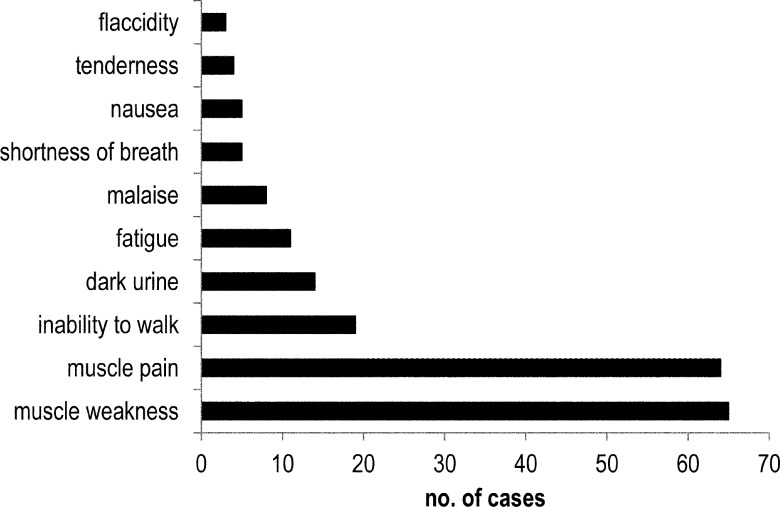
Results: A total of 112 cases met the inclusion criteria. The majority were in men (70%) and people over 45 years of age (mean 64 [SD 14] years). Simvastatin was the most commonly reported statin (n=55); the majority of cases reported the use of concomitant medications such as fibrates (n=25). Weakness (n=65) and muscle pain (n=64) were the most common symptoms. In 19 cases, the patient was referred to rehabilitation, but the case reports do not include descriptions of the treatment.
Conclusion: Statin-induced rhabdomyolysis was more commonly reported when statins were used in conjunction with other drugs, which potentiated its effect. Research is needed to identify the role of exercise and rehabilitation following statin-induced rhabdomyoloysis since muscle damage may be severe and may have long-term effects on muscle function.
Objectif : Trouver des rapports de cas portant sur la rhabdomyolyse provoquée par les statines et résumer les facteurs prédisposants communs, les symptômes, les résultats diagnostiques, les résultats fonctionnels, les caractéristiques, le traitement et la réadaptation. Méthodes : On a cherché dans les bases de données MEDLINE, CINAHL, SCOPUS et PEDro (1990–2013) des rapports de cas pertinents en utilisant les termes de recherche Statins, Rhabdomyolysis, Myalgia, Muscle damage, Muscle injury et Myopathy. Un chercheur en a évalué la pertinence (en fonction du titre et du résumé) et deux autres ont revu indépendamment les articles pertinents pour déterminer s'il fallait les inclure dans la recherche. Résultats : Au total, 112 cas répondaient aux critères d'inclusion. La majorité des cas portaient sur des hommes (70 %) et les plus de 45 ans (âge moyen de 64 [ET 14] ans). La simvastatine a été la statine incriminée le plus souvent dans les rapports (n=55), la majorité des cas signalant l'utilisation simultanée de médicaments comme des fibrates (n=25). La faiblesse (n=65) et les douleurs musculaires (n=64) étaient les symptômes les plus courants. Dans 19 cas, le patient a été aiguillé vers la réadaptation, mais les rapports ne décrivent pas le traitement. Conclusion : On a signalé une rhabdomyolyse causée par les statines plus souvent lorsqu'elles étaient conjuguées à d'autres médicaments, ce qui en a accentué l'effet. Des recherches s'imposent pour déterminer le rôle de l'exercice et de la réadaptation à la suite d'une rhabdomyoloyse causée par les statines puisque les dommages musculaires peuvent être graves et qu'elles peuvent avoir des effets à long terme sur la fonction musculaire.
Keywords: HMG-CoA; muscular diseases; rhabdomyolysis; statins.
Figures
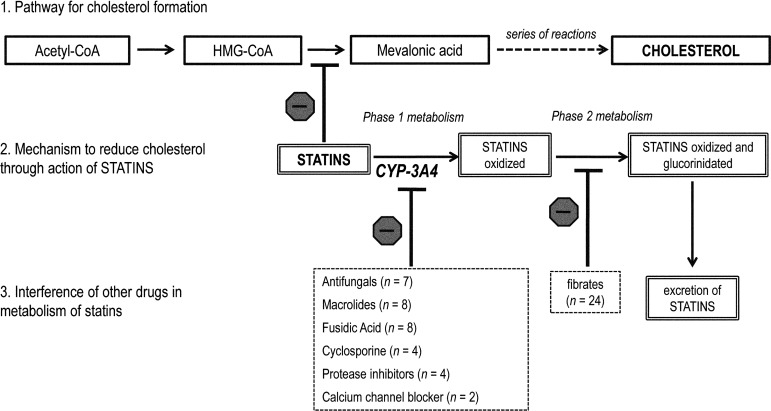
 indicates “inhibition” of the pathway). Statins inhibit the enzyme 3-hydroxy-3-methyl-glutaryl-CoA (HMG-CoA) reductase which is responsible for the conversion of HMG-CoA to mevalonic acid and the subsequent production of cholesterol. CYP-3A4 (a member of the cytochrome P450 family oxidase system) is the liver enzyme responsible for oxidizing statins and allowing them to be excreted out of the body. However, many known drugs inhibit CYP3A4, thereby reducing the oxidation of statins in Phase 1 metabolism, resulting in greater bioavailability of statins and therefore greater inhibition of cholesterol synthesis. Fibrates are a class of drug that inhibit Phase 2 metabolism, which is normally responsible for further metabolism of the statin for excretion out of the body. With inhibition of phase 2 metabolism, statins that are oxidized are not excreted and stay in the body, exerting their inhibitory effect.
References
-
- Line RL, Rust GS. Acute exertional rhabdomyolysis. Am Fam Physician. 1995;52(2):502–6. Medline:7625324. - PubMed
-
- Arrington ED, Miller MD. Skeletal muscle injuries. Orthop Clin North Am. 1995;26(3):411–22. Medline:7609956. - PubMed
-
- Landesman KA, Stozek M, Freeman NJ. Rhabdomyolysis associated with the combined use of hydroxymethylglutaryl-coenzyme A reductase inhibitors with gemfibrozil and macrolide antibiotics. Conn Med. 1999;63(8):455–7. Medline:10500341. - PubMed
-
- Di Stasi SL, MacLeod TD, Winters JD, et al. Effects of statins on skeletal muscle: a perspective for physical therapists. Phys Ther. 2010;90(10):1530–42. http://dx.doi.org/10.2522/ptj.20090251. Medline:20688875. - DOI - PMC - PubMed
-
- Conway JR, Genest J, Habib R, et al. Canadian Lipid Guidelines Update. Montréal: E.O.C.I. Pharmacomm Ltd.; 2009.
LinkOut - more resources
Full Text Sources
Other Literature Sources
Miscellaneous