


Effects of oxycodone on brain responses to emotional images
- PMID: 24800897
- PMCID: PMC6720110
- DOI: 10.1007/s00213-014-3592-4
Effects of oxycodone on brain responses to emotional images
Abstract
Rationale: Evidence from animal and human studies suggests that opiate drugs decrease emotional responses to negative stimuli and increase responses to positive stimuli. Such emotional effects may motivate misuse of oxycodone (OXY), a widely abused opiate. Yet, we know little about how OXY affects neural circuits underlying emotional processing in humans.
Objective: We examined effects of OXY on brain activity during presentation of positive and negative visual emotional stimuli. We predicted that OXY would decrease amygdala activity to negative stimuli and increase ventral striatum (VS) activity to positive stimuli. Secondarily, we examined the effects of OXY on other emotional network regions on an exploratory basis.
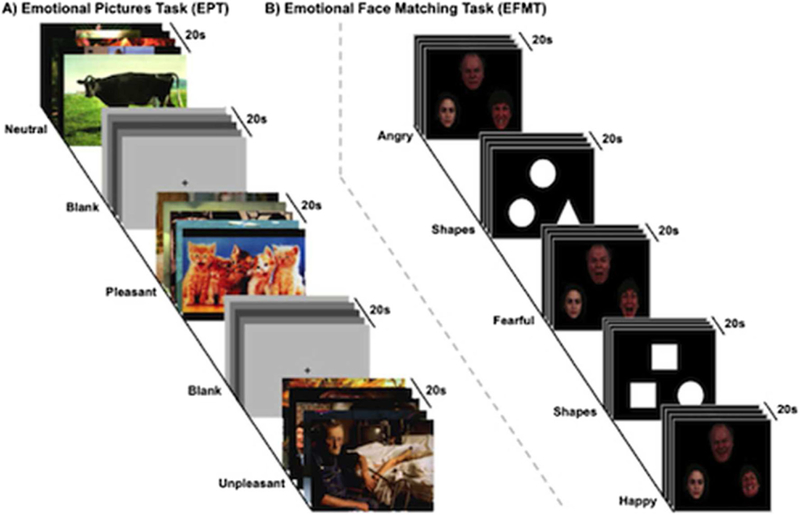
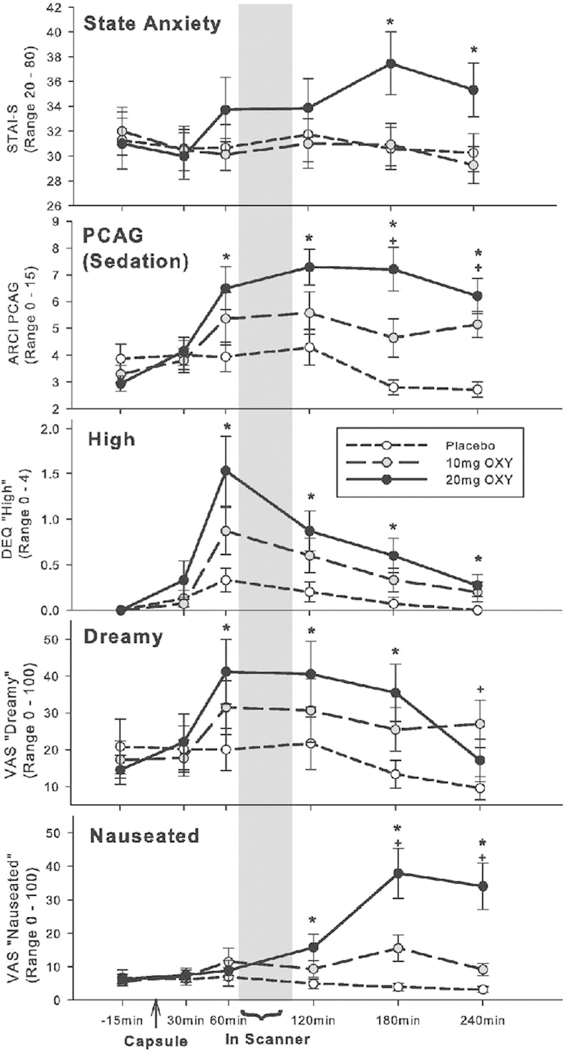
Methods: In a three-session study, healthy adults (N = 17) received placebo, 10 and 20 mg OXY under counterbalanced, double-blind conditions. At each session, participants completed subjective and cardiovascular measures and underwent functional MRI (fMRI) scanning while completing two emotional response tasks.
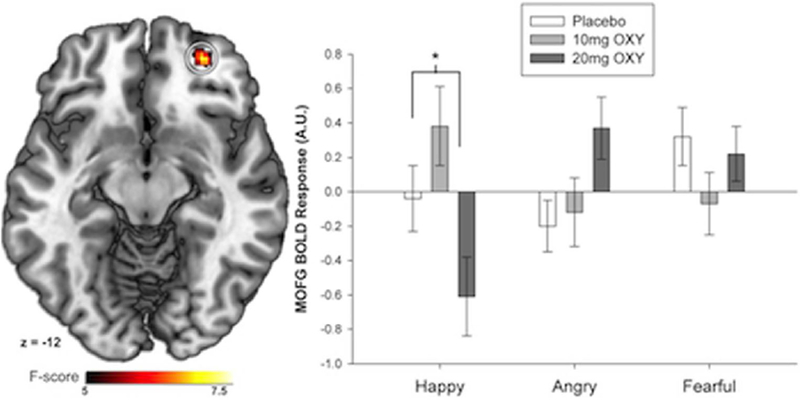
Results: Our emotional tasks reliably activated emotional network areas. OXY produced subjective effects but did not alter either behavioral responses to emotional stimuli or activity in our primary areas of interest. OXY did decrease right medial orbitofrontal cortex (MOFC) responses to happy faces.
Conclusions: Contrary to our expectations, OXY did not affect behavioral or neural responses to emotional stimuli in our primary areas of interest. Further, the effects of OXY in the MOFC would be more consistent with a decrease in value for happy faces. This may indicate that healthy adults do not receive emotional benefits from opiates, or the pharmacological actions of OXY differ from other opiates.
Conflict of interest statement
All authors declare that they have no conflicts of interest.
Figures
References
-
- Adler LJ, Gyulai FE, Diehl DJ, Mintun MA, Winter PM, Firestone LL (1997) Regional brain activity changes associated with fentanyl analgesia elucidated by positron emission tomography. Anesth Analg 84:120–126 - PubMed
-
- Beardsley PM, Aceto MD, Cook CD, Bowman ER, Newman JL, Harris LS (2004) Discriminative stimulus, reinforcing, physical dependence, and antinociceptive effects of oxycodone in mice, rats, and rhesus monkeys. Exp Clin Psychopharmacol 12:163–172 - PubMed
-
- Becerra L, Harter K, Gilberto Gonzalez R, Borsook D (2006) Functional magnetic resonance imaging measures of the effects of morphine on central nervous system circuitry in opioid-naive healthy volunteers. Anesth Analg 103:208–216 - PubMed
-
- Beer JS, John OP, Scabini D, Knight RT (2006) Orbitofrontal cortex and social behavior: integrating self-monitoring and emotion-cognition interactions. J Cogn Neurosci 18:871–879 - PubMed
Publication types
MeSH terms
Substances
Grants and funding
LinkOut - more resources
Full Text Sources
Other Literature Sources
