Fecal contamination of drinking-water in low- and middle-income countries: a systematic review and meta-analysis
- PMID: 24800926
- PMCID: PMC4011876
- DOI: 10.1371/journal.pmed.1001644
Fecal contamination of drinking-water in low- and middle-income countries: a systematic review and meta-analysis
Abstract
Background: Access to safe drinking-water is a fundamental requirement for good health and is also a human right. Global access to safe drinking-water is monitored by WHO and UNICEF using as an indicator "use of an improved source," which does not account for water quality measurements. Our objectives were to determine whether water from "improved" sources is less likely to contain fecal contamination than "unimproved" sources and to assess the extent to which contamination varies by source type and setting.
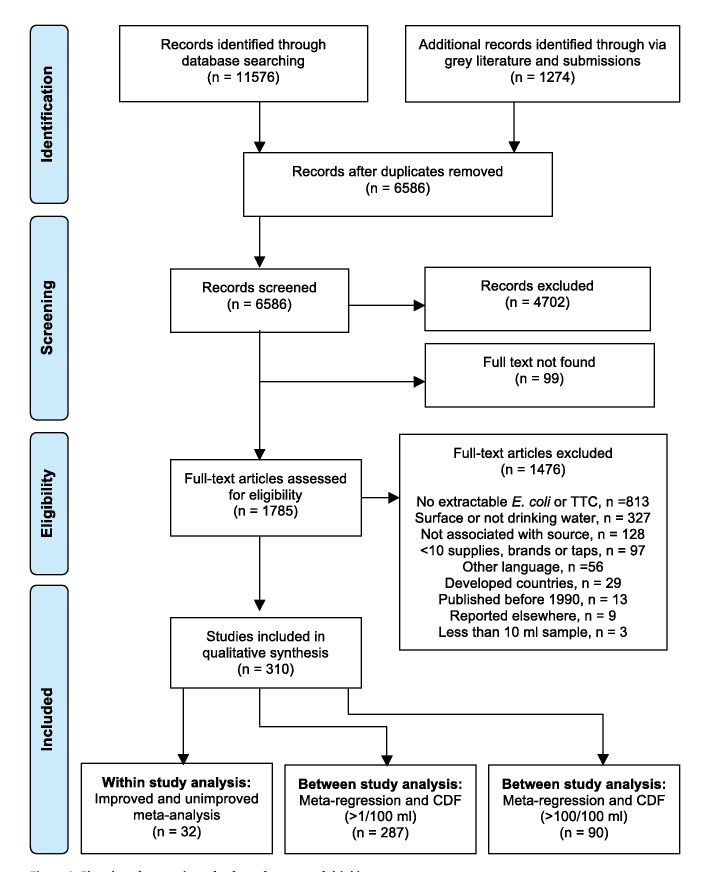
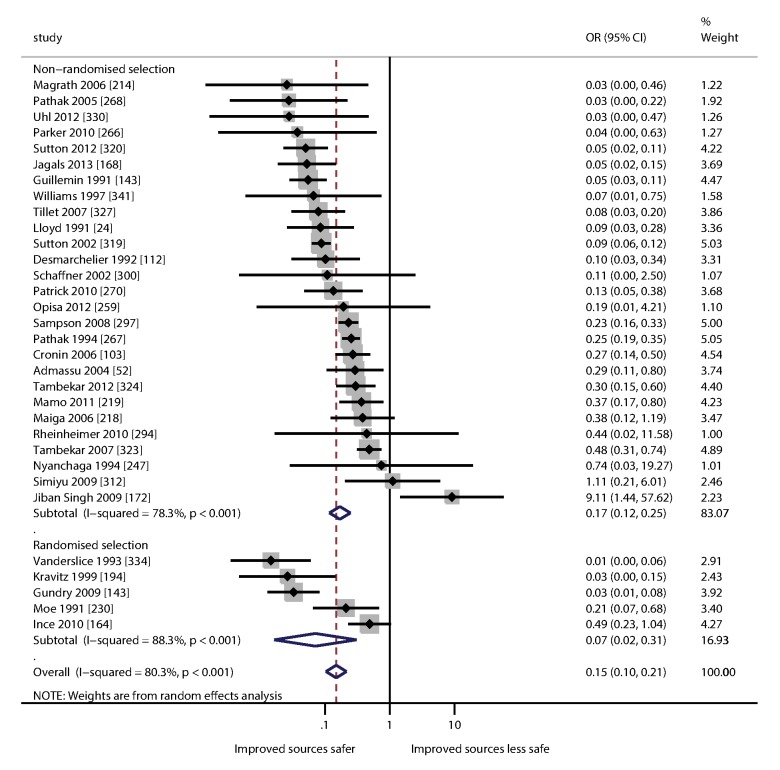
Methods and findings: Studies in Chinese, English, French, Portuguese, and Spanish were identified from online databases, including PubMed and Web of Science, and grey literature. Studies in low- and middle-income countries published between 1990 and August 2013 that assessed drinking-water for the presence of Escherichia coli or thermotolerant coliforms (TTC) were included provided they associated results with a particular source type. In total 319 studies were included, reporting on 96,737 water samples. The odds of contamination within a given study were considerably lower for "improved" sources than "unimproved" sources (odds ratio [OR] = 0.15 [0.10-0.21], I2 = 80.3% [72.9-85.6]). However over a quarter of samples from improved sources contained fecal contamination in 38% of 191 studies. Water sources in low-income countries (OR = 2.37 [1.52-3.71]; p<0.001) and rural areas (OR = 2.37 [1.47-3.81] p<0.001) were more likely to be contaminated. Studies rarely reported stored water quality or sanitary risks and few achieved robust random selection. Safety may be overestimated due to infrequent water sampling and deterioration in quality prior to consumption.
Conclusion: Access to an "improved source" provides a measure of sanitary protection but does not ensure water is free of fecal contamination nor is it consistent between source types or settings. International estimates therefore greatly overstate use of safe drinking-water and do not fully reflect disparities in access. An enhanced monitoring strategy would combine indicators of sanitary protection with measures of water quality.
Conflict of interest statement
TS chairs the WHO/UNICEF JMP expert working group tasked with developing targets and indicators for enhanced global monitoring of drinking-water post-2015 which commissioned the systematic review to inform its deliberations. JB is a member of the expert working group and is an unpaid advisor to both WHO and UNICEF.
Figures
References
-
- Committee on Economic Socal and Community Rights (2002) General comment no. 15, The right to water. UN Doc. E/C.12/2010. New York: United Nations.
-
- United Nations (2010) Resolution on Human Right to Water and Sanitation. United Nations General Assembly. A/64/292. New York: United Nations.
-
- United Nations (2013) UN Goal 7: Ensure Environmental Sustainability. Available: http://www.un.org/millenniumgoals/environ.shtml. Accessed 1 December 2013.
-
- UNICEF/WHO Joint Monitoring Programme: definitions and methods. Available: http://www.wssinfo.org/definitions-methods/. Accessed 1 December 2013.
-
- WHO/UNICEF (2013) Progress on Sanitation and Drinking-Water: 2012 Update WHO/UNICEF. Available: http://www.wssinfo.org/definitions-methods. Accessed 1 December 2013.
Publication types
MeSH terms
Substances
LinkOut - more resources
Full Text Sources
Other Literature Sources
Medical