


Expression levels of insulin-like growth factors 1 and 2 in head and neck squamous cell carcinoma
- PMID: 24802266
- PMCID: PMC4083007
- DOI: 10.1016/j.ghir.2014.04.003
Expression levels of insulin-like growth factors 1 and 2 in head and neck squamous cell carcinoma
Abstract
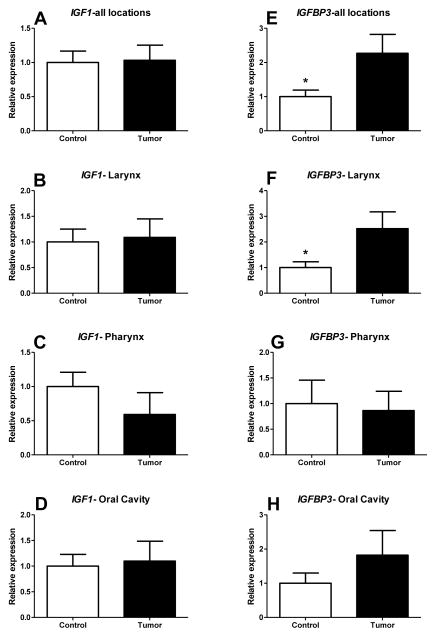
Insulin-like growth factors (IGF) 1 and 2 are known as potential mitogens for normal and neoplastic cells. IGF2 is a main fetal growth factor while IGF1 is activated through growth hormone action during postnatal growth and development. However, there is strong evidence that activation of IGF2 by its E2F transcription factor 3 (E2F3) is present in different types of cancer. Also high levels of IGF1 strongly correlate with cancer development due to anti-apoptotic properties and enhancement of cancer cell differentiation, which can be attenuated by IGFBP3. Head and neck cancer is known as one of the six most common human cancers. The main risk factor for head and neck cancer is consumption of tobacco and alcohol as well as viral infection and bacterial infection by stimulation of chronic local inflammation. There is also a genetic basis for this form of cancer; however, the genetic markers are not yet established. In this study we investigated the levels of the expression of IGF2, IGF1, E2F3 and IGFBP3 in human cancers and healthy tissues surrounding the tumor obtained from each of 41 patients. Our study indicated that there is no alteration of the levels of expression of IGF2, E2F3 and IGF1 in head and neck squamous cell carcinoma (HNSCC) cases studied in selected experimental population, but there was evidence for upregulation of pro-apoptotic IGFBP3 in cancer when comparing to healthy tissue. These important findings indicate that insulin-growth factors are not directly associated with HNSCC showing some variability between patients and location of tumor. However, elevated level of IGFBP3 suggests possible regulatory role of IGF signal by its binding protein in this type of tumor.
Keywords: IGF1; IGF2; Oral cancer; Survival.
Copyright © 2014 Elsevier Ltd. All rights reserved.
Conflict of interest statement
The Authors declare that there is no conflict of interest
Figures

References
-
- DeChiara TM, Efstratiadis A, Robertson EJ. A growth-deficiency phenotype in heterozygous mice carrying an insulin-like growth factor II gene disrupted by targeting. Nature. 1990;345(6270):78–80. - PubMed
-
- Ferguson-Smith AC, et al. Embryological and molecular investigations of parental imprinting on mouse chromosome 7. Nature. 1991;351(6328):667–70. - PubMed
-
- Morison IM, et al. Somatic overgrowth associated with overexpression of insulin-like growth factor II. Nat Med. 1996;2(3):311–6. - PubMed
Publication types
MeSH terms
Substances
Grants and funding
LinkOut - more resources
Full Text Sources
Other Literature Sources
Medical
Miscellaneous
