Observational Study
. 2014 May 7;20(17):5104-12.
doi: 10.3748/wjg.v20.i17.5104.

TNM staging of colorectal cancer should be reconsidered by T stage weighting

Affiliations
Observational Study

TNM staging of colorectal cancer should be reconsidered by T stage weighting

Jun Li et al. World J Gastroenterol. .

Abstract

Aim: To verify that the T stage has greater weight than the N stage in the staging of colorectal cancer.

Methods: Open data from the Surveillance, Epidemiology, and End Results program were reviewed and analyzed according to the T stage, N stage, and patients' observed survival (OS). The relative weights of the T and N stages were calculated by multiple linear regressions based on their impact on survival. Risk scores for 25 TN categories were then calculated from the T and N stage relative weights, and a rearranged tumor node metastasis (TNM) staging system was proposed via a cluster analysis of the TN scores.

Results: Both T and N stages significantly affect the OS of patients with colorectal cancer. Moreover, the T stage has greater weight than the N stage in the TNM staging system of colorectal cancer. For colon cancer, the relative T and N stage weights were 0.58 and 0.42, respectively, and for rectal cancer, the relative T and N stage weights were 0.61 and 0.39, respectively. On the basis of cluster analysis of the TN scores, T1N1a was classified to stage I, and T2N1a-1b and T1N1b-2a were classified to stage II in our revised TNM staging system for both colon and rectal cancer. For colon cancer, T4bN0 was classified to stage IIIa, but for rectal cancer, it was classified to stage IIIb.

Conclusion: As the T stage affects colorectal cancer survival more significantly than the N stage, the TNM staging should be revised by relative T stage weight.

Keywords: Cluster analysis; Colorectal cancer; Neoplasm staging; Observational study; Survival analysis.


Figures
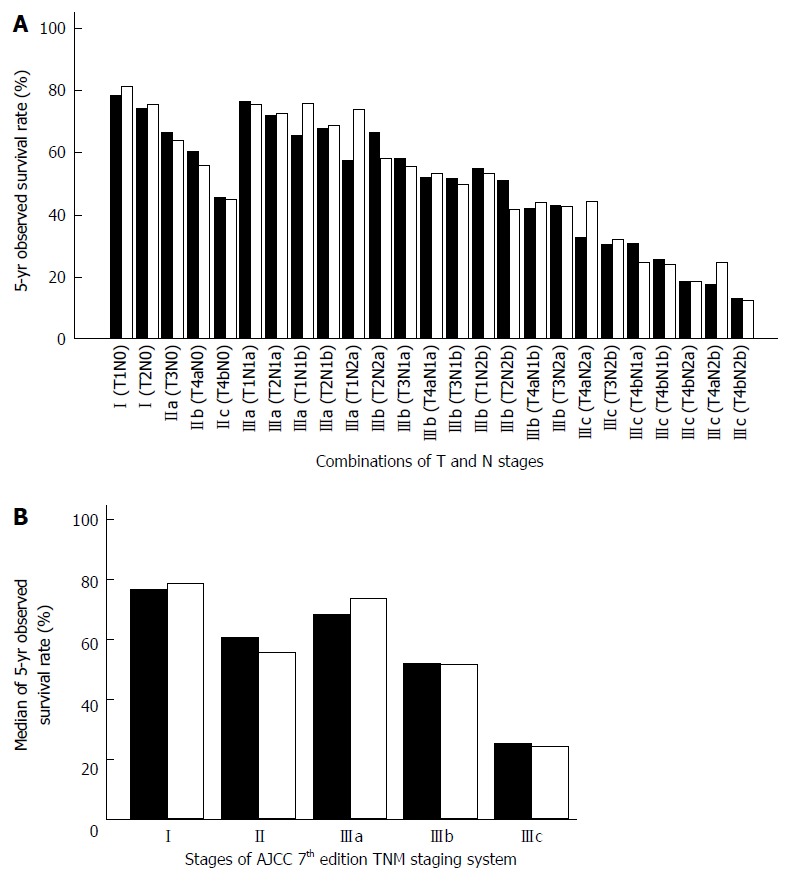
Figure 1
Figure 1
Relationship between survival of colorectal cancer patients and stages of the American Joint Committee on Cancer 7th edition tumor node metastasis staging system. A: The 5-year observed survival rate of colorectal cancer patients according to 25 combinations of T and N stages of the American Joint Committee on Cancer (AJCC) 7th edition tumor node metastasis (TNM) staging system; B: The median 5-year observed survival rate of colorectal cancer patients for overall stages (I, II, IIIa, IIIb and IIIc) according to the 7th edition of the AJCC TNM staging system. Colon cancer is represented by the solid black grids. Rectal cancer is represented by the white grids (Surveillance, Epidemiology, and End Results open data).
Figure 2
Figure 2
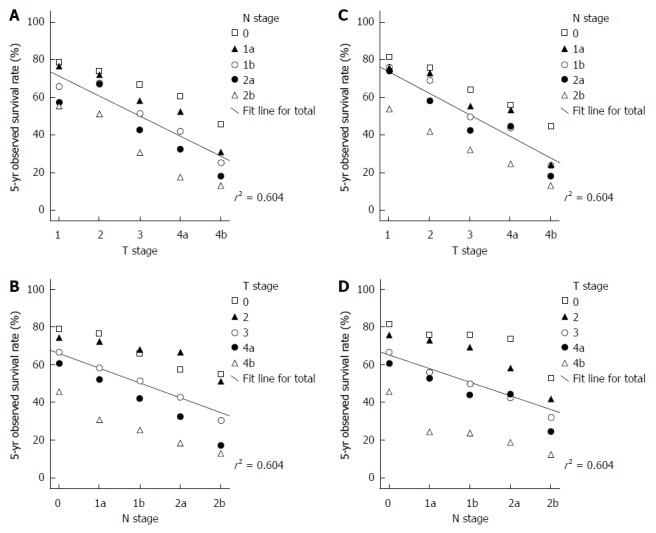
Scatter plots for T stage, N stage and the 5-year observed survival of colorectal cancer patients. A: Highlight of the T stage of colon cancer; B: Highlight of the N stage of colon cancer; C: Highlight of the T stage of rectal cancer; D: Highlight of the N stage of rectal cancer.
Figure 3
Figure 3
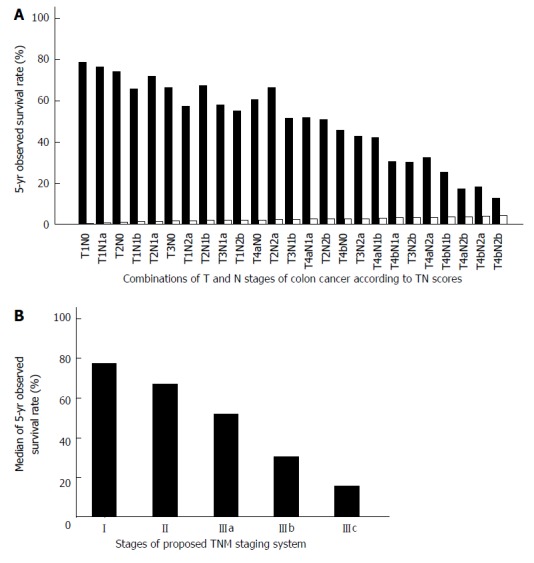
Relationship between survival of colon cancer patients and stages of the revised tumor node metastasis staging system. A: The 5-year observed survival rate of colon cancer patients for combinations of T and N stages according to TN scores. The observed survival rate is represented by the solid black grids. TN scores are represented by the white grids; B: The median 5-year observed survival rate of colon cancer patients for the proposed tumor node metastasis (TNM) staging system according to TN scores.
Figure 4
Figure 4
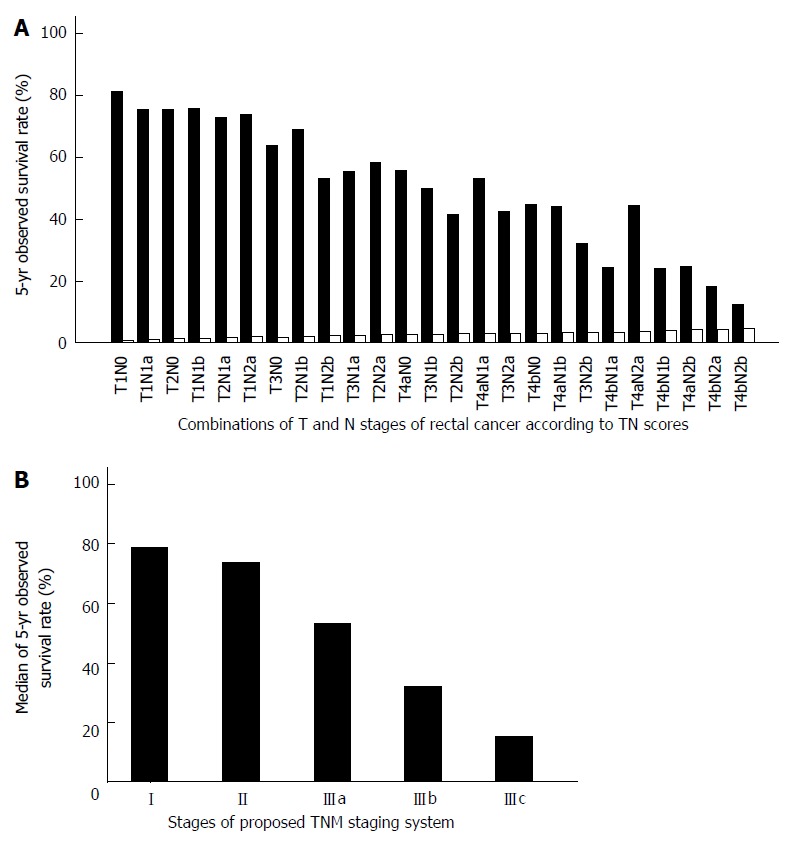
Relationship between survival of rectal cancer patients and stages of the revised tumor node metastasis staging system. A: The 5-year observed survival rate of rectal cancer patients for combinations of T and N stages according to TN scores. The observed survival rate is represented by the grey grids. TN scores are represented by the white grids; B: The median 5-year observed survival rate of rectal cancer patients for the proposed tumor node metastasis (TNM) staging system according to TN scores.

References

    1. Edge SB, Byrd DR, Compton , CC , Fritz AG, Greene FL, Trotti A. AJCC Cancer Staging Manual. 7th ed. New York: Springer; 2010.
    1. Gunderson LL, Jessup JM, Sargent DJ, Greene FL, Stewart AK. Revised TN categorization for colon cancer based on national survival outcomes data. J Clin Oncol. 2010;28:264–271. - PMC - PubMed
    1. Gunderson LL, Jessup JM, Sargent DJ, Greene FL, Stewart A. Revised tumor and node categorization for rectal cancer based on surveillance, epidemiology, and end results and rectal pooled analysis outcomes. J Clin Oncol. 2010;28:256–263. - PMC - PubMed
    1. Mori T. A comparison of the new (planned) TNM classification and Japanese general rule for staging colorectal cancer. Cancer Invest. 2010;28:387–392. - PubMed
    1. Frades I, Matthiesen R. Overview on techniques in cluster analysis. Methods Mol Biol. 2010;593:81–107. - PubMed

Publication types