


The near-eastern roots of the Neolithic in South Asia
- PMID: 24806472
- PMCID: PMC4012948
- DOI: 10.1371/journal.pone.0095714
The near-eastern roots of the Neolithic in South Asia
Abstract
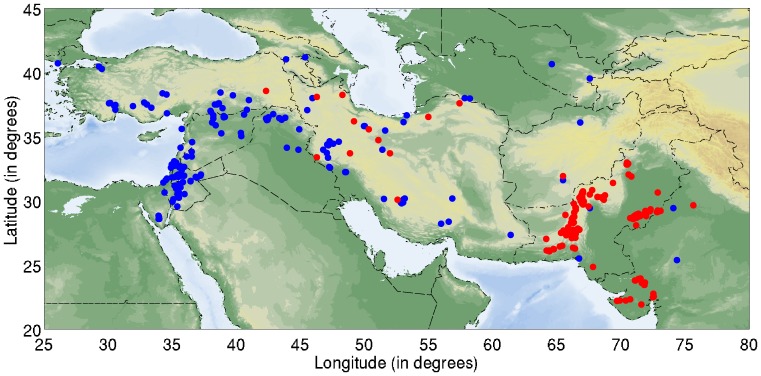
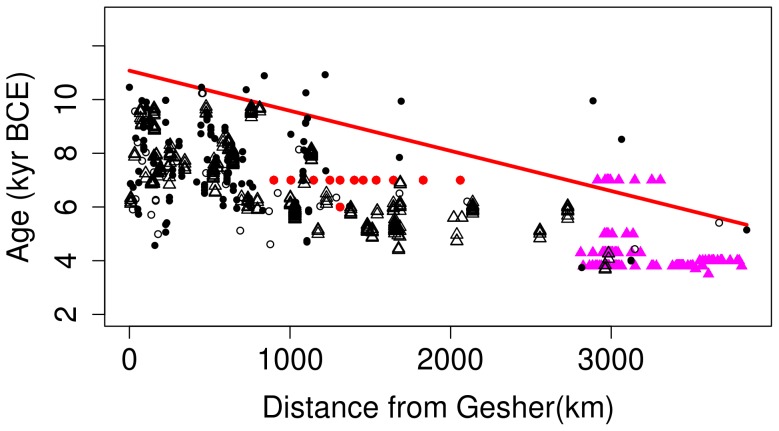
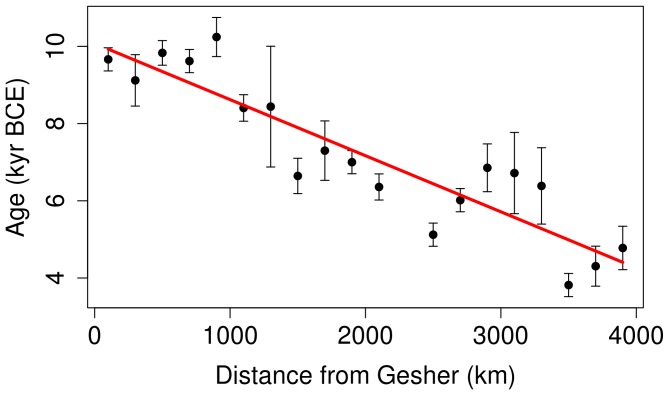
The Fertile Crescent in the Near East is one of the independent origins of the Neolithic, the source from which farming and pottery-making spread across Europe from 9,000 to 6,000 years ago at an average rate of about 1 km/yr. There is also strong evidence for causal connections between the Near-Eastern Neolithic and that further east, up to the Indus Valley. The Neolithic in South Asia has been far less explored than its European counterpart, especially in terms of absolute (14)C) dating; hence, there were no previous attempts to assess quantitatively its spread in Asia. We combine the available (14)C data with the archaeological evidence for early Neolithic sites in South Asia to analyze the spatio-temporal continuity of the Neolithic dispersal from the Near East through the Middle East and to the Indian subcontinent. We reveal an approximately linear dependence between the age and the geodesic distance from the Near East, suggesting a systematic (but not necessarily uniform) spread at an average speed of about 0.65 km/yr.
Conflict of interest statement
Figures
References
-
- Lubbock J (1913) Pre-Historic Times: as Illustrated by Ancient Remains and the Manners and Customs of Modern Savages. London: Williams and Norgate.
-
- Childe VG (1925) The Dawn of European Civilization. London: K. Paul, Trench, Trubner & Co. 11.
-
- Price TD (2000) Europe’s First Farmers. Cambridge: Cambridge Univ. Press.
-
- Rowley-Conwy P (2011) Westward Ho! The spread of agriculture from Central Europe to the Atlantic. Curr Anthropol 52: S431–S451.
-
- Bellwood PS (2005) First Farmers: The Origins of Agricultural Societies. London: Blackwell.
Publication types
MeSH terms
Substances
LinkOut - more resources
Full Text Sources
Other Literature Sources
